Verse 5after 1821aaho jaanaa
G5
In this meter the first long syllable may be replaced by a short; and the next-to-last long syllable may be replaced by two shorts.
1
from weakness, weeping became changed into cold sighs/'breaths'
2
it became credible to us-- [the process of] water's becoming air
'Changed, altered; exchanged; substituted'.
'Breath, vital air, life... ;--breath or blast (of a furnace or oven); a puff, whiff'.
'Belief, faith, confidence, trust, credit; —adj. True, credible, trustworthy'.
| References | |
|---|---|
| Arshi, Imtiyaz Ali | Ghazal# 36 |
| Raza, Kalidas Gupta | 355 |
| Hamid Ali Khan | Open Image |
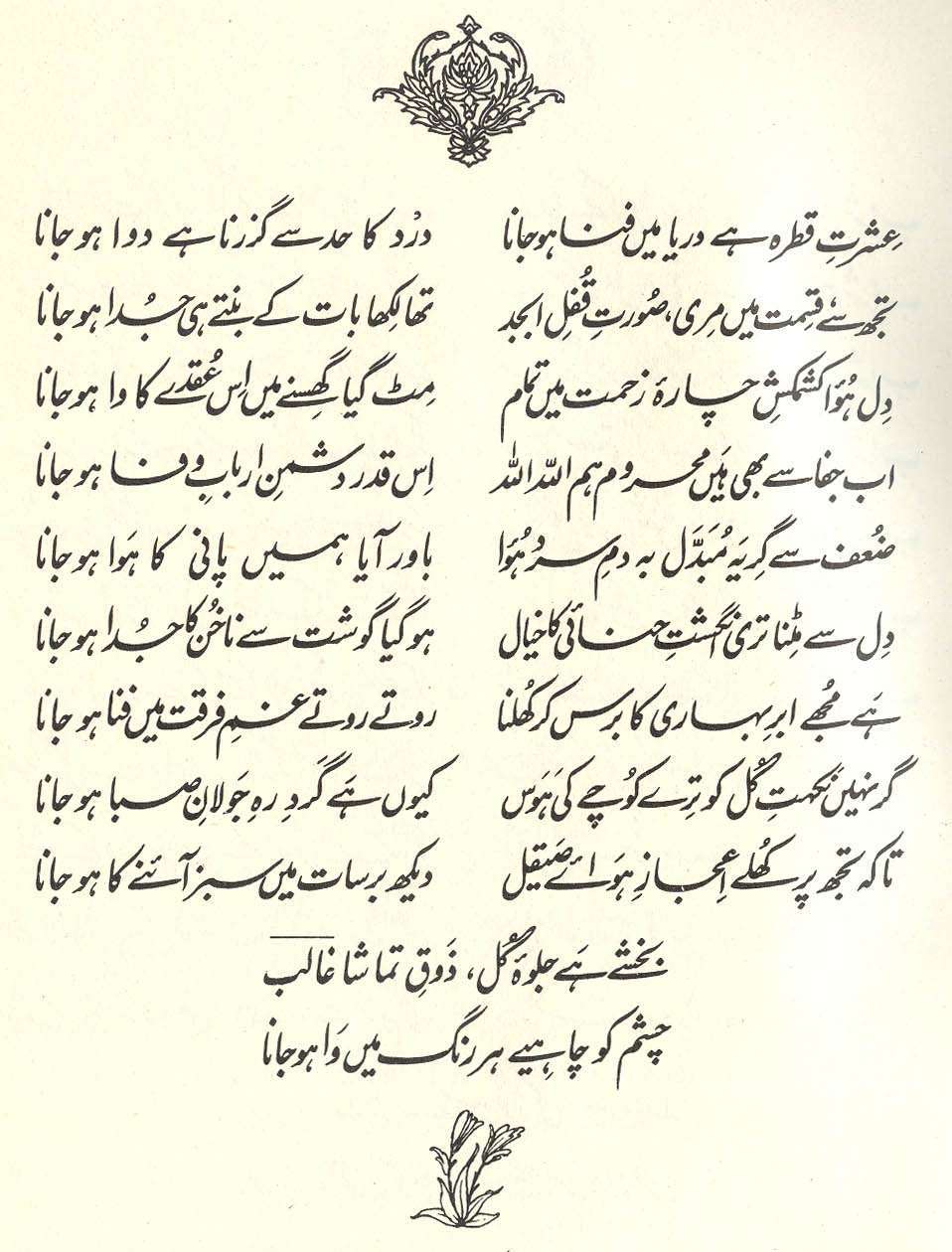
That is, previously we didn't understand the changing of one element into another; now we have tested it, and it has become credible. (43)
== Nazm page 43

Urdu text: Vajid 1902 {48}
Up till now we were not convinced about the problem of the changing of elements. But when we saw that because of weakness and feebleness, our weeping changed into cold sighs, then after such a test we were convinced. (86)
There was such an excess of weakness that neither did blood remain in the body, nor did the strength for weeping remain in the heart. Now instead of tears dust flies in my eyes. Indeed, I constantly heave cold sighs. Now, through experience, I've understood the problem of the changing of elements-- that water becomes air. (109)
[See his comments on Mir's M 12,5 .]
The speaker suggests that the process of evaporation is analogous to the way weeping gives way to sighing after exhaustion sets in. If he had said that the process was identical, we'd have the official form of ' elegance in assigning a cause '. Instead, he presents his own experience as an illustrative example, a means of enhancing his understanding of scientific principles. For the lover, the whole cosmos revolves around the experience of passion: he accepts scientific principles only because they correspond to emotional realities. What teaches him about evaporation is not the observation of sun and water, but the experience of tears and sighs.
There's also a lovely bit of wordplay or 'script play': in the first line and in the second line are spelled identically in Urdu script. In fact at the end of the first line, the , 'cold sighs/breaths', makes it very tempting to read the following word as , 'air'. This gives us, so to speak, two occurrences in the verse, along with to emphasize the sound effects. In addition, we have , which contains the great aural phrase 'baddal badam' that in itself sounds like some kind of a small transformation.
For a very similar verse, see 48,7 .
graphics/evaporation.jpg