Verse 7after 1821aaho jaanaa
G5
In this meter the first long syllable may be replaced by a short; and the next-to-last long syllable may be replaced by two shorts.
1
to me, the raining/bursting and opening/unravelling of the springtime rain-cloud is
2
weeping and weeping, in the grief of separation, to become obliterated
'To rain, be wet; to fall like rain, fall in showers, be poured or showered down; to be showered, shed, scattered; ... to burst, discharge (as a boil)'.
'To open, come open or undone; to open, expand... ; to open out, unravel; to be opened (as a knot)'.
| References | |
|---|---|
| Arshi, Imtiyaz Ali | Ghazal# 36 |
| Raza, Kalidas Gupta | 355 |
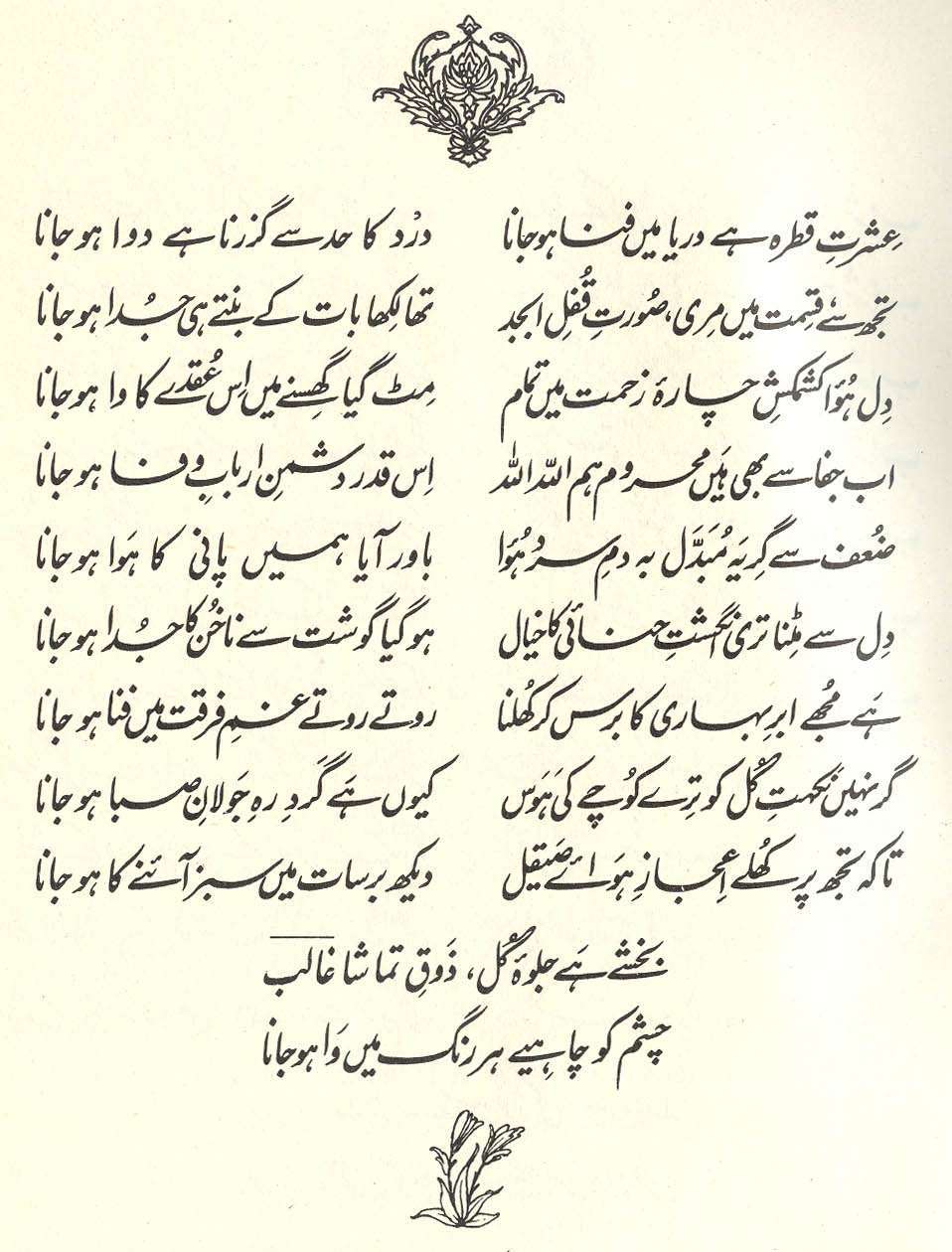
| Hamid Ali Khan | Open Image |
[July 28, 1862, to Ala'i:] Listen-- Thursday to Thursday eight; Friday nine; Saturday ten; Sunday eleven ../hali/index.html . Not for a single eyelash-flicker does the rain stop coming down in torrents. Right now it's pouring. I've had a charcoal brazier lit and placed beside me; I write two pages, then dry the paper by the fire. What can I do? I must certainly answer your letter....
My dear boy, I'm in great difficulty. The doors of the ladies' apartments [] have collapsed. The bathroom has become a ruin. Water is dripping through the roof. Your aunt [=Ghalib's wife] keeps saying, 'Alas, I'm crushed! Alas, I'm killed!' My own apartments [] are in even worse shape. I am not afraid of dying, I'm fearful of a lack of peace/comfort. The roof is a sieve. If the clouds rain for two hours, then the roof rains for four. If the landlord wants to make repairs, how can he do so? If the rain would stop, then everything would be done. And then, while the repairs are being made, how can I keep sitting here? If you can, then get your father to give me, for the duration of the rainy season, the haveli where Mir Hasan used to live, for your aunt to stay in; and the upper apartment with the downstairs hall where the late Ilahi Bakhsh Khan lived, for me to stay in. When the rainy season is over, the repairs will be made....
==Another trans.: Russell and Islam pp. 272, 275
==Urdu text: Khaliq Anjum vol. 1, pp. 394-95, pp. 398-99
[July 29, 1862, to Majruh:] Speaking of the rainy season, first listen to an overview. There was the revolt of the blacks; then the tumult of the whites; then the disturbance of the demolition of houses; then the disaster of the epidemics; then the difficulty of the famine. Now this rainy season is all of them rolled into one. Today is the twenty-first day. The sun is visible here and there the way lightning flashes. At night, if sometimes the stars can be seen, people take them for fireflies. In the dark nights, thieves flourish. Not a day passes without news of burglaries at three or four houses. Don't think it's an exaggeration-- thousands of houses have collapsed, hundreds of people have been crushed to death. In every lane, a river flows. To make a long story short, the earlier famine was caused by the failure of the rains; grain did not grow. This one is a water-famine: so much rain fell that the sown seeds were washed away. Those who haven't yet sown, have held back from sowing. You've heard the state of things in Delhi. Other than this, there's nothing new. ==Another trans.: Russell and Islam p. 275 ==Urdu text: Khaliq Anjum vol. 2, pp. 534-35
[July 29, 1862, to Majruh:] Speaking of the rainy season, first listen to an overview. There was the revolt of the blacks; then the tumult of the whites; then the disturbance of the demolition of houses; then the disaster of the epidemics; then the difficulty of the famine. Now this rainy season is all of them rolled into one. Today is the twenty-first day. The sun is visible here and there the way lightning flashes. At night, if sometimes the stars can be seen, people take them for fireflies. In the dark nights, thieves flourish. Not a day passes without news of burglaries at three or four houses. Don't think it's an exaggeration-- thousands of houses have collapsed, hundreds of people have been crushed to death. In every lane, a river flows. To make a long story short, the earlier famine was caused by the failure of the rains; grain did not grow. This one is a water-famine: so much rain fell that the sown seeds were washed away. Those who haven't yet sown, have held back from sowing. You've heard the state of things in Delhi. Other than this, there's nothing new. ==Another trans.: Russell and Islam p. 275 ==Urdu text: Khaliq Anjum vol. 2, pp. 534-35
That is to say, to weep and weep in the grief of separation and be finished off is, in my view, as commonplace a thing as for the spring clouds to open and rain down. This is an entirely original simile .
==Urdu text: Yadgar-e Ghalib , p. 144
That is, to weep and weep until I die is for me a cause for joy. I consider it to be like the way the clouds rained down and became a cause for joy. The excellence in this is the freshness of the simile. (43)
== Nazm page 43

Urdu text: Vajid 1902 {48}
The refinement and colorfulness of the simile is worthy of praise. (109)
This verse is an obvious companion piece to 48,5 . Compared to that one it's an even clearer example of ' elegance in assigning a cause ', because the equation is made explicit. The speaker maintains that in his opinion the bursting open and raining down, and thus the vanishing, of the springtime rainclouds 'is' their weeping their hearts out in the grief of separation, until they become entirely empty and obliterated.
Thus the macrocosm is identified with the microcosm: the causes that inform the lover's behavior operate on the spring rainclouds as well. Not that this claim is made with a show of objectivity: on the contrary, it is true 'to me' []. But what else does the ghazal universe consist of, except the passionate (and mad?) lover's subjectivity?
For another example of the 'springtime raincloud', see 33,7 . For an invocation of the 'rainy season' that isn't necessarily equated with spring, see 48,10 . And for a general discussion of the fascinating problem of 'springtime' versus the 'rainy season', see 49,4 .
I couldn't resist including these excerpts from Ghalib's letters, in order to juxtapose the poetically weeping clouds of the ghazal world to the actual rains that Ghalib experienced during one particularly severe and painful monsoon season. And how could I not also add Nazir Akbarabadi's ?
graphics/raincloud.jpg