Verse 8after 1821aaho jaanaa
G5
In this meter the first long syllable may be replaced by a short; and the next-to-last long syllable may be replaced by two shorts.
1
if the scent of the rose doesn't have desire/lust for your street
2
why is [there the act of] becoming dust in the movement-path of the breeze?
'Desire, lust, concupiscence, inordinate appetite; --ambition; --curiosity'.
| References | |
|---|---|
| Arshi, Imtiyaz Ali | Ghazal# 36 |
| Raza, Kalidas Gupta | 355 |
| Hamid Ali Khan | Open Image |
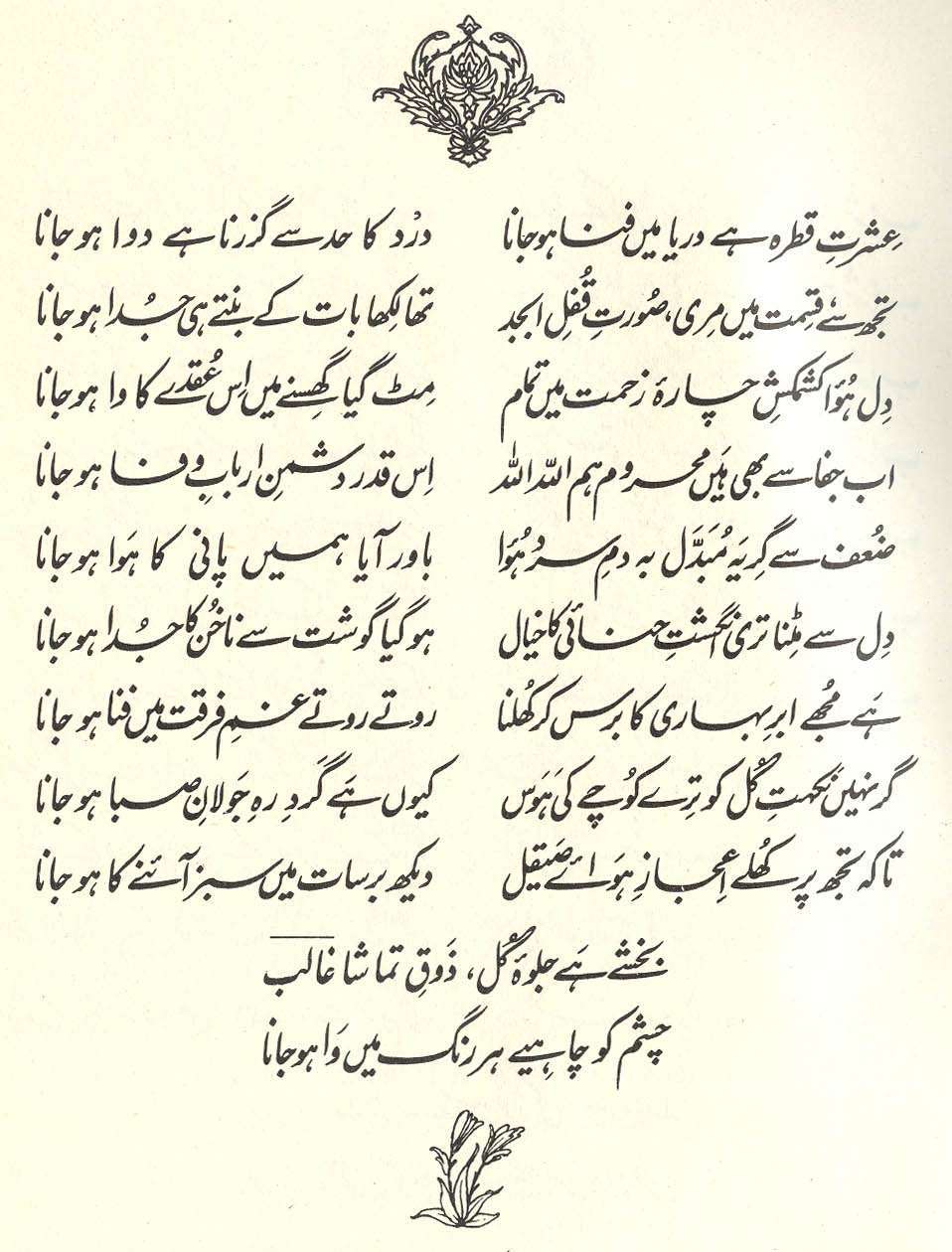
That is, why does it become dust in the path of the breeze? That is, it wants to travel with the breeze to your street. The refrain has fallen from the level of idiom. (44)
== Nazm page 44

Urdu text: Vajid 1902 {48}
He says, if the scent of flowers doesn't long and yearn to reach your street, then why does it fly around, roaming, with the spring breeze? (86)
The scent of the rose is always wandering here and there. But the lover, because of the ardor of love or jealousy, thinks, if the scent of the rose doesn't long to arrive in your street, then why does it like, despite its delicacy, to be trodden underfood by the spring breeze? That is, even delicate/coquettish ones are mad, and oppressed, with love for you. (109)
The , 'to become', like any infinitive, can be used the way a gerund is used in English, so that, for example, means 'the boy's going didn't please me', and can mean 'his/her/its becoming dust'. But as Nazm points out, the second line, while grammatical, sounds somewhat awkward. I've tried to keep both the literalness and the awkwardness; otherwise, the normal English form of the question would be 'why does it become dust?'.
The verse has a larger problem, though. Its parts just don't assemble themselves into an exciting or revelatory whole. The attributing of desire or lust [] to something as impalpable as rose-scent is justified by a set of three inert constructions: the rose-scent becomes 'dust of road of movement of breeze'. In other words, it places itself humbly and free-floatingly, like dust, in the path of the breeze, hoping to be borne toward the beloved's street. Thus the cloud of rose-scent is, somewhat awkwardly, depicted as feeling a strong human emotion, but acting in a feeble, vague, and passive way to express it.
What (if anything) energizes the verse is the lover's pathological jealousy. He is morbidly suspicious, and always on the lookout for a Rival , even in the most improbable places. Thus his interrogative approach, and possibly a hectoring tone to go with it: 'Oh, so you've been flirting again-- I knew it! Hah! That's why the rose-scent is pursuing you, isn't it?'
The argument could also be made that the verse implicitly plays with the double meaning of the (Persian) word , which can mean both 'desire' and 'wind, air'. If so, it's a subtle form of play, since the word doesn't appear in the verse, unless we consider the (Arabic) word to be a sort of evocation of it. For an explicit play of this kind on , see 48,10 .
graphics/dust.jpg