Verse 9after 1821aaho jaanaa
G5
In this meter the first long syllable may be replaced by a short; and the next-to-last long syllable may be replaced by two shorts.
1
the glory/appearance of the rose bestows a relish/taste for spectacle, Ghalib
2
the eye should, in every aspect/condition/'color', become open
is an archaic form of ( GRAMMAR )
'Manifestation, publicity, conspicuousness; splendour, lustre, effulgence'.
'Colour, colouring matter, pigment, paint, dye; colour, tint, hue, complexion; beauty, bloom; expression, countenance, appearance, aspect; fashion, style; character, nature; mood, mode, manner, method; kind, sort; state, condition'.
| References | |
|---|---|
| Arshi, Imtiyaz Ali | Ghazal# 36 |
| Raza, Kalidas Gupta | 355 |
| Hamid Ali Khan | Open Image |
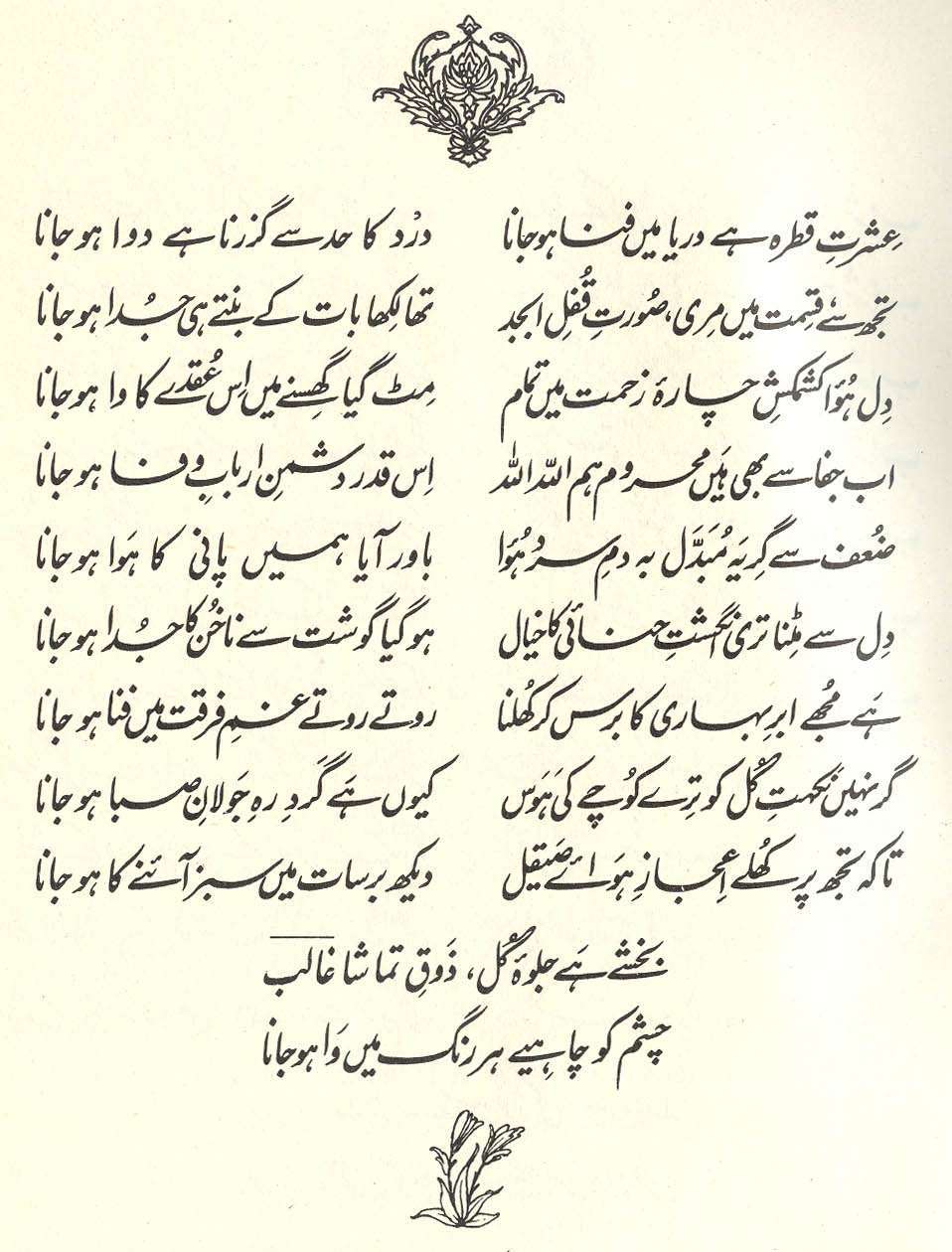
That is, seeing flowers of many colors blooming in the garden, there is born a relish to have the eye remain open in every color/mood, and see every kind of sight.... The second line explicates the 'relish for spectacle'. (44)
== Nazm page 44

Urdu text: Vajid 1902 {48}
Oh Ghalib, the springtime/flourishing of flowers gives pleasure. The duty of humans is that in whatever state they might be, they should behold the scenery of the world. (110)
In former times it was a common custom to end a ghazal with a verse-set , and in order to indicate where the verse-set begins, they put the pen-name in its first verse. By Ghalib's time this custom had not remained very prevalent, but neither had it entirely vanished. Thus these two verses are of this type. Those editors of the who didn't know about this custom have assumed the verse with the pen-name to be the closing-verse and have put it at the end.
== (1989: 59) 2006: 76-78
[For further comments on this verse as part of the verse-set, see 48,10 .]
This verse marks the beginning of a two-verse verse-set that comprises {48,9-10}. Some editors, including Hamid, don't mark the verse-set, and reverse the order of the two verses so that the formal closing-verse is at the very end. (On this see Faruqi's comments above.) As always, I follow Arshi.
This stark verse feels very modern, doesn't it? The rose's glory/appearance lures us on, so that we crave to see and enjoy the loveliness of the world, we have a relish for its 'spectacle'. But there's no real good cheer in this verse, no emphasis on the beauties of nature or the flowers that bloom in the spring. The second line is suddenly all too ominously bleak: the eye should, 'no matter what', be open. We humans ought to look fate in the eye.
The wordplay of , in every 'aspect/condition/color', is at the center of the verse. For 'color' is exactly the chief glory of the rose, and the source of its allure. But the rose's color is all too probably an inviting veneer that coats a darker reality. It gives us a relish for looking at the world. But then, looking at the world seems to become a kind of grim or gallant act of noblesse oblige, a requirement of fully human integrity: the eye 'ought to' or 'should' become open, no matter what kind of reality it is destined to behold. For a clear example of the potential grimness of , see 78,7 .
Although it shouldn't be forgotten that sometimes the eye that ought to be open is a mystical one: on the double sense that , 'spectacle', has for Ghalib, see 8,1 . (And sometimes, as in 117,1 , wide open eyes may even have good effects.)
In any case, the other verse of the verse-set, 48,10 , with its imagery of the mirror and the spring greenery, gives a more fruitful and hopeful twist to the idea of looking.
Compare Mir 's equally brilliant and insistent advice that the eye must remain open: M 1232,2 . But then, since this is poetry rather than philosophy, he also insists that the eye must remain closed: M 178,3 .
graphics/openeye.jpg