Verse 3after 1847uukyaa hai
G9
In this meter the next-to-last long syllable may be replaced by two shorts.
1
there's this jealousy/envy-- that he [habitually] is a fellow-speaker with you
2
otherwise, what fear is there of the enemy's bad teaching/learning?
'Teaching; learning; taught'.
'To learn; to teach'. (Steingass p.101)
| References | |
|---|---|
| Arshi, Imtiyaz Ali | Ghazal# 219 |
| Raza, Kalidas Gupta | 404-05 |
| Hamid Ali Khan | Open Image |
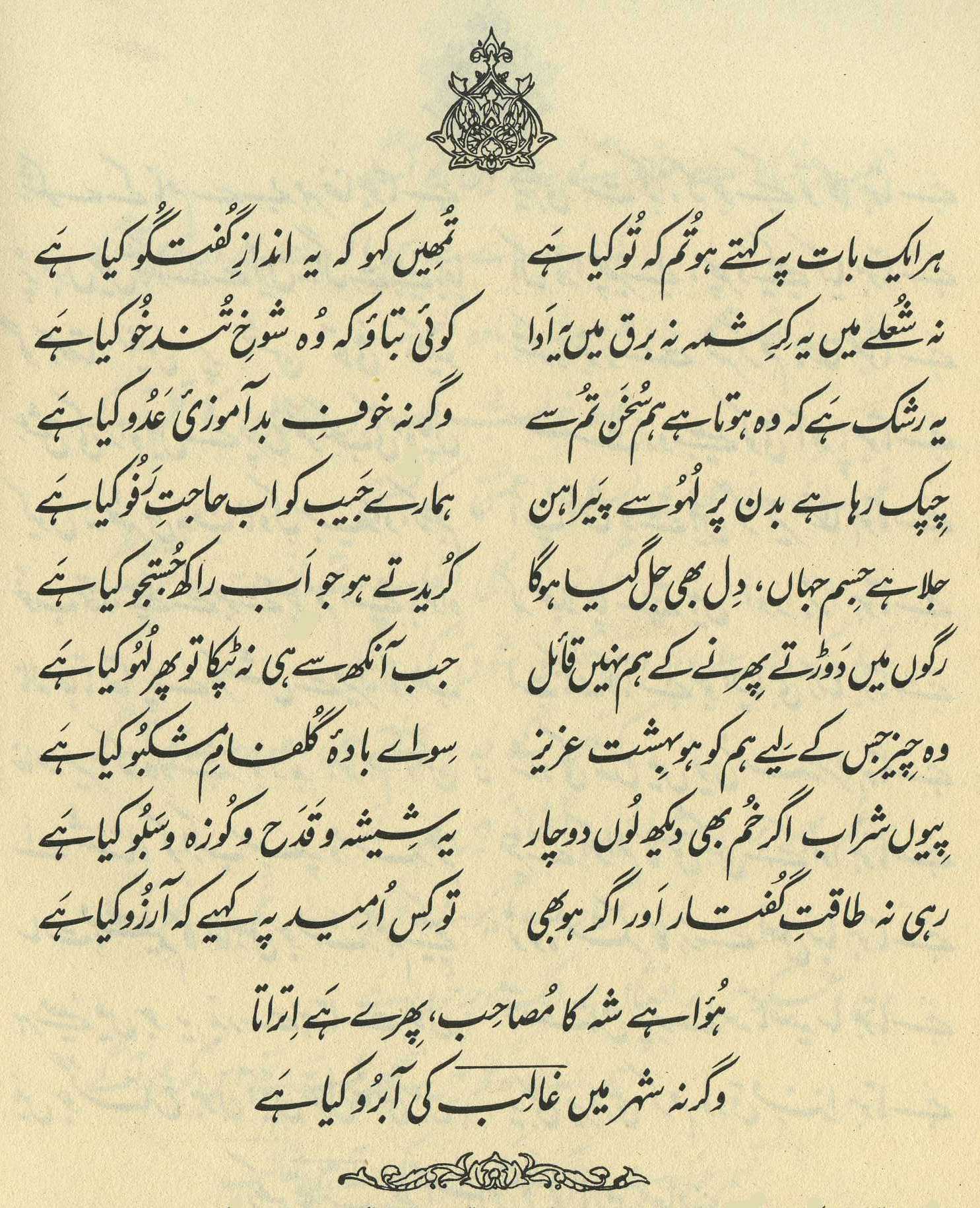
Let him say a hundred thousand extremely bad things about me-- I don't care. I only feel jealousy/envy: 'Why does he converse with you?'. (200)
== Nazm page 200

He says, 'I remain anxious and brooding out of jealousy/envy because he converses with you. Otherwise, I care nothing about the bad teaching/learning of the enemy. No matter how he may abuse me to you, I'm not afraid of that.' (259)
I don't at all feel any fear that from his insults and slander you and I would have a falling-out. Rather, I feel jealousy/envy at why he speaks with you at all. In the guise of love, how a plea is being made for her not conversing with the Rival ! (351)
The commentators explicate one possible reading of the verse. In their view, the fear that the lover strongly-- maybe even a little too strongly-- denies, is that the enemy may do 'bad teaching' and put undesirable thoughts into the beloved's head. This is certainly a legitimate reading. On this reading, the beloved is innocent until possibly propagandized by the 'bad teaching' of the enemy.
Even a quick glance at Platts, however, will show that can mean not only 'teaching', but also 'learning'-- or, more precisely, 'being taught' (see the definitions above). And it's that sense of 'being taught' that helps to open up the verse more enjoyably.
For if the 'enemy' regularly converses with the beloved, another possibility is that he may become 'taught' by her in some bad way. Where else except from her could he pick up so many cruel and wicked tricks, so many deadly-effective taunts, so much scandalous gossip? After all, we already know what the beloved is capable of: she is unkind to all parties, and is nobody's friend (see 42,1 ; she is not only unfaithful but a radical 'denier of faithfulness' (see {97,6 ). Compared to her own evil behavior, that of the 'enemy' cannot be more than a pale shadow, and thus hardly worth noticing.
For more on the complexities of , see 53,4 .
graphics/heart.jpg