Verse 10after 1847uukyaa hai
G9
In this meter the next-to-last long syllable may be replaced by two shorts.
1
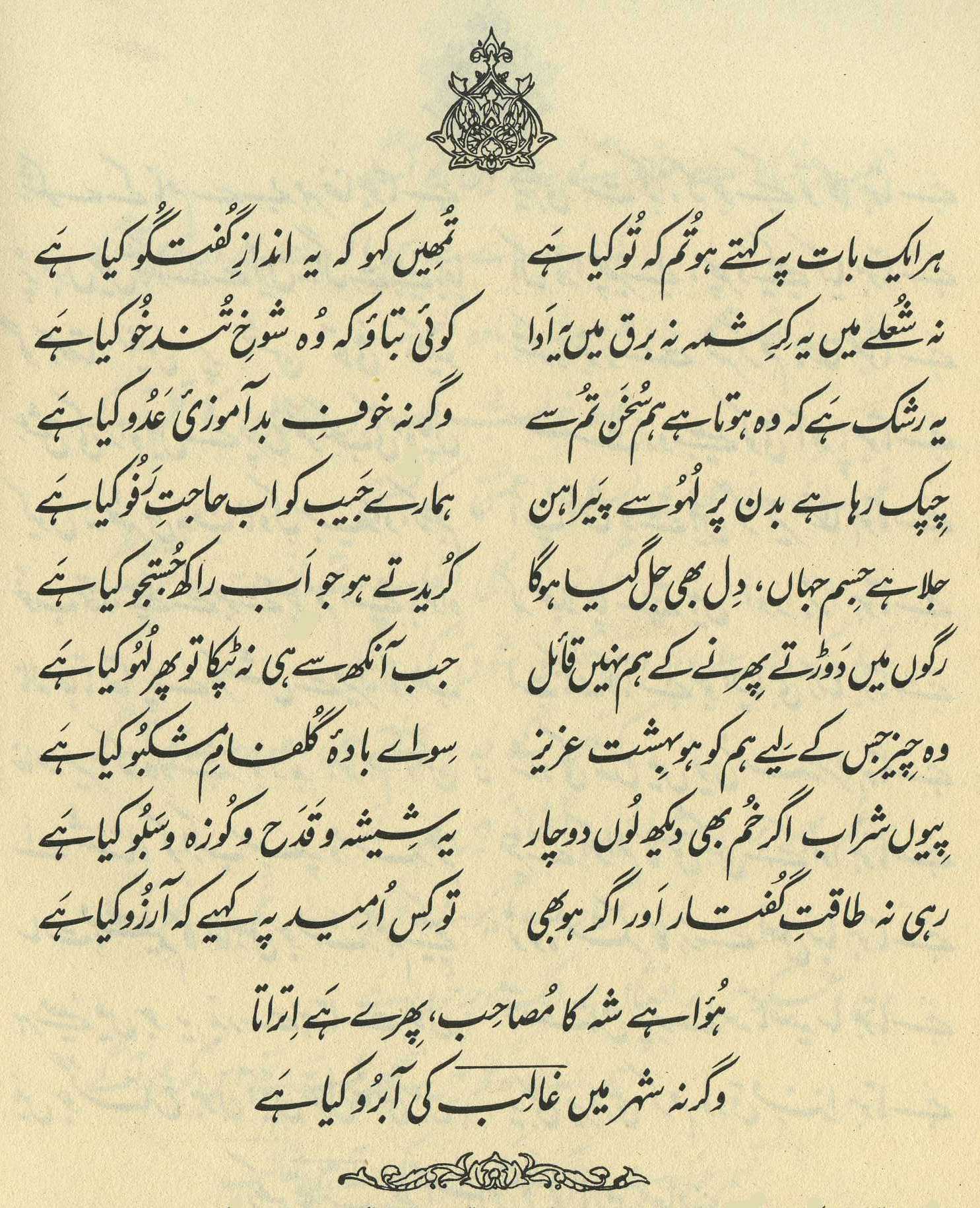
he's become the King 's companion-- he goes around giving himself airs
2
otherwise, what honor/dignity/reputation does Ghalib have in the city?!
'A companion, an associate, a friend; favourite (of a prince)'.
is an archaic form of ( GRAMMAR )
'To behave with pride or self-conceitedness, or boastfulness, or arrogance, or insolence; to give oneself airs'.
'Brightness of face'; honour, character, reputation, rank, dignity; grandeur; pride, credit, ornament, show, appearance'.
| References | |
|---|---|
| Arshi, Imtiyaz Ali | Ghazal# 219 |
| Raza, Kalidas Gupta | 404-05 |
| Hamid Ali Khan | Open Image |
To make a sand-grain into the sun, and a drop into the sea, and the low into the high, is a shopworn theme , which people always use in the informative [] style. Look at the power of the author's literary skill [], that he has presented that very same old theme in the style! (202)
== Nazm page 202

He says, 'Becoming a 'companion' to the King has made Ghalib vain; now he goes around putting on airs. Otherwise, before this, who in the city knew him?' What a fine closing-verse he has composed! And what a well-adorned [] ghazal he has written! (260)
How he has praised the King, and in what a new manner! And how he has expressed his poetic creativity []! (356)
Apparently a thinly-veiled hit at Zauq , the king's companion and poet laureate. Zauq was of humble birth and in Ghalib's view a facile versifier but not a poet. It is said that Ghalib composed the first line with direct reference to Zauq. The king heard of it and called him to account, whereupon Ghalib completed the couplet so as to make the whole thing refer humorously to himself.
==The Seeing Eye: Selections from the Urdu and Persian Ghazals of Ghalib (Islamabad: Alhamra, 2003), pp. 222-223
In the second line the speaker is asking a question, as Nazm points out. And as all the commentators observe, it's basically a scornful, negative, rhetorical one. (What honor does Ghalib have in the city? Why, none at all, of course!) As Bekhud Mohani observes, the whole effect works beautifully as a subtle form of praise for the King. It's so much more elegantly framed than the over-the-top hyperbolic flattery of, say, 177,10 .
The speaker doesn't seem to be 'Ghalib' himself; though of course he could always be talking to himself in a bitter and sarcastic mode, imitating the gibes of his enemies. For the speaker really does sound like an envious person enjoying a round of spiteful gossip. For another such example, see 22,9 .
I don't know where Ralph Russell got the anecdote about the first line referring to Zauq, but I'm dubious about its accuracy. It sounds like a folk anecdote to me, a back-formation from the rhetorical structure of the first line. (Or else a back-formation from a similar anecdote involving a different poem in a different genre.) And in any case, Ghalib surely didn't begin to recite a verse explicitly attacking the royal Ustad in the royal presence. So how would the emperor come to hear of a single line of an unfinished verse? It doesn't seem likely.
graphics/bahadurshah.jpg