Verse 9after 1847uukyaa hai
G9
In this meter the next-to-last long syllable may be replaced by two shorts.
1
strength for/of speech did not remain; and even/also if it would exist
2 a
with/upon what hope/expectation would you say, 'What is [your] longing?'
2 b
with/upon what hope/expectation would you say what your longing is?
'Hope, expectation; trust, dependence'.
The polite imperative (scanned long-long to suit the meter) is here used as a form of subjunctive.
| References | |
|---|---|
| Arshi, Imtiyaz Ali | Ghazal# 219 |
| Raza, Kalidas Gupta | 404-05 |
| Hamid Ali Khan | Open Image |
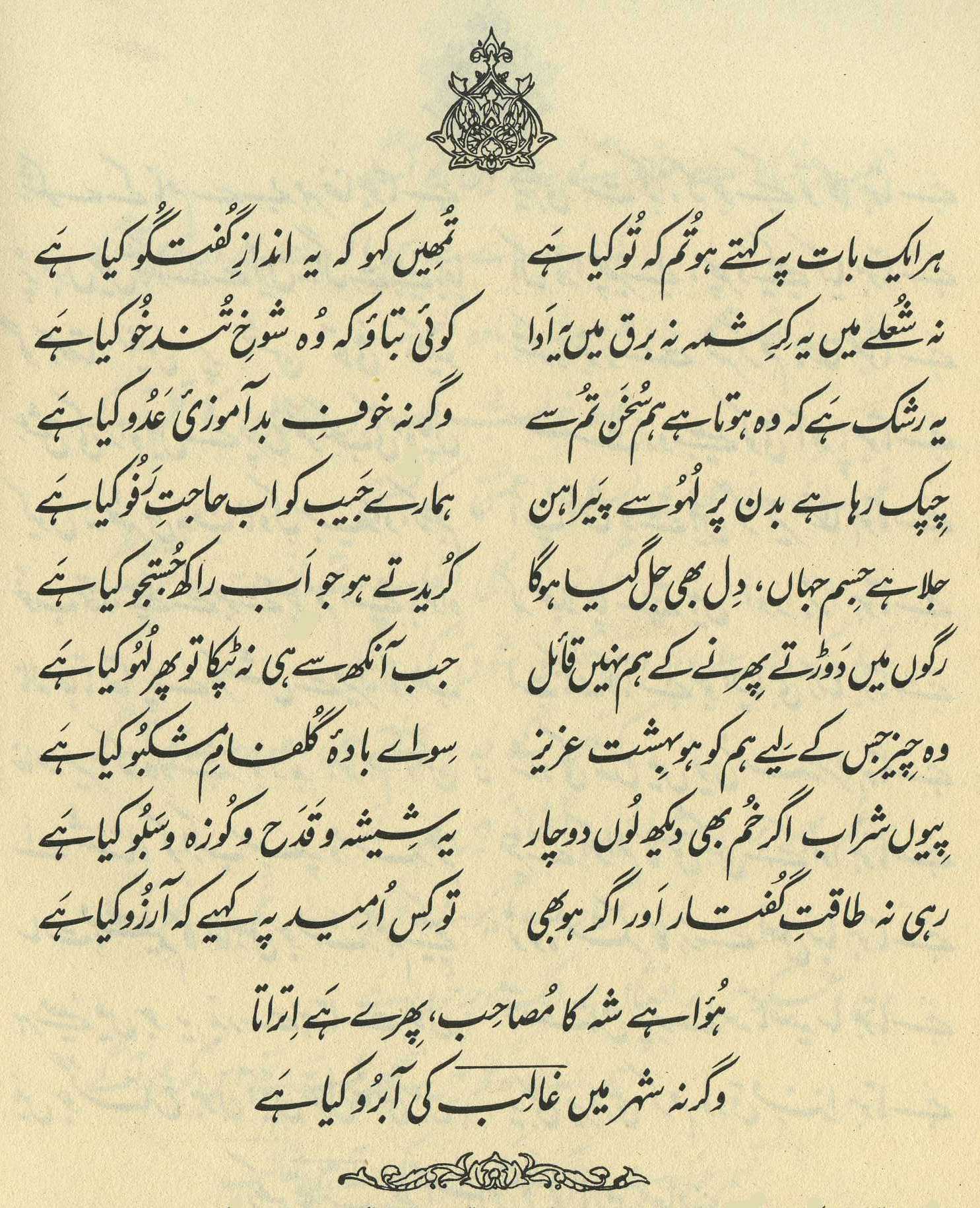
Woe to the self-restraint!-- that in a state of longing I was finished off, so that not even the strength for speech remained, but I never emitted a single syllable of ardor from my lips. Alas, the despair!-- which turned the expression of desire into blood, and permitted it to remain within the heart. (202)
== Nazm page 202

He says, 'I was a man of such self-restraint that in a state of longing itself I gave up my life, and never brought a word of the longing to my lips. Now the strength for speech no longer remains. But when I had control over the power of speech, even then I never allowed a word of despairing passion to come as far as my lips.' (260)
That is, the heart is constantly making the demand, 'Oh tyrant, have mercy on me, and present to the beloved the petition of longing'. But the lover says, 'With what hope?-- she's not one to melt in any way'. (355-56)
This is one of the many verses in which speech itself is spoken about, often paradoxically (there's no strength for , but then there's the speech proposed by ).
Here, the dialogue in the second line might be with some sympathetic friend, or even with the beloved herself. In that case, the situation is like that of 52,1 : the beloved has come, but 'at what a time!'-- when it's entirely too late. With what expectation [] would anyone now even bother asking him, 'What's your longing?' (2a). There could be none, of course, since it's doubly too late: he can't talk, and even if he could, he can't live long enough for any such longing to be satisfied (even if anybody wanted to satisfy it, which is by no means clear).
An alternative possibility is that he might simply be talking to himself, contemplating his own situation. Not only is he too weak for speech, but he's also in a state of despair: there's no hope [] left of any satisfaction, so even if he could speak, why would he bother to put his hopeless longing into words? (2b).
graphics/deathbed.jpg