Verse 11833
G5
In this meter the first long syllable may be replaced by a short; and the next-to-last long syllable may be replaced by two shorts.
1
the eyes closed just as I was in the act of opening them, Ghalib
2 a
friends brought her to my pillow/bedside-- but at what a time!
2 b
friends brought her to my pillow/bedside-- but when?
'A pillow, a cushion; a couch; bed'. (Steingass p.151)
| References | |
|---|---|
| Arshi, Imtiyaz Ali | Ghazal# 53 |
| Raza, Kalidas Gupta | 379 |
| Hamid Ali Khan | Open Image |
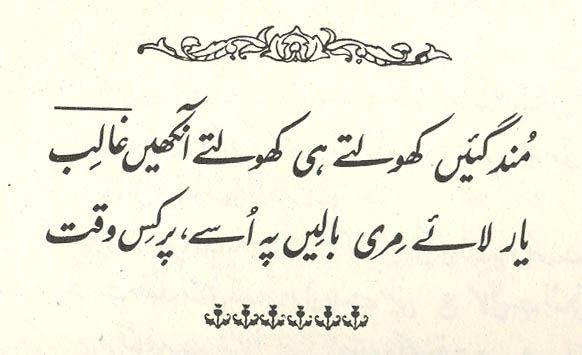
The eyes' closing is an implication of death. And in this ground there is only this one verse, and it too should have been removed. Later on there's a verse with this very same theme : 72,3 . (48)
== Nazm page 48

He says, my companions brought her to my bedside at the time when I was in my death throes. Just as a lamp flickers as it is being extinguished, in the same way my eyes, even as they were opening, closed forever. The meaning is that my friends have made an ill-timed effort, and the beloved has showed ill-timed kindness. (91)
It's a verse strangely full of vain longing. (116)
Compare 72,3 . (197)
The quizzical ending of line two opens up many moods-- grief, reproach, irony, a genuine question. As usual, it's left for us to decide-- and decide afresh as many times as we recite the verse.
But the main pleasure of the verse is contained in line one, in the idea that the lover's eyes closed just as he was in the act of opening them []. C. M. Naim has pointed out (July 2005) how different , with its sense of purpose and volition, is from , which would merely have referred to the eyes as becoming open, with no further information. And it's also contrasted with , which simply reports that the eyes closed somehow or other, for reasons unspecified-- perhaps involuntarily, perhaps helplessly-- rather than being closed by the will or action of the speaker.
Note for grammar fans: What this distinction represents is of course the difference between the transitive , 'to open', and the intransitive , 'to become open' (with no agent involved). Similarly, the intransitive , 'to become closed' (with no agent involved), carries an implicit contrast with the transitive , 'to close'. Exactly the same contrast is created in 72,3 . Here is * Naim's own account * of transitives and intransitives.
Ghalib was so fond of that phrase that he used it identically (though perhaps less effectively) in the first line of the very similar 72,3 as well. For more on such re-using of phrases and lines, see 49,1 . For more on the beloved's visits to the lover, see 106,2 .
The dying lover's eyes are apparently closed in fatigue or despair, since it's only the news of the beloved's arrival that causes him to begin to open them. And then, just as they are coming open, they close again. Nothing in the verse itself tells us that this second closing is a sign of death--only the power of implication makes us aware of the melancholy and ironic truth. This verse belongs to the 'dead lover speaks' set; for others, see 57,1 .
Possibly the intense emotion generated by awareness of the beloved's presence has been too much for the lover's much-abused heart, and has itself brought on his death. Thus the beloved's life-giving presence, which might almost have revived the lover (or perhaps had actually begun to do so, as his eyes fluttered open), has been death-giving. Compare 9,7 , in which the lover is killed by the stress of Jesus's breathing on him to restore him to life.
Compare Mir 's lighter, wittier take on the too-late show of kindness: M 1806,1 . (There's also the more similar but less impressive M 2,3 .)
graphics/deathinayatkhan.jpg