Verse 1after 1821aamauj-e sharaab
G5
In this meter the first long syllable may be replaced by a short; and the next-to-last long syllable may be replaced by two shorts.
1
again the time occurred that it would be wing-opening, the wave of wine
2
[that it] would give to the wine-duck the heart and hands of a swimmer, the wave of wine
t-e mai>> : 'A kind of goblet in the form of a duck'.
'Swimming; a swimmer'. (Steingass p.761)
| References | |
|---|---|
| Arshi, Imtiyaz Ali | Ghazal# 49 |
| Raza, Kalidas Gupta | 356 |
| Hamid Ali Khan | Open Image |
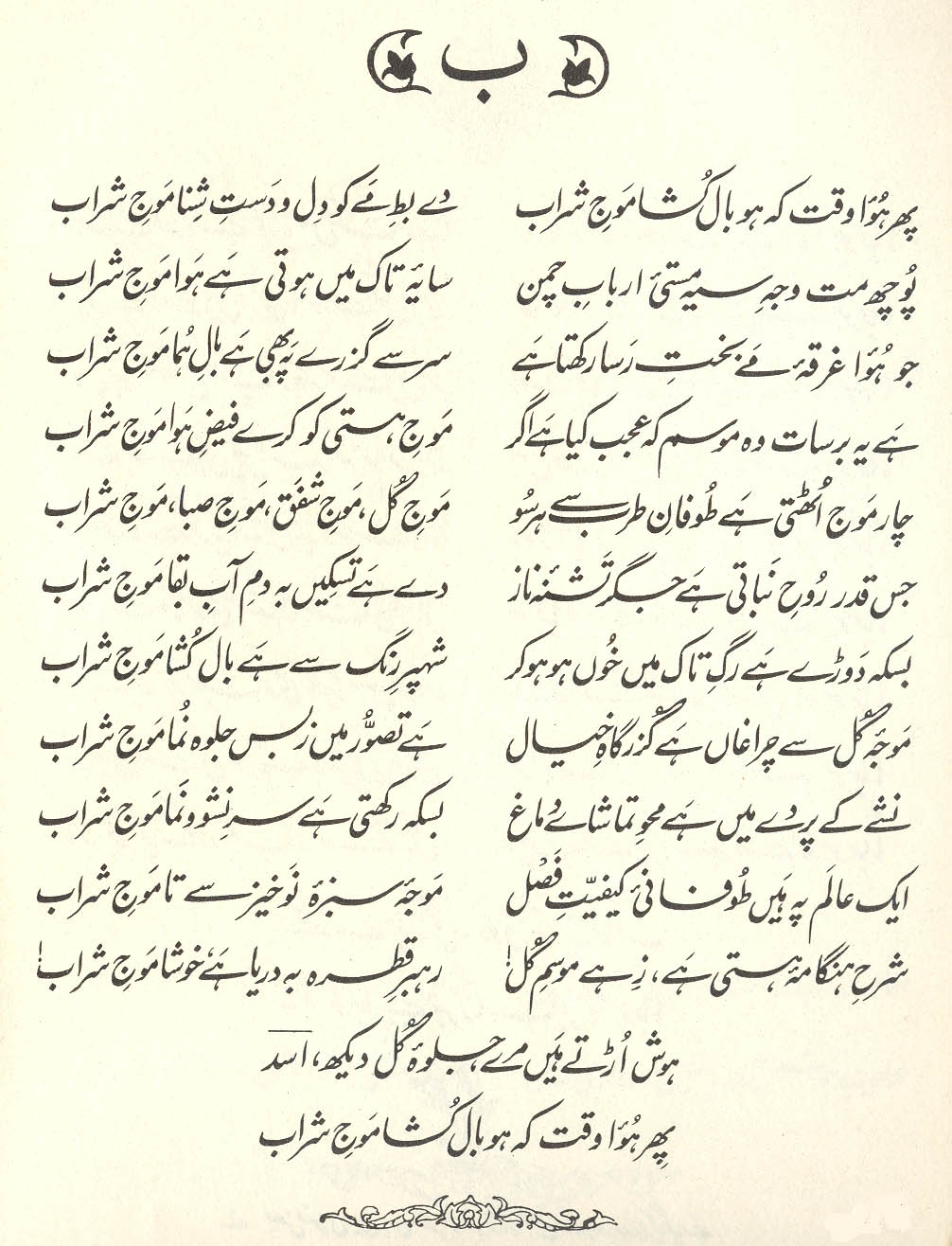
The extent to which Mirza has versified theme s related to wine in his ghazals and ode s and verse-set s and quatrain s won't be less than that of [the Persian poets] Khvajah Hafiz and Umar Khayyam. [Hali also provides an account of Ghalib's own drinking habits, with anecdotes.]
==Urdu text: Yadgar-e Ghalib , pp. 71-74
To fly on the great wings of wine is a metaphor for the tumult of wine, and by time is meant the springtime, whose mischief gives ebullience and tumult to wine. And to give to the wine-duck the heart and hands of a swimmer means that tumultuous wine itself will be its heart. And the hand of the Cupbearer will be for it the hand of a swimmer-- that is, from his hand it will swim into the circle of a prison-cell []. And he has given the glass itself too the simile of the heart. (44)
== Nazm page 44

He said, that time has come when a wave of wine would spread its wing to fly, and the wave of wine would bestow on the wine-duck a heart with an ardor for swimming.... [The flagon into which newly pressed wine is poured] they call the 'wine-duck'.... The meaning of the verse is that springtime has come again, and the perfume of wine has again begun to pervade the air. Then the flagons, like ducks, float along in the pools. (87)
Nowadays wine is not cooled in ice, but rather the 'wine-duck' swims in the step-wells, and Mirza establishes the reason for its swimming to be not the waves or the motion of the air, but the wine's own fervor. (111)
ABOUT REPETITIONS OF PHRASES AND LINES: Such repetitions of whole lines and long phrases are very rare in the divan . In addition to the present case (the first line of {49,1} and the second line of 49,12 ), which is the most spectacular and deliberate-seeming, there are also: the second line of 41,1 and the second line of 41,8 ; the first line of 33,3 and the second line of 80,1 ; and (most of) the first lines of 52,1 and 72,3 . Note also Ghalib's amusing praise for repetition in 53,11 .
This ghazal has a remarkably long and specific refrain . Since every verse ends in , 'wave of wine', this unifying semantic effect turns the entire ghazal into a sort of unofficial quasi- verse-set . (Compare 211 , with its refrain of .) And the effect is intensified by the fact that the first line of this opening-verse is repeated identically as the second line of the closing-verse , 49,12 .
But of course, unofficial is the operative word; the unity of the ghazal is merely thematic, not (in principle) narrative or sequential. In this one ghazal, since it's possible, I've made a point of translating in a way that preserves the refrain, so that every translated verse ends in 'wave of wine'.
The idea of a 'wine-duck' is so striking and poetically appropriate that it's easy to see why Ghalib would want to use it. Bekhud Mohani appears to think of it as something in actual contemporary use, though other commentators are much less sure of exactly what it is. For a 'boat of wine', with a Moth-wing for a sail, see 166,3 .
For our purposes, the details seem less important than the image. In the first line, the 'wave of wine' itself, not the duck, is what opens its wings. It thus inspires the wine-duck to swim-- in the water of a cooling pond? in the 'wave of wine' itself? It's not clear of course-- but does it matter? Maybe Ghalib himself didn't know; perhaps he had simply seen the image in earlier Persian or Urdu ghazals; an example from Mir is cited below. (Also, think of 1,1 -- Ghalib's comments show that he himself, never having gone to Persia, could never have seen the alleged 'paper robe' custom.)
For other 'wave of wine' verses, see 152,2 ; 351x,2 ; 361x,5 .
I once had a go at translating (1991) this ghazal.
Compare Mir 's use of the 'wine-duck', which Ghalib might have borrowed: M 178,4 .
Just for pleasure, here is a Mughal-era 'pilgrim flask' (in which travelers carried water), in the shape of two conjoined ducks:
graphics/duckflask.jpg
And here is not exactly a wine-duck, but a -duck, courtesy of the Met:
graphics/paanduck.jpg
A trinket-box duck:
graphics/duckbox.jpg