Verse 6after 1821aamauj-e sharaab
G5
In this meter the first long syllable may be replaced by a short; and the next-to-last long syllable may be replaced by two shorts.
1
to the extent that the vegetative soul is thirsty-livered for/with coquetry
2
[it] gives peace with a drink of the 'water of eternity', the wave of wine
'The soul, spirit, life, the vital principle, the breath of life; the spirit or essence (of anything)'.
'Vegetation; herb, vegetable; plant, grass'.
is an archaic form of ; GRAMMAR .
'Consolation, comfort, mitigation, rest, assurance, peace (of mind)'.
'Breath, vital air, life; --a moment, an instant; --breath or blast (of a furnace or oven); a puff, whiff, pull, draw (of a ); a draught (of water)'.
'Remaining; duration, permanence; eternity; immortality'.
| References | |
|---|---|
| Arshi, Imtiyaz Ali | Ghazal# 49 |
| Raza, Kalidas Gupta | 356 |
| Hamid Ali Khan | Open Image |
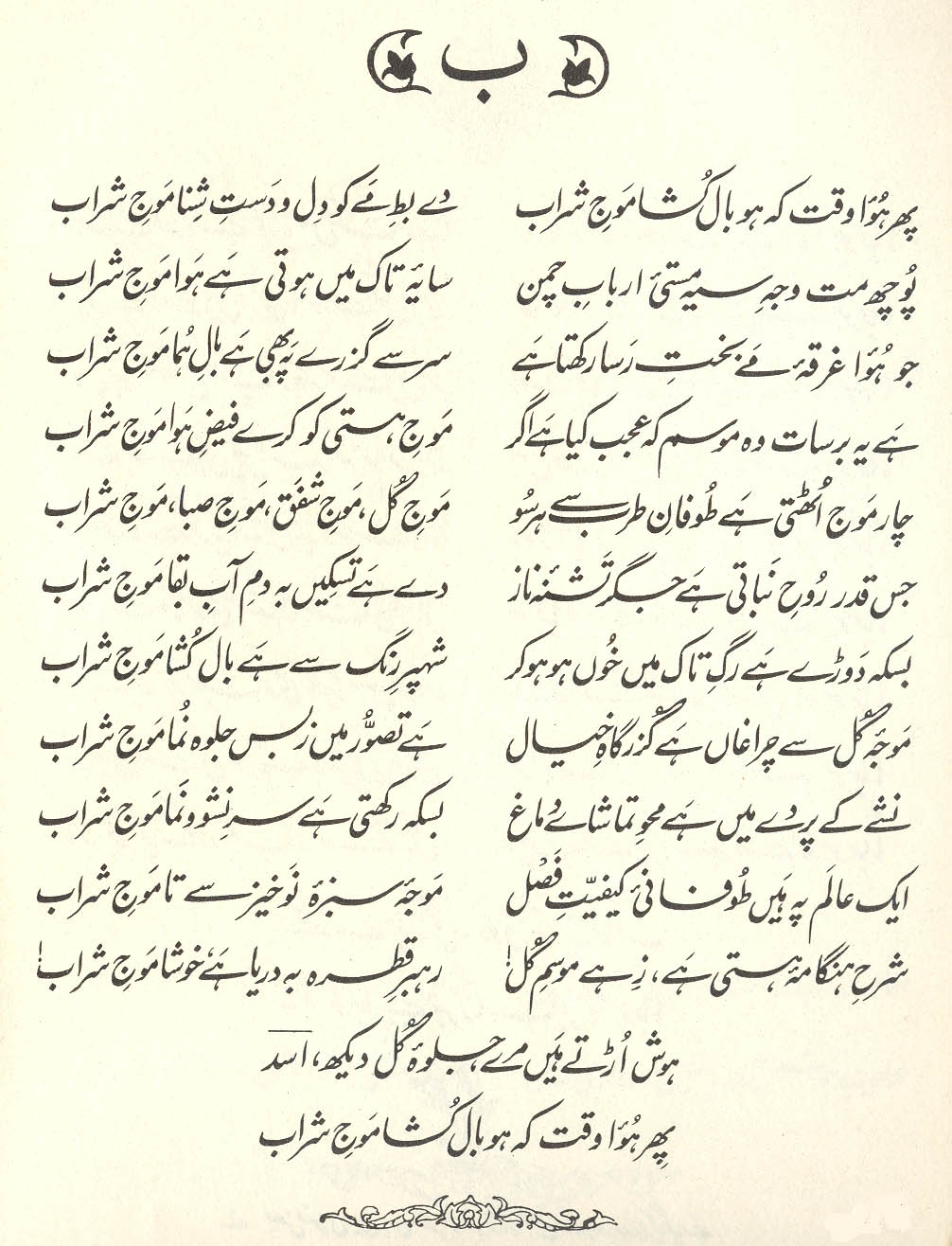
By 'vegetative soul' is meant the power of growth, which is in humans too. The meaning is that the longing and turbulence that arises in us through wine is the action of the power of growth. That is, wine works for the power of growth the way rain works for plants. And here, 'coquetry' means to swagger and spread oneself, which is the necessary part of pride and coquetry, and the special feature of growth. (45)
== Nazm page 45

He says that the extent to which trees have the power of growth in the rainy season, in the same way in the hearts of wine-drinkers longing and turmoil are begotten. That is, wine is a kind of power of growth which generates in people's hearts not only growth and flourishingness, but also pride and coquetry. (88)
To the extent that the vegetative soul of mankind is coquettish, the wave of wine gives it exactly that many sips of the water of eternity and brings it peace. That is, according to the longing for the strength of growth, the wave of wine gives help in flourishingness and increase. The meaning is that the way vegetation, etc., flourishes because of rain, in the same way human strength flourishes because of wine. (112)
ABOUT the 'water of life': Is the 'water of eternity' the same as the proverbial 'water of life' [] that looms so large in the stories of Khizr and Alexander ? For examples of similar references see 166,7x , 215,9 (and Mir 's glorious M 1741,3 ). Ghalib seems not to use the standard phrase 'water of life', but the reference may indeed be the same, since 266x,3 links Khizr clearly with the . There's also 413x,8 , in which Gyan Chand explicitly equates the two. But in any case the question doesn't seem very important with regard to the present verse (or in fact with regard to most of the others as well).
The 'vegetative soul' is deeply thirsty, thirsty all the way down to its liver, and the wave of wine comforts it with a drink of the 'water of eternity' ; that much is clear.
The word comes from an Arabic root for 'to grow', and growth both seeks its own enhancement, and somehow subliminally looks for its limits. Is there (or is there not?) something that the principle of growth is growing toward? The excellent ambiguities of the make it impossible for us to pin things down. Is the 'vegetative soul' thirsting (1) to display coquetry (by showing off its verdure and luxuriance); or (2) to submit to coquetry (by encountering a 'beloved' who has a power and glory greatly superior to its own)? The commentators endorse the first meaning, but I would emphasize the second. The idea of 'thirsting' goes especially well with something based on longing rather than on arrogance. For an example of such a longing to experience from a beloved, see 71,5 .
By offering the water of eternity, the wave of wine perhaps reassures the 'vegetative soul' that its radiant, adorable growth is powerful and indeed almost infinite, since it is nourished by the water of eternity. Alternatively, it perhaps gives to the 'vegetative soul' the calming, settling assurance that its merely finite, repetitive, this-worldly growth is bounded by the limits of time, and is held in check by an even stronger fate that is outside time altogether, so that it can prepare to make a (comforting, reassuring) submission to its destiny. (Swinburne, in ' The Garden of Proserpine ', captures something like the latter mood.)
Do I even need to say that surely Ghalib means for us to entertain both possibilities, together and/or in alternation? The 'wave of wine' is the perfect medium for the conveying of such a double-edged vision, since wine can help to reconcile us to life, and also perhaps to death.
graphics/winewave2.jpg