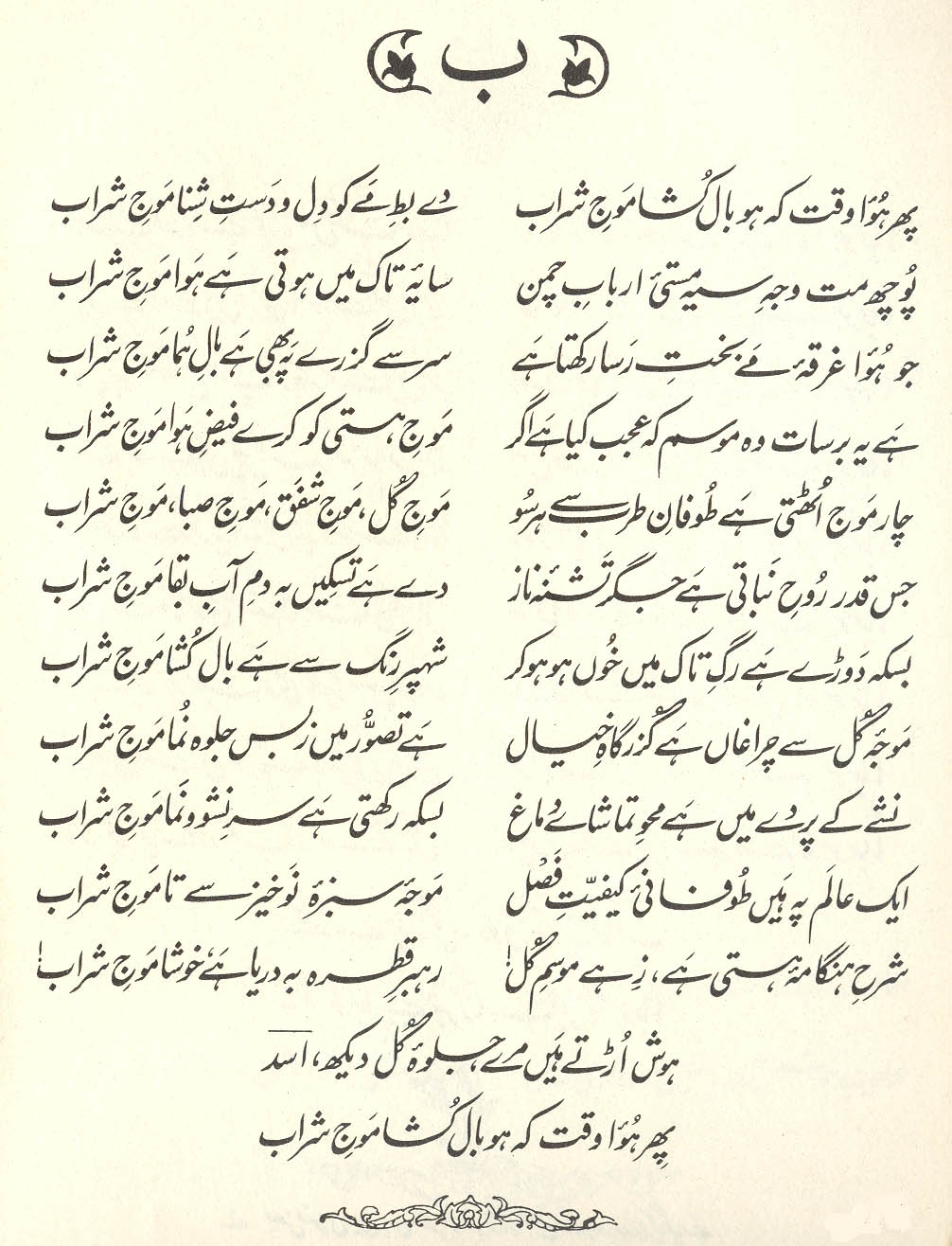
Verse 4after 1821aamauj-e sharaab
G5
In this meter the first long syllable may be replaced by a short; and the next-to-last long syllable may be replaced by two shorts.
1
this rainy season is that [kind of] season-- such that it's hardly strange if
2
the munificence of the breeze would make the wave of existence, a wave of wine
'Overflowing, abundance, plenty; --beneficence, munificence, liberality, bounty, bountiful kindness favour, grace; charity'.
'Air, atmosphere, ether, the space between heaven and earth; --air, wind, gentle gale;... --affection, favour, love, mind, desire, passionate fondness; lust, carnal desire, concupiscence'.
| References | |
|---|---|
| Arshi, Imtiyaz Ali | Ghazal# 49 |
| Raza, Kalidas Gupta | 356 |
| Hamid Ali Khan | Open Image |
The spring breeze [] brings such revolutionary changes.... When one substance turns into another, it gives great pleasure. A second reason that poets have given attention to this theme is that when in a simile movement is the ground of similitude, then that simile is usually extremely eloquent [].... In short, the author has here created a movement in expressing the generosity of the air-- he has given the simile of a wave for swiftly-passing existence, and thanks to the generosity of the air he has made that wave a wave of wine, with the affinity of being joy-producing. (45)
== Nazm page 45

He says that in the rainy season, the fallen rain on the ground engenders greenery. Is it strange if the spring breeze [] would make the wave of life into a wave of wine? The meaning is that the spring season [] produces fervor and enthusiasm in temperaments. (88)
The mention of the rainy season along with springtime in this verse has come in because in Iran, spring and the rainy season come together, and these Persian ideas have spread over Urdu too. (122)
ABOUT 'SPRINGTIME' AND THE RAINY SEASON: The rainy season in India has always been the season of erotic bliss for lovers who are together, and of extreme suffering for lovers who are separated. But it isn't exactly 'springtime'. After the baking summer heat of the North Indian plains, those first few powerful rainstorms, with their heavy clouds and thunder and lightning, do feel like a return of coolness and life to a dried-up and dusty world. There's a potent erotic effect in all that, and in the way the plants and animals rush into their breeding seasons (the wild, strange call of the peacock is emblematic). But then gradually the mood of the season changes, as the rain continues to drip down and the constant humid heat takes its toll. The fertility becomes so lush and voluptuous that it's almost overripe; life is lived in a world of sticky sweat and mildew. The monsoon air then feels not like a 'wave of wine', but more like a wave of steamy water vapor, until the weather gradually cools off into 'autumn' and winter.
But in the present verse, as Josh observes, the rainy season is pressed into service to play the role that spring plays in different climates. The main South Asian seasons have been described as 'cold' (mid-December to March), 'hot' (April to June), 'monsoon' (July to September), and 'post-monsoon' (October to mid-December). But opinions differ. Azad speaks of Zauq as living in a small house through 'heat, cold, rains-- the full 'flowerings' of all three seasons': p. 448 . Azad gives the seasons out of order-- and conspicuously brings in , 'flowerings', for the sake of the 'spring' wordplay-- but he does insist that there are only three. However the year is broken up, there's only a very imperfect overlap between the monsoon season and our 'spring'. For examples of 'springtime' verses, see 13,2 .
Nazm and Bekhud Dihlavi and other commentators effortlessly turn 'the rainy season' into 'spring' in their commentary, apparently without even noticing the discrepancy. And I had never given it any thought either, until Josh's observation made me reflect. For more examples of rainy season imagery, with and without conflation with springtime, see 48,7 ; 95,2 ; 97,13 ; 139,10 .
Similarly, see Faruqi's equation of springtime with the rainy season in his discussion of Mir: M 1850,3 .
According to Arshi, this verse is the beginning of a verse-set . I myself really couldn't tell where it would end, but Faruqi maintains that it's a two-verse one, and that sounds quite plausible. Since nobody but Arshi seems to mark it or treat it as a verse-set at all, I don't have any other information. But Arshi does indeed mark it in both editions of his work, so I'm duly noting it.
But then, when it comes to 'springtime', how important is this seasonal discrepancy really? The world of the ghazal is in any case made up of characters and environments possessing exactly, and only, the qualities needed for poetic effectiveness within the verse. If roses smile and laugh, captured birds talk, beloveds shoot eyelash-arrows, and dead lovers describe their own 'dust', does it really matter if the rainy season is endowed with the qualities of a stylized springtime?
graphics/winewave.jpg