Verse 12after 1821aamauj-e sharaab
G5
In this meter the first long syllable may be replaced by a short; and the next-to-last long syllable may be replaced by two shorts.
1 a
my senses 'take flight', having seen the glory/appearance of the rose, Asad
1 b
my senses 'take flight'-- look at the glory/appearance of the rose, Asad !
2
again the time occurred that it would be wing-opening, the wave of wine
'The senses to fly or to be lost'; to lose (one's) senses; to be or become confounded; to become senseless or silly'.
| References | |
|---|---|
| Arshi, Imtiyaz Ali | Ghazal# 49 |
| Raza, Kalidas Gupta | 356 |
| Hamid Ali Khan | Open Image |
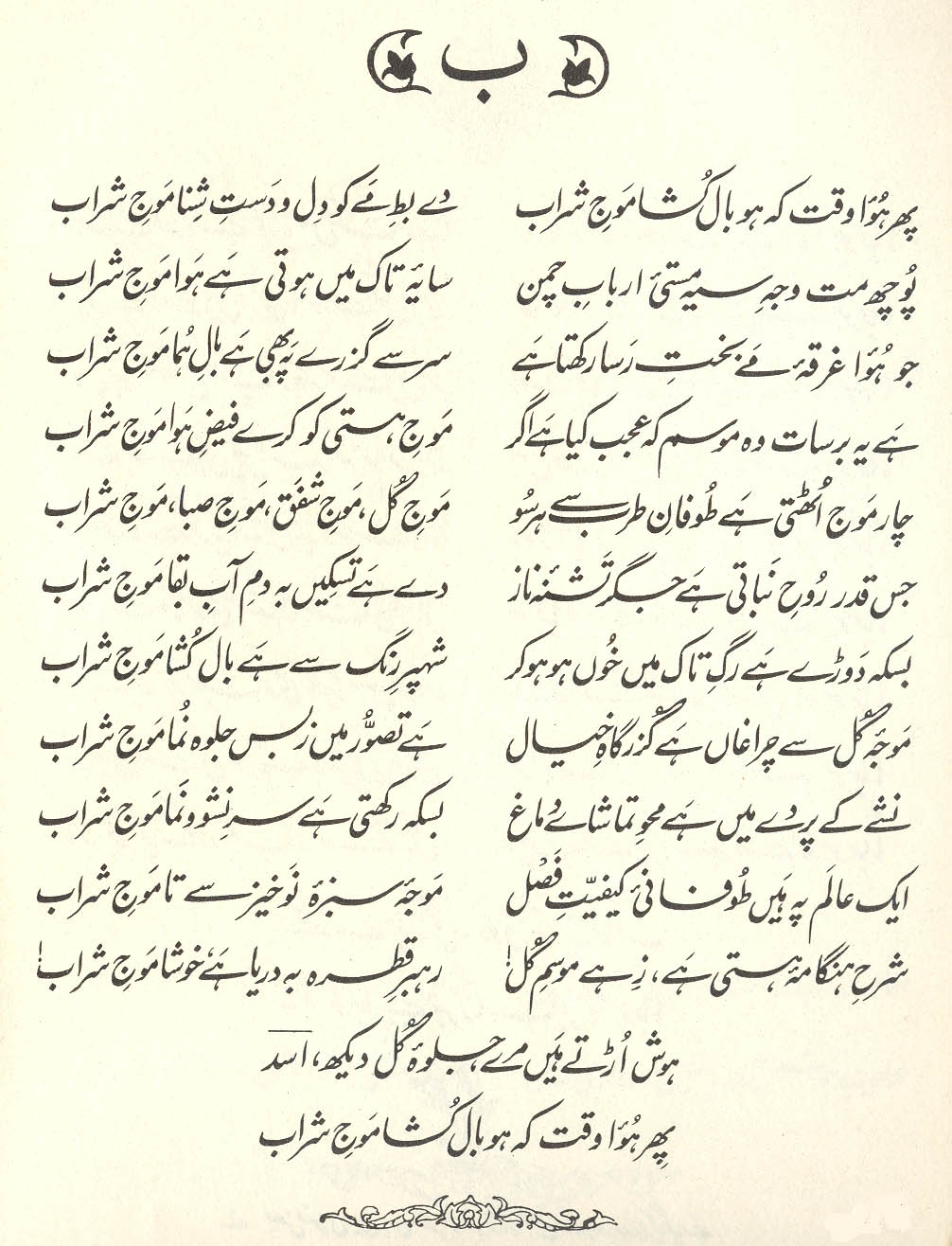
== Nazm page 46

He says, 'Oh Asad, since I saw the glory/appearance of the rose my senses have started to leave me. It seems that that time is coming, along with the spring, when the wave of wine will begin to fly in the air'-- that is, here and there wine distilleries will be set up. (89-90)
'Oh Asad, having seen the glory/appearance of the rose, my senses are leaving me. It seems that again that time has come when the wave of wine would begin to move'-- that is, the flagon would circulate for wine-drinking. It's possible that might be the imperative of the verb. Between 'take flight' and 'wing' is a verbal affinity . (147)
Because of the wordplay of flying, he has described the wave of wine as 'spreading its wings'.... The first line of then the opening-verse has been repeated in the closing-verse . This repetition too is pleasurable in concluding a thought. Musicians too end their melodies by repeating the first line. (124)
As Josh points out, the first line of 49,1 has been repeated as the second line of this last verse, thus providing an unusual sense of circularity and closure. In this respect too, as in the substantialness and influence of its refrain, this ghazal is unique in the whole divan . For more on this kind of repetition, see 49,1 .
For the 'senses to take flight', meaning 'to become confounded, confused, senseless' is a well-established idiomatic expression (see the definition above). As usual in such cases, Ghalib uses the expression in both this colloquial sense, and its dictionary sense: the senses literally 'take flight' because the wave of wine would be 'wing-opening' and would fly off with them.
'My senses take flight' is in any case a fine way to end such a sensuous ghazal, one so full of soaring and intoxication. The speaker faints, he swoons, he loses his senses-- because he has seen the glory/appearance, the , of the rose. (This reading takes as a colloquially shortened form of .)
Or else, feeling himself losing his senses, he urges himself to make the glory of the rose the last sight to be fixed in his eyes. (This reading takes as an intimate imperative.) As Baqir observes, the structure of the line easily lends itself to both interpretations; though perhaps the former has a slight edge, since it doesn't require a change in subject from first person to second person in the course of the line.
Note for grammar fans: Here's one more case in which we're one step further in the past in Urdu than we would be in English. Because of the present-tense verb [] in the first line, in normal English the second line would be 'the time has come'. My translation sticks with the literal Urdu, as usual; but the clunkiness in English is very obvious. For more on this, see 38,1 .
graphics/rosewine.jpg