Verse 21826ednahii;N
G11
In this meter the first long syllable may be replaced by a short; and the next-to-last long syllable may be replaced by two shorts.
1
kingship has come [down] from hand to hand
2 a
a glass of wine is not the seal/end/'signet-ring' of Jamshid
2 b
the seal/end/'signet-ring' of Jamshid is not a glass of wine
'A signet-ring; a finger-ring; --a seal, stamp, mark; --end, finish'.
'Splendid king'; name of an ancient king of Persia'.
| References | |
|---|---|
| Arshi, Imtiyaz Ali | Ghazal# 98 |
| Raza, Kalidas Gupta | 364 |
| Hamid Ali Khan | Open Image |
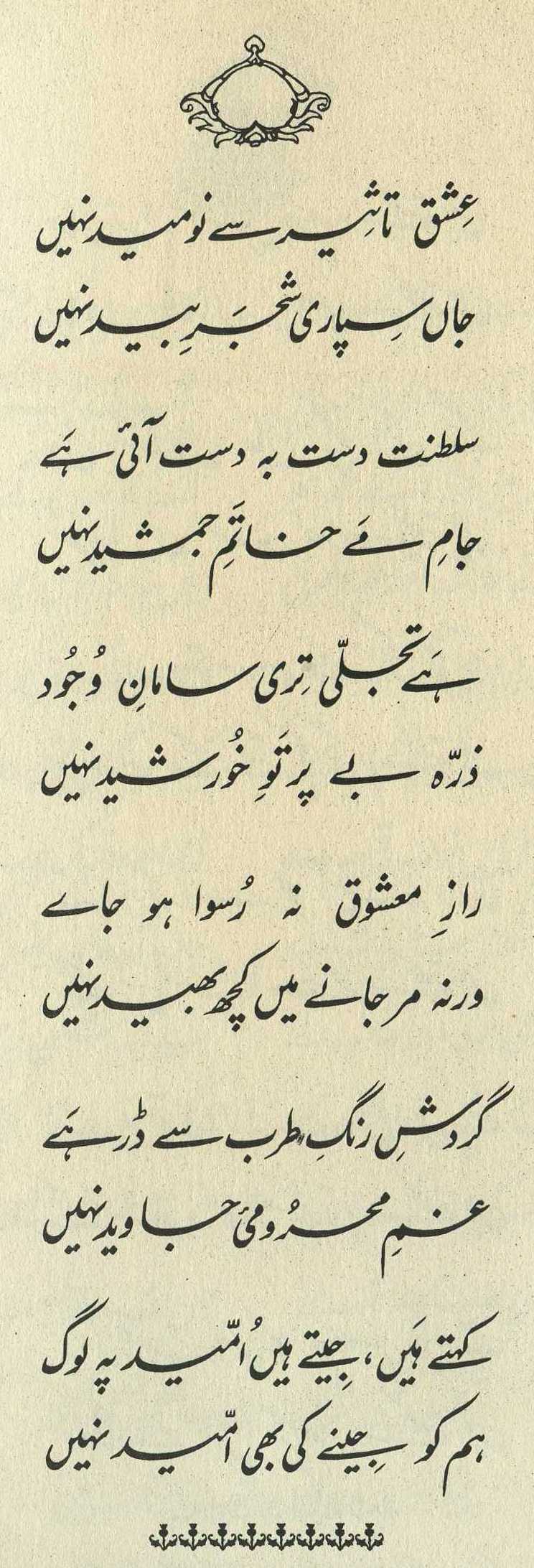
He says, the glass of wine is a kingship, which has come down, from hand to hand, from Jamshid to the rakish ones []. This is not the ring [] of Jamshid, that his name alone would be engraved on it, and it would be reserved especially for him. (96)
== Nazm page 96

The meaning is that Jamshid had the Cup of Jamshid [], in which wine was drunk. Nobody except rakish ones could establish a right to it. (146)
The kingship is like the Cup of Jamshid []. Or the Cup of Jamshid is like the kingship, in that it has kept on being received by one after another. (And this will keep on happening.) A cup of wine is not Jamshid's ring, which after his death was not received by anybody. (190)
The meaning of is 'ring' or 'seal' or the face of a ring that is used as a seal. The first meaning of is 'to be passed from one to another'. (In it the sense of 'inheritance' is also hidden.) If the meaning of is examined, then we learn that it is also used in the sense of 'victory', 'predominance', 'conquest', 'force', 'power', 'manner', 'path', and 'custom'. In this way the meaning of 'to come from hand to hand' can also be like [the proverb] 'Of whom the stick, of him the water-buffalo'-- that is, to be transferred on the basis of victory and conquest.
If is taken in the sense of 'seal'-- that is, the thing that is Jamshid's personal property-- then the interpretation becomes that the kingship comes down from hand to hand (through conquest and predominance and power). It's neither a glass of wine that comes to a suitable person, nor Jamshid's seal that is Jamshid's alone-- that is, the property of only one person. The kingship is a separate thing, the glass of wine is a separate thing, and the seal of Jamshid is a separate thing. Among there is an affinity .
A second interpretation can be that the kingship (the symbol of which is the seal of Jamshid) comes down from hand to hand, but the glass of wine comes to a suitable person. This is a greater thing than the kingship; the kingship can also come to unworthy people.
On Ghalib's verse there certainly fell a ray of this verse of Dard 's:
[nothing depends upon kingship--
the one to whose hand the cup comes, is Jamshid].
== (1989: 123) 2006: 145-46
On the pronunciation of the rhyme -words in this ghazal, see the discussion in 95,1 .
In the first line, we learn that something is true of A. In the second line, we learn that B is not C (and/or, through the symmetry of such equations, that C is not B). Given the complete grammatical and semantic independence of the two lines, how are we to arrange them-- which line is in the service of the other? Is wine like kingship, or is kingship like wine? And of course, what about the signet ring or seal of Jamshid (or Jamshed)?
For at the center of the verse is the figure of Jamshid , famous both as a king and as the owner of the legendary Cup of Jamshid []. He could look into the surface of the wine-filled Cup and see reflections of past, present, and future. Neither his own royal signet ring or seal, nor his own special Cup, have been passed down through the generations, but ordinary marks of kingship (every king has a seal) and ordinary wine-glasses (every drinker gets a glass) have 'made the rounds' many times over, as the 'revolving' of the wheel of fortune has exalted some and ruined others, and as the 'going round of the cup' (, as in 97,5 ) in the wine-house has opened the way to intoxication for drinker after drinker.
So if we try to chart the possible relationships among kingship, wineglass, and seal, here are some of the main possibilities, as best I can make them out:
=Kingship and the wineglass are alike (they travel from hand to hand), and are unlike the seal of Jamshid (which belongs to him alone). But the wine-glass is just an illustrative metaphor; the point is to illumine the nature of kingship-- it flows from one partaker to another like wine.
=Worldly kingship and the wineglass are alike (they travel from hand to hand), and are unlike the seal of Jamshid (which belongs to him alone). But worldly kingship is just an illustrative metaphor; the point is to illumine the nature of wine-drinking-- it confers a superior, democratic, mystical form of 'real' kingship.
=Kingship (which travels through worldly force and violence) and the seal of Jamshid (which is an emblem of kingship) are alike; while the glass of wine, which is freely shared among suitable (and mystically inclined?) friends, is different; people of real insight know very well which of them is the more desirable.
But this list is by no means exhaustive; the verse remains somehow elusive. A number of links are possible, but none of them are entirely obvious. Who would have thought this simple-looking little verse would open out into such a complex puzzle! It might be time to go and have a glass of wine.
On seals and signet-rings, see 61,5 .
graphics/jamejam.jpg