Verse 51847aabme;N
G3
1
when did the going-round of the cup, in her/his gathering, come as far as to me?
2 a
may the Cupbearer not have mixed something into the wine!
2 b
might the Cupbearer not have mixed something into the wine?
| References | |
|---|---|
| Arshi, Imtiyaz Ali | Ghazal# 109 |
| Raza, Kalidas Gupta | 391-92 |
| Hamid Ali Khan | Open Image |
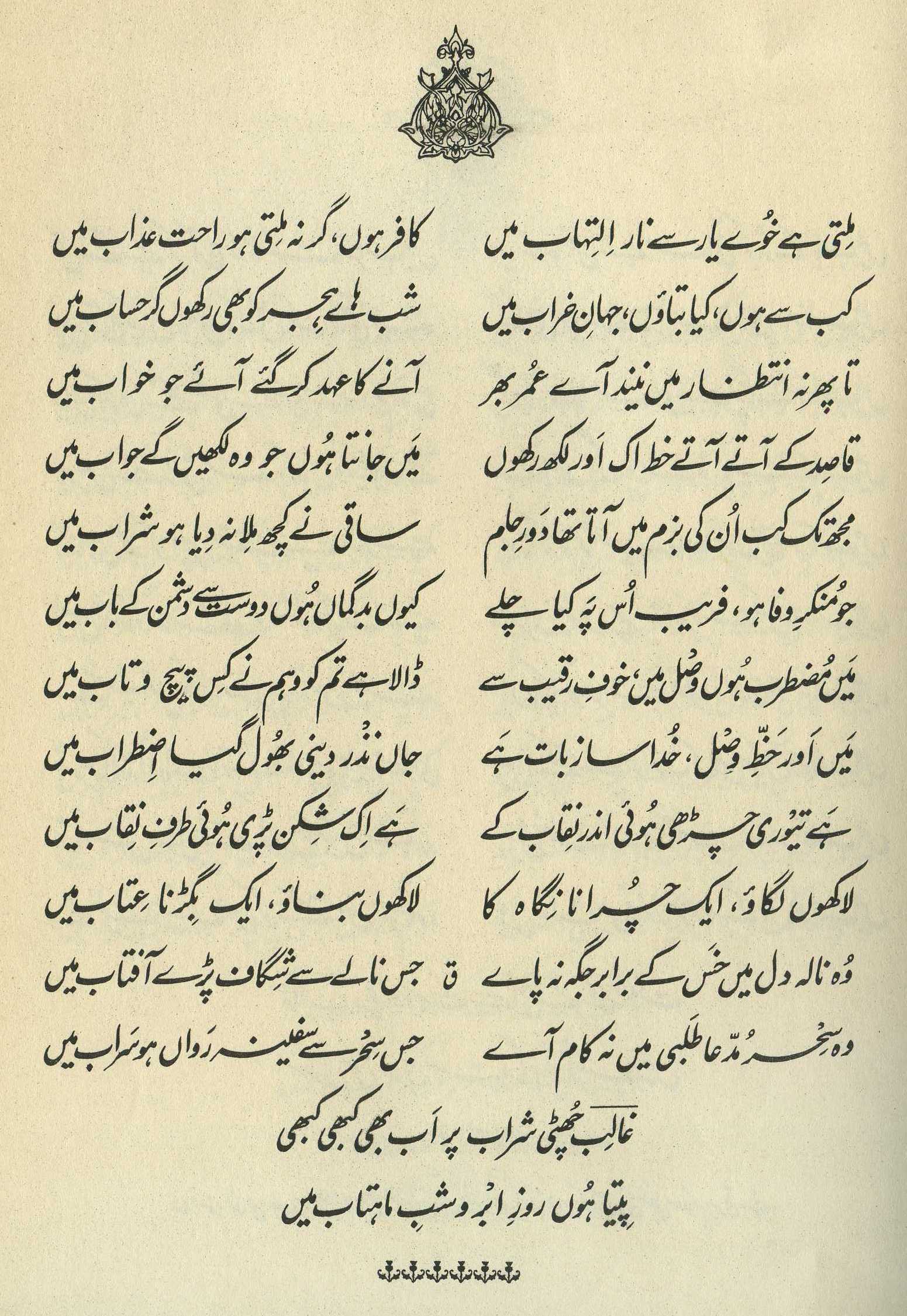
[1854, to Taftah:] That is to say, 'Now that the rounds of the cup have come to me, I'm fearful'. This whole sentence is implied []. Anyone who looks at my Persian divan will realize that I leave sentence upon sentence implied. But [as Hafiz says] 'every utterance has a [suitable] time and every point has a [suitable] place' []. This difference is indeed intuitively perceptible [], not expressible in words []. (Arshi p. 234)
== Khaliq Anjum vol. 1, pp. 262-63
==(translated with interpretive help from S. R. Faruqi, Feb. 2000)
In this verse after the first line this much of a phrase is omitted : 'then today since contrary to custom the rounds of the cup have reached to me'. This omission has made the verse of a very high order. The kind of omission in which context provides the evidence, and the omitted words, without being mentioned, are speaking between the two lines-- this is counted among the beauties of a verse.
==Urdu text: Yadgar-e Ghalib , p. 148
gathering-- that is, the Rival 's. If the Cupbearer had mixed poison in, then it would hardly be strange. (99)
== Nazm page 99

Apparently people asked for explanations of this verse, so that both Ghalib and Hali have dutifully provided them. That's surprising, since it doesn't at all seem to be one of his difficult ones. The grammar of the first line itself colloquially implies a negative rhetorical question-- literally, 'when did the going-round of the cup [habitually] come as far as to me?' (It never did, of course, so the speaker is skeptical and suspicious of the change.) There's a similar form in English: 'Since when have they started passing me the wine?' (Only this once, of course, so that the question conveys skepticism and suspicion on the speaker's part.)
This is a verse of implication , like the previous one, 97,4 . Ghalib himself explicitly says so, in the letter cited above, and emphasizes his habitual use of this technique. Look at all the unstated things we known about the lover: (1) that he habitually attends someone's parties; (2) that he's always very rudely treated there; (3) that he accepts and expects this rude treatment; (4) that when he is suddenly treated with normal courtesy, his first thought is of foul play.
Either we have here a case of advanced paranoia, or we have someone subject to constant minor harassment, varied only with probable major persecution (perhaps to the point of death). Or both, of course ('paranoids have enemies too'). And they both sound like the lover, don't they? He is paranoid (think of 14,3 ), and he is persecuted too (as we know from all too many examples).
Whose gathering is it? Nazm thinks it's the Rival 's; that's an unduly literal-minded choice, but it can't be ruled out. The more obvious and piquant possibility is that the gathering is the beloved's own. But does it really matter?
This would have been a wonderful mushairah verse, too. The first line leaves us wondering where the poet is going with this. Maybe the lover is just reminiscing about the bad old days? ('When I went to her parties, she never even used to pass me the wine!') Maybe she's now asking for some extravagant favor? ('And after the way she treated me-- why, when I went, etc.'). Under mushairah performance conditions, we of course have to wait until the reciter is ready to offer us the second line.
And even then, not until we hear the word , at the end of the line, do we learn what all this anxiety is about. They've offered him a glass of wine! And the effect is to throw him into amusing fits of anxiety and paranoia. How likely is it that a gentleman visitor at an elegant evening gathering will be poisoned by arsenic in the wine? Not likely at all, of course, even in the ghazal world; this is not a common trope. And yet the lover's whole life is uncommon-- uncommonly wretched. The way some people are accident-prone, he's persecution-prone. Just think of 22,1 .
graphics/ominouswineglass.jpg