Verse 111847aabme;N
G3
1
that lament would not find, in the heart, space equal to a grass-blade--
2
the lament through which a crack would befall, in the sun
'Split, rent, slit, crack, cleft, fissure, chink, crevice, chasm, flaw'.
| References | |
|---|---|
| Arshi, Imtiyaz Ali | Ghazal# 109 |
| Raza, Kalidas Gupta | 391-92 |
| Hamid Ali Khan | Open Image |
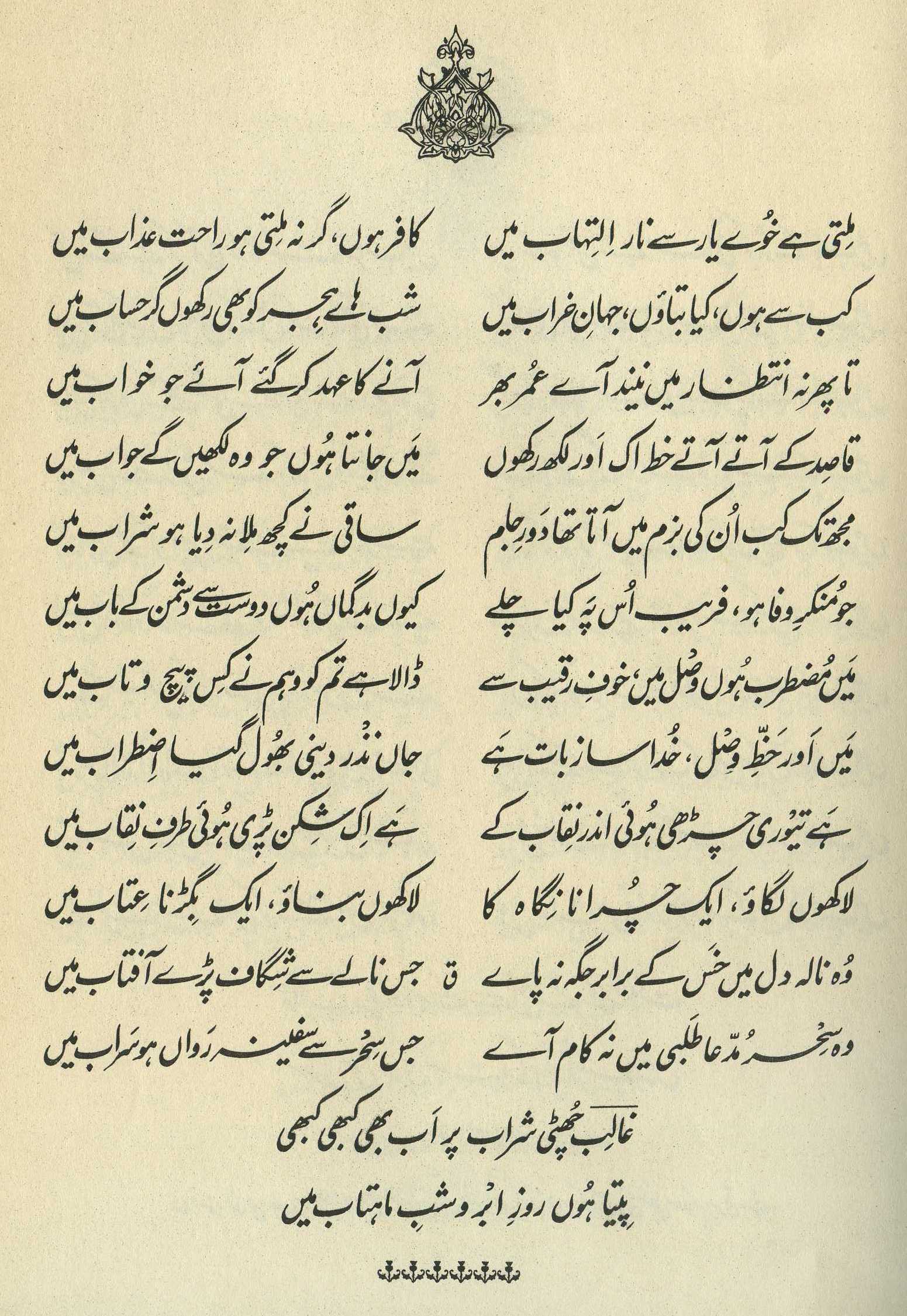
Both [this and the following] verses are about extraordinary situations. And by 'heart' is meant the beloved's heart. (100)
== Nazm page 100

He says, It's a cause for great surprise. That lament doesn't find in the beloved even as much space as a straw-- the lament by means of which a long [scar] appears in the sun. (150)
With extreme surprise he says, that lament from which the sun would be split in fragments-- that lament wouldn't have the effect of even a hair's breadth in the beloved's heart. And those magically effective words [in 97,12 ] through which a ship would begin to move in a mirage-- they wouldn't serve to achieve the purpose. It's a cause for astonishment. That is, that lament and those words through which impossible things would become possible-- they turned out to be so ineffective that they didn't achieve the smallest result. (196)
[See his discussion of Mir's M 64,6 .]
A number of editors and commentators (including Hamid, Nazm, Bekhud Mohani, Shadan, and Mihr) treat this and the following verse as a verse-set . But others disagree; the dissenters include Bekhud Dihlavi, Baqir, Josh, and Chishti-- and Arshi, whose usage I follow, as always. Even if it's not to be formally identified as a verse-set, it's easy to see why the idea could arise. The two verses are strikingly similar both formally and semantically. And they have a close (though less madly beautiful) cousin in 120,3 .
They were two of my favorites, too, back in the days when I thought I could translate Ghalib. Because they could be translated! They could be made to sound good in English! What an all-too-rare pleasure it turned out to be, to find such verses.
The verbs are both in the future subjunctive, so none of this has happened. The lover is not reporting real events, but only giving us his thoughts. Of course, his thoughts are based on long and painful experience with lesser laments and lesser refusals. So here is his cosmic conclusion, projecting his experience to the limit of imagination.
And what a limit it is! The beauty and power of this verse lie in the second line with its vivid image, both real and unreal. The 'lament that could slash a scar across the sun', was how I planned to put it in my translation.
graphics/sunspots.jpg
