Verse 11847aabme;N
G3
1
(hell)fire approaches/resembles the beloved’s temperament in heat
2
I'm an infidel, if I wouldn't [habitually] find comfort in torment/punishment!
'To be mixed, be mingled, be blended; be confounded; be amalgamated; be shuffled; to be joined, be united; to become connected (with, )'.
'Fire; hell-fire; hell'.
'Punishment, chastisement; pain, torture, torment'.
| References | |
|---|---|
| Arshi, Imtiyaz Ali | Ghazal# 109 |
| Raza, Kalidas Gupta | 391-92 |
| Hamid Ali Khan | Open Image |
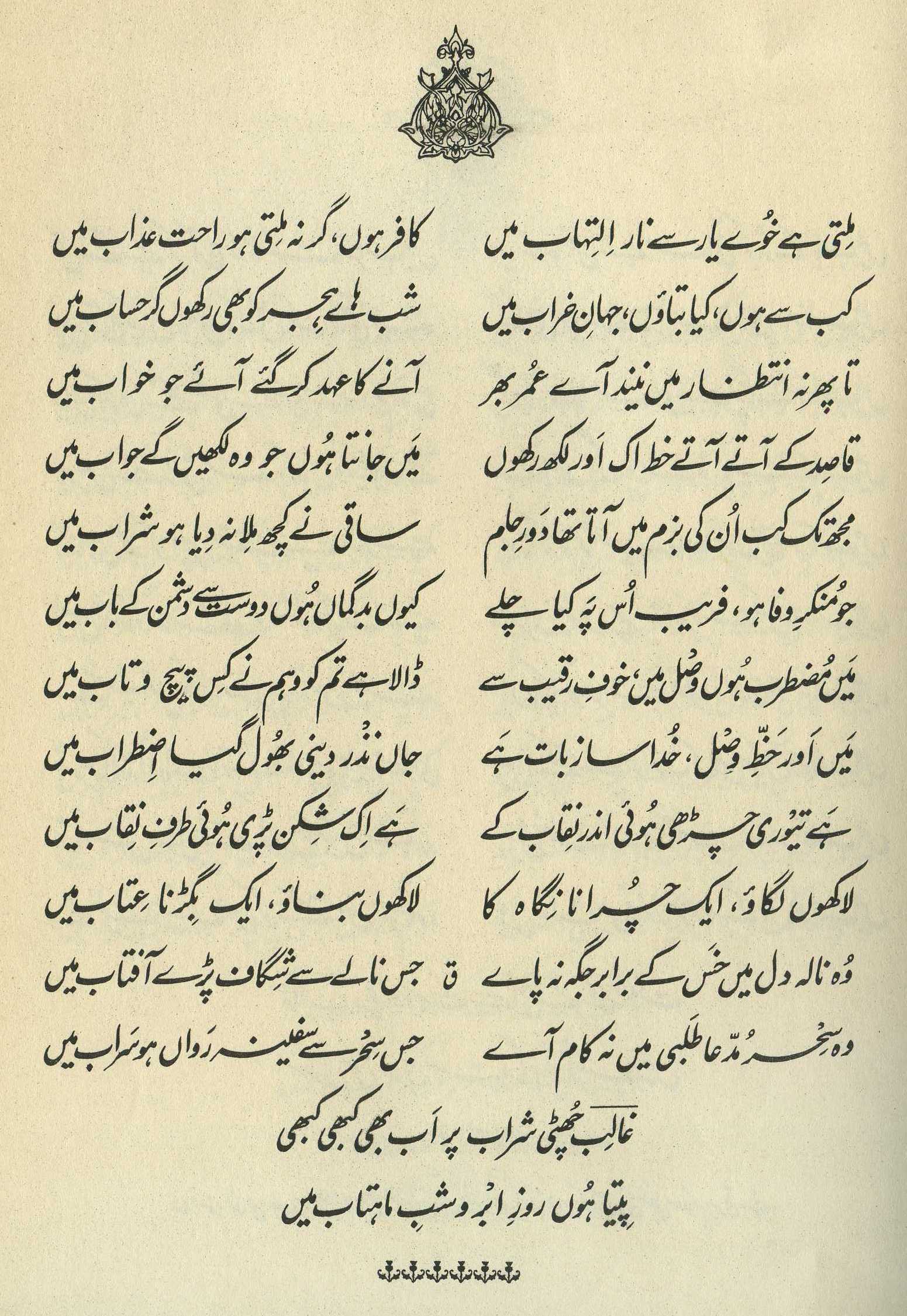
After the Rebellion [of 1857], when his pension had been cut off and he hadn't received permission to attend the [British] darbar, Pandit Moti Lal ... came to visit. There was some talk of the pension. Mirza Sahib said, 'In my whole life, if there's any day when I haven't drunk wine, then I'm an infidel []; and if I've done the prayer one time, then I'm a sinner []. So I don't know how the Government has counted me among the rebel Muslims!'
==Urdu text: Yadgar-e Ghalib , pp. 75-76
==Azad's version: Pritchett and Faruqi , p. 508
That is, to burn me and rain down fire on me was a trait of the beloved's too. Then why wouldn't I find pleasure in the torment of hellfire? The late Atish says,
[the sky is welcome to rain down a shower of swords
the new moon created the curve of your curls] (98)
== Nazm page 98

Because of fire's quality of burningness, he has used it as a simile for the beloved's temperament. Thus only on the basis of this similarity I find comfort in the torment of hellfire. (86)
When fire flares up, then it creates the splendor of the beloved's blazing with wrath. If there would be no rest in the torment of hell, then consider me an infidel. That is, when the beloved's coquetry is in hellfire too, then what does it mean to say that the lover suffers from this? He finds comfort. He has shown the limit case of love. (193-94)
This ghazal and the next one, 98 , are formally identical, making them a 'double ghazal' []. Some editions of the divan even treat {98} as a continuation of this ghazal; on this see 98,1 . For extensive discussion of these issues, see 15,1 .
Above all, this verse is based on a cleverly inverted use of a common idiom. At the beginning of the second line, 'I'm an infidel if--' [] seems at first to be an ordinary kind of emphatic oath, like 'Damned if--' in English (which is actually short for 'I'm damned if', though many people may not even notice this bit of lost history). But as we take in the rest of the line, we realize that Ghalib has done one of his tricks. To swear 'I'm an X if...' suggests that the person is not only not an X, but also wouldn't dream of being one. To swear that he would be comfortable in hell, the speaker has said, essentially, 'I'm an infidel, if I wouldn't be comfortable in hell'. The implication of which is, 'Since I'm most definitely not an infidel, I definitely would be comfortable in hell'.
But why would someone who's definitely not an infidel be content to envision himself in hell at all-- much less to claim that he'd be comfortable there? After all, though infidels may by definition be uncomfortable in hell (since that's the purpose of the place), surely a good Muslim would, also by definition, be uncomfortable in hell (since it's a state of perpetual Divine rejection and punishment). So where does that leave the speaker? Ghalib has created a paradox -- he's made another of his 'Catch-22' feedback loops, and since we can't very well get out of it, all we can really do is relish his cleverness.
Hali's anecdote shows Ghalib entertaining his friends with exactly the same twisted, paradoxical-sounding use of the same idiom, and the same kind of word/meaning play. He says that if he hasn't drunk wine, he's an infidel. But of course if he has drunk wine, this too is infidel behavior. And he says that if he's done the prayer even once, then he's a sinner. But of course if he done the prayer even once, then he's a much bigger sinner, or even an infidel! What a treat it would have been to have known him.
Two occurrences of , one in each line-- and each with a different meaning. Especially piquant is the direction of comparison in the first line. It's not that the beloved's temperament is hot like hell-- rather, hellfire is hot like her temperament. There are a number of verses that make witty use of such comparisons, which are fundamental to how the ghazal universe works.
In the ghazal universe, the lover and beloved are always cosmically primary, and the mere forces of nature and history and the physical world are emphatically derived from lover and beloved alone. Perhaps 219,3 is the most amusing-- in it Adam's disgrace at being kicked out of Eden is compared (to its disadvantage) with the much more memorable disgrace of the lover's being kicked out of the beloved's street. And there's the very appropriate 62,8 , in which every day one of the lover's blazing wounds appears as a (or the?) sun.
graphics/hellfire.jpg