Verse 81852aa;Naur
G13
1
people are mistaken/deceived about the world-burning sun
2
every day I show a single/particular/unique/excellent additional/different hidden scar/wound
'as last member of compounds), part. adj. Burning, inflaming, kindling; shining, irradiating; turning, twisting, folding'.
'Deceit, deception, delusion; blunder, mistake; disappointment, baulking; doubt, hesitation'.
'One, single, sole, alone, only, a, an; the same, identical; only one; a certain one; single of its kind, unique, singular, preëminent, excellent'.
'A mark burnt in, a brand...; scar, cicatrix; wound, sore; grief, sorrow, misfortune, calamity; loss, injury, damage'.
'And, also, for the rest, besides; again, moreover; but, yet, still; over, else; ...another, other, different; more, additional'.
| References | |
|---|---|
| Arshi, Imtiyaz Ali | Ghazal# 65 |
| Raza, Kalidas Gupta | 424 |
| Hamid Ali Khan | Open Image |
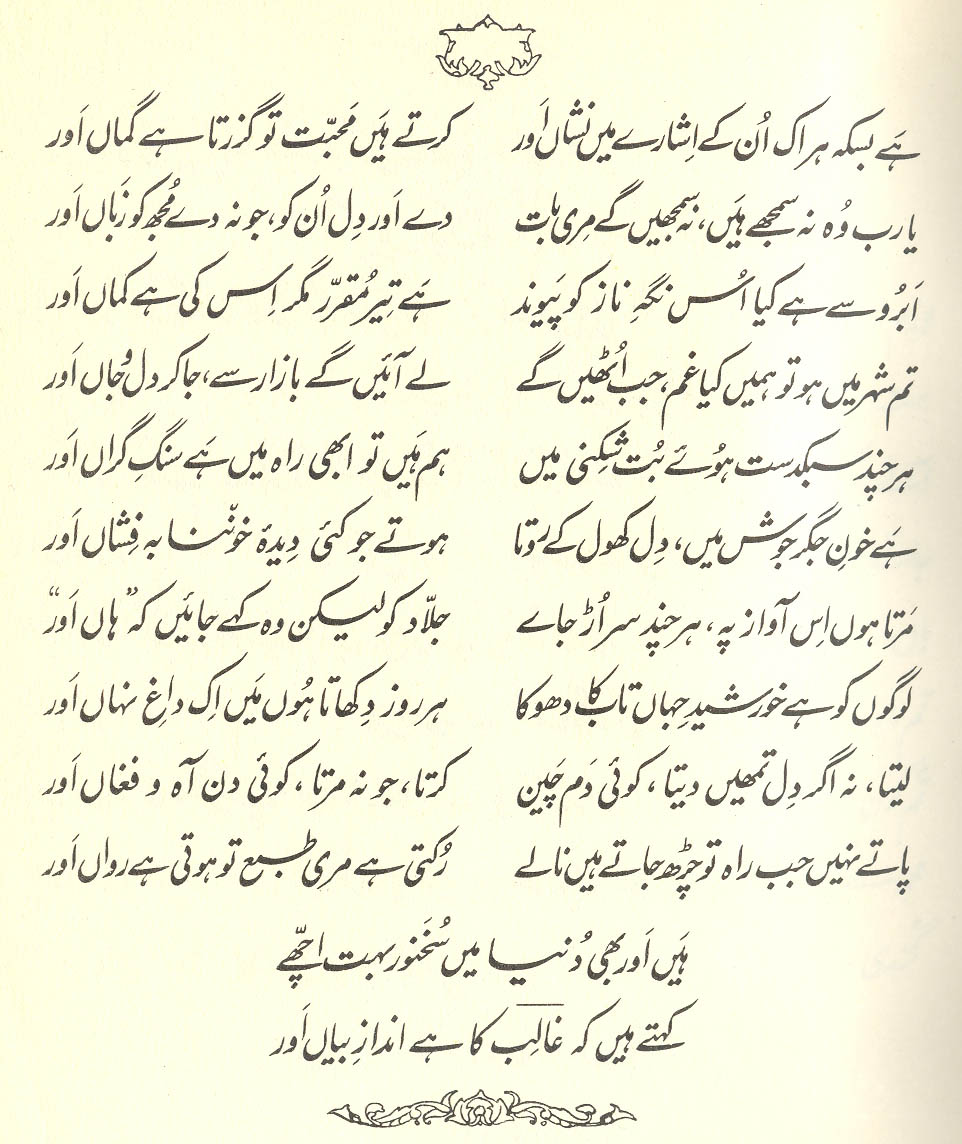
Every day I reveal one more hidden scar/wound, which people erroneously think to be the rising of the sun. And they consider that what they see emerging is the sun. (63)
== Nazm page 63

He says, thousands of scars/wounds are hidden in my heart and liver. From among those scars/wounds, every day at dawn I show people a new scar/wound. People think that the world-illumining sun has, as usual, risen in the east. (110)
That is, every scar/wound in my heart is a sun. (143)
In the first line we learn that people make a mistake, or are deceived, when they think they see the 'world-burning sun'. But what kind of a mistake is it? As so often, we can't tell, under mushairah performance conditions, until we get to hear the second line. Then, here as so often, Ghalib has carefully framed several possible mistakes, all of them amusing, and all of them triggered by the information in the second line.
People think they see the sun rising, but they're actually seeing 'one' of the speaker's scars/wounds []. And look at the elegance of in this situation! It can mean anything from the dismissive ('single, only'), through the particularizing ('a certain one'), through the generally descriptive ('singular'), to the boastful ('unique, excellent'); see the definition above. Furthermore, every one of these meanings works most enjoyably with some or all of the various possibilities of the verse.
Why are people fooled in this way? Because every day the lover brings a new scar/wound out from hiding and reveals it, the way the sun rises every day. The line of the scar/wound suggests the glowing line of the rising sun at dawn. (For more on this 'crack of dawn' motif, see 67,1 .) And his scar/wound is blazing like fire, because his heart is a hotbed (literally) of flaming passion. So people are dazzled by the intense light and heat, and naturally mistake his scar/wound for the sun itself. Probably people also make this mistake because the real sun is nothing much compared to the lover's scar/wound. (This verse belongs to the 'snide remarks about the natural world' set; for others, see 4,8x .)
Or even more drastically, maybe there is no 'real' sun at all. Maybe the scar/wound of the lover's passion is all that heats and lights the world? If so, it's fortunate that his scar/wounds are innumerable, so that a new one can be revealed every day and the world won't be left in the dark and cold. Thus what people call the 'sun' is only one of the lover's scars/wounds. (Similarly, perhaps we owe the blooming of the rose entirely to the crazed behavior of the Nightingale, as in 33,3 ; or the liveliness of the bazaar, to the lover's fiery breaths, as in 222,3x .)
Or else, in another and more amusing kind of mistake, curious people come to visit the lover and see his by-now-legendary scars. He shows an additional/different [] one every day, as a kind of morbid tourist attraction. Whenever he unveils one of them, people are so overwhelmed and dazzled that they invariably mistake it for the sun itself. He has to calm then down and provide them with dark glasses, and explain their error. For another example of the scars/wounds in the heart as tourist attractions, see 5,5 ; for a more cosmic instance, see 67,1 .
This is a tongue-in-cheek verse, of course, so exaggerated as to be comical. As hyperbolic as it is, I don't think it suffers from the grotesque quality of 62,6 . It's less off-putting to imagine someone as having an implausibly dazzling, glowing, burning scar, than as having a bunch of extra blood-raining eyes. But is there really any kind of consistent line that can be drawn here? Probably not. This is one of the many topics I'm thinking through as I go along.
For a similar verse of cosmic ambition by Mir , see M 7,10 ; and for an unfortunately bland one along the same lines, see M 770,7 . But consider too the delightful M 504,1 :
[the sky is not [dark-]blue, as you suspect
from the smoke of my liver, this whole roof is dark/black].
graphics/dawn.jpg