Verse 31852aa;Naur
G13
1 a
as if that glance of coquetry had a connection with the eyebrow!
1 b
does that glance of coquetry have a connection with the eyebrow?
2
it is certainly an arrow-- but/perhaps it has a different/additional bow
'Junction, conjunction, addition; connection, relation; relationship'.
'Certainly, assuredly, unquestionably, undoubtedly, positively, &c.'. (Platts p.21
'And, also, for the rest, besides; again, moreover; but, yet, still; over, else; ...another, other, different; more, additional'.
| References | |
|---|---|
| Arshi, Imtiyaz Ali | Ghazal# 65 |
| Raza, Kalidas Gupta | 424 |
| Hamid Ali Khan | Open Image |
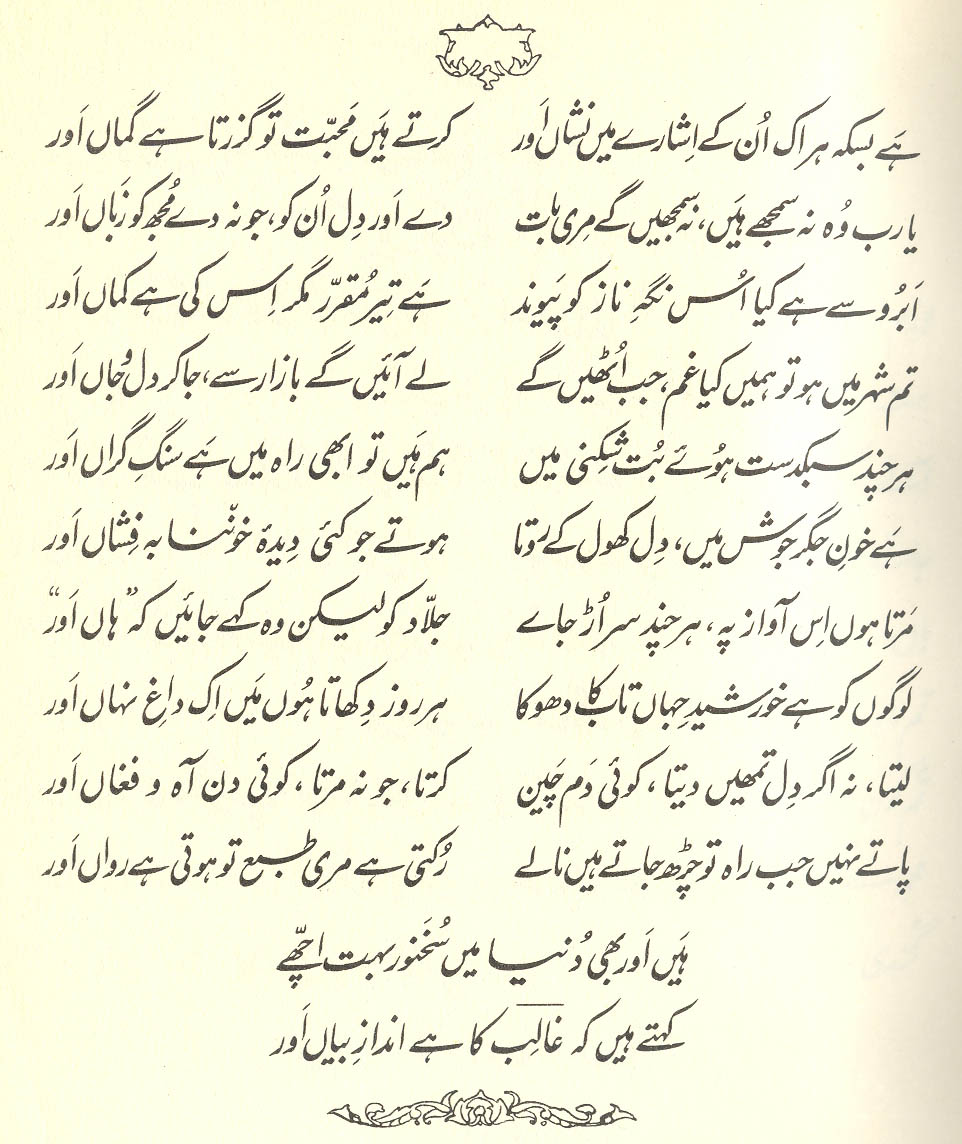
To call the eyebrow a bow, and the glance an arrow, is an old simile . The author has in this case made it fresh-- that is, the arrow of the glance does not come from the bow of the eyebrow. The heart-trickery of beauty exerts its energy upon it. (62)
== Nazm page 62

Considering the old simile of arrow and bow to be worn out, Mirza Sahib has taken a new tack. He says that her glance of coquetry has no connection with the eyebrow. That is, the glance of coquetry is certainly an arrow, but its bow is not the eyebrow. The arrow of this glance of coquetry strikes its target through the bow of the intention of the heart. Thus the wounds it causes are always of different kinds. Sometimes it makes the lover writhe with the happiness, sometimes is slays him with the arrowhead of anger. (109)
The glance is certainly an arrow, but this arrow does not come from the bow of the eyebrow. Rather, the niche [] of the lips is its bow. The arrow has no connection with the eyebrow. The author has created a new bow for the arrow of the glance. (141)
The speaker seems to be mulling over the usual 'glance = arrow' and 'eyebrow = bow' equations; while he accepts the former, he questions and/or rejects the latter. We can't be entirely sure, however, for the verse contains three separate layers of uncertainty. It poses a remarkably open-ended question, and doesn't even pretend to answer it.
First: thanks to the beauties of speech once again, the first line is a technically a question (1a); but it's one that can also easily be read, because of the multivalence of , as an indignant negative exclamation (1b).
Second: the second line makes use of the double meaning of as both 'but' and 'perhaps'. By no coincidence, the 'but' meaning goes perfectly with (1a), and the 'perhaps' meaning goes perfectly with (1b).
Third: can refer to an additional bow (as well as the eyebrow), or to an entirely different bow (ruling out the eyebrow).
Surely the heart of the verse, conceptually and also through its striking sound effects, is the juxtaposition , or 'certainly perhaps/but' in the second line. The speaker can speculate, he can have intuitions, but he remains in doubt.
Because after all, the speaker is talking about 'that' [] glance of coquetry, not just any old glance. It is so different from all the others-- how can it have come merely from the usual source, the arched eyebrow? Does it come from the beloved's curved lips, as Bekhud Mohani suggests? Does it come from her steely will, as she coolly pierces her prey with a single carefully-calibrated glance? Does it come from some irresistible or even divine source, bearing with it the power of fate and doom? The commentators seem sure of the source, but the verse itself insists on remaining enigmatic.
graphics/rainbow.jpg