Verse 101852aa;Naur
G13
1
when they don't find a path/road, then rivulets/laments rise/ascend
2 a
when/if my temperament halts, then it moves along more/differently
2 b
when/if my [poetic] temperament halts, then it becomes more flowing
'A watercourse; channel (for water), a ravine; a rivulet, brook, canal'.
'Complaint, plaint, lamentation, moan groan; weeping'.
tab((a>> : 'Nature, innate or natural disposition; genius; natural temper, temperament; idiosyncrasy; quality'.
'And, also, for the rest, besides; again, moreover; but, yet, still; over, else; ...another, other, different; more, additional'.
| References | |
|---|---|
| Arshi, Imtiyaz Ali | Ghazal# 65 |
| Raza, Kalidas Gupta | 424 |
| Hamid Ali Khan | Open Image |
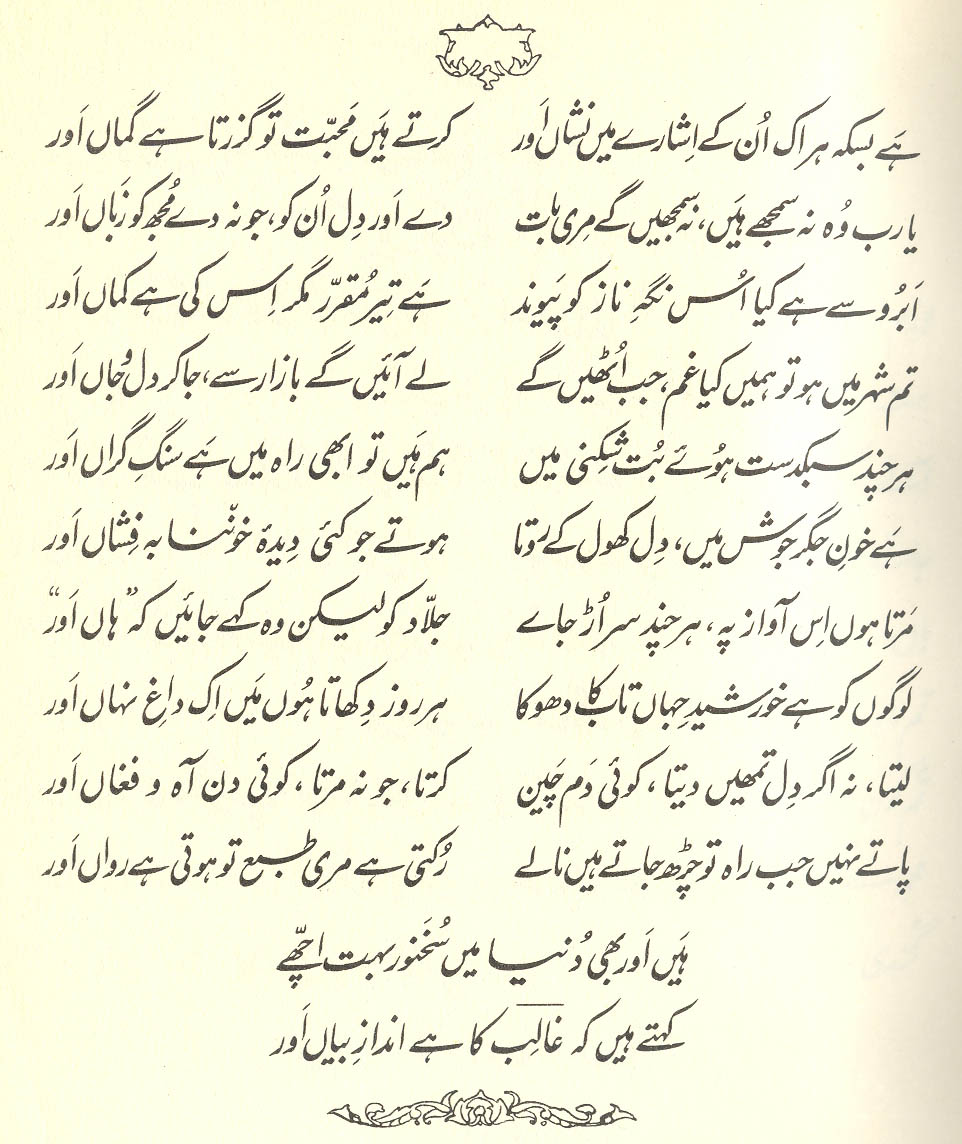
Laments, that is to say, river-like laments, not sighs and such. How appropriate the illustration is, and how suitably the theme is established! In fact, when because of suffering and grief and trouble the poet's temperament halts, to exactly that extent it makes way. Especially the theme that he writes according to his circumstances at the time-- it is extremely effective and pain-evoking.
==Urdu text: Yadgar-e Ghalib , p. 145
That is, when the temperament starts to move again after being halted, then it moves more strongly. The way when a risen stream finds a path, it flows with a great deal of force; the meaning is one of comparison: that is, compared to formerly, there is more flowingness . (64)
== Nazm page 64

When flowing streams don't find a path, then they become even fuller; and in that situation, wherever they find a path they flow with great force. He says, when after some days of non-production my temperament is moved to compose poetry, then more force is created in it. Then I compose-- and I compose well. (143)
He's used a flowing river as a simile for his flowingness of temperament. (147)
Compare 58,1 . (203)
The first line is heard most readily as describing the behavior of water in confined spaces: it's an obvious fact that when water-channels are blocked or dammed, the water level in them rises. Only after hearing the second line-- an event, in mushairah performance practice, that's delayed as much as is conveniently possible-- do we recall that is the plural form not just of , or 'watercourse', but also of , or 'lament' (see the definitions above).
Both meanings are quite clearly activated. After all, or lamentation can itself consist of 'weeping', which effectively equates laments with water. When streams [] are dammed, their level rises; when the speaker's laments [] are blocked, they 'rise' (in level? in volume? in power?). For other such tours de force, see 120,3 .
In addition to the marvelously contrived superimposition of and , the first line is also full of sounds, while then resolves itself into , so that the line has a strong, repetitive rhythm.
The second line can be read in two ways. 'Temperament' [] can mean either what we would think of in English ('personality, disposition'), or a specifically literary capacity, such that it's assumed to mean 'poetic temperament'. It is in this sense that (2b) is appropriate, for ' flowingness ' [] is a term used for verses with a certain musical quality. And of course, just to complete the word- and meaning-play, 'flowingness' as a literary term was derived from a quality of water in the first place.
Like the previous verse, this one consists of two parallel-seeming abstract statements, with no indication as to how to connect them to each other; for more on this pattern of parallelism , see 22,5 . We might take the two lines to be describing the same situation, in which case the pleasure lies in the equation of something as specific as 'laments' with the lover's whole 'temperament', through the mediation of water imagery. For after all, what else does the proper lover need in his temperament except an inexhaustible capacity for laments? His poetry too would ideally consist of nothing but versified lamentations.
Or we might take the two lines to be describing two different, but similar, situations. When streams are dammed, the water pressure rises; when laments are blocked, the person lamenting becomes even more desperate, aggrieved, and determined-- he redoubles the force of his complaints (1). Similarly, when the speaker is blocked or thwarted, his temperament gets moving again (2a)-- but how? Either with 'more' of the same kind of movement, or 'differently', with some other kind (what kind?) of movement. Or else when he encounters a (literary? romantic?) setback, his poetic temperament displays even more 'flowingness' than before (2b).
graphics/swiftstream.jpg