Verse 51852aa;Naur
G13
1
{although / however much} we became dextrous/'light-handed' in idol-breaking
2
if we exist/'are', then even/also now in the road is a different/additional heavy stone
'Although, even if, notwithstanding; --how-much-soever; howsoever; as often as'.
'Light (not heavy); light-footed, expeditious, active, nimble; light, frivolous'.
'Even now, yet, as yet, still'.
'Heavy, weighty, ponderous; great, important, momentous; difficult; burdensome, grievous; —precious, valuable; dear, expensive'.
'And, also, for the rest, besides; again, moreover; but, yet, still; over, else; ...another, other, different; more, additional'.
| References | |
|---|---|
| Arshi, Imtiyaz Ali | Ghazal# 65 |
| Raza, Kalidas Gupta | 424 |
| Hamid Ali Khan | Open Image |
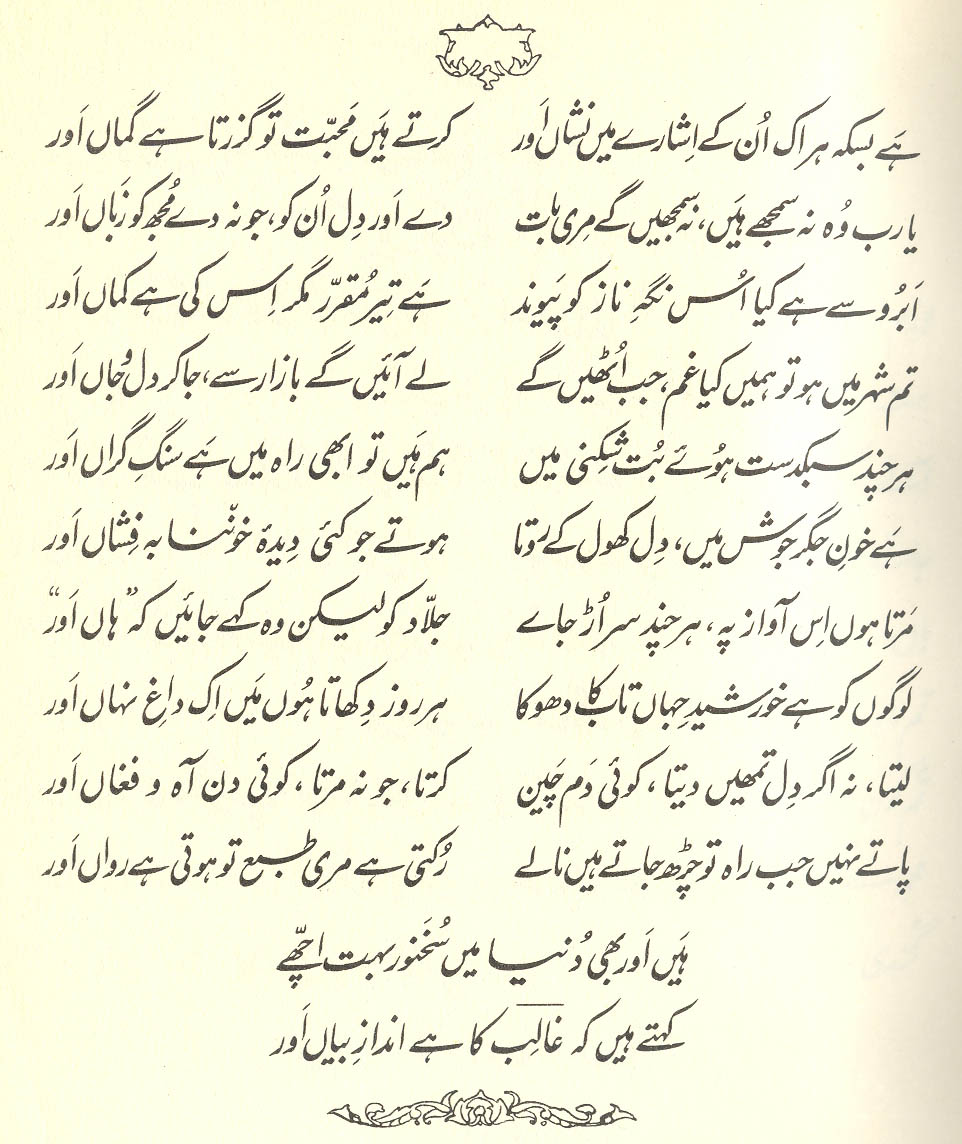
In this verse the whole emphasis is on the word 'we'. That is, as long as our existence remains, so long will there remain one more heavy stone obstructing the path of mystical knowledge of the divine. Thus, if we have obtained dexterity in idol-breaking, what's the benefit? A big heavy stone-- that is, our existence-- is still present.
==Urdu text: Yadgar-e Ghalib , p. 144
== Nazm page 62

As long as pride and arrogance and ego are present, then not to speak of a knower of mystical knowledge, one cannot even become a human being. (142)
This meaning [of Hali's] is very fine. But from emphasizing , one more subtle meaning appears: that our existence by its very nature claims a hundred roads-- or rather, keeps on drawing towards itself the obstacles in the road. Even if we've broken some idols, then so what? We are here, and as long as we are, more heavy stones will keep rising up to block the road. That is, from the point of view of Hali's commentary the theme of the verse is, how can the level of oblivion be obtained? And according to the present commentary, the theme is that man is inherently inclined to err. As long as he is human, he will keep drawing to himself obstacles in the road to truth. Humans are by nature sinful; their very existence guarantees that their path of progress will remain blocked.
== (1989: 76) 2006: 92
For more on , see 59,7 .
The delight of this verse centers on , '[if] we are, then'. At first glance, it looks like the cliche it is. It is read the way 'as long as we live' would be read in English, as simply a strong petrified phrase of duration ('As long as we live, we'll never forget such-and-such'). And the verse works that way very well, of course: 'As long as we live, we'll keep on finding stones in the road'.
But after a second look, what was once a mere duration-claim springs to life in its own right, offering (by implication ) a causal connection: as long as we live, there will be more stones in the road-- because we ourselves are the stones, or the source of the stones. (For more on such reactivation of a cliche, see 62,7 .) What a wry, dry, amused comment! Can anyone read this verse without an inner (rueful) smile of recognition?
Then of course there's the elegant wordplay of our becoming 'light-handed' [] at breaking 'heavy' [] stones/idols. In the ghazal world, idols are always made of stone. (Even if they're beautiful beloveds, they of course have hearts of stone.) Idols block our spiritual path, just as stones in the road block our physical path. Spiritual growth consists in recognizing and destroying one idol after another, as we move along the path toward the Truth; the parallel with travellers on a stony road works so well that it can all be done instantly, effortlessly, by implication.
As is the case throughout this ghazal, is also made to work brilliantly. As long as we are alive, there is always in the road one heavy stone . Is that an 'additional' heavy stone, merely the latest in a long series? Or is it a 'different' heavy stone, such that we routinely break all the others but find that the stone of our life can only be broken by our death?
Although the verse uses some Persianized vocabulary and an , most of the words in it are short and colloquial. It feels unforced, natural, flowing . Yet it's so provocative, so inviting to mull over, so entertaining to say aloud. In the whole firmament of world poetry, there can't be many geniuses like Ghalib. And of course, he was lucky to have a genre like the ghazal at his disposal.
Note for grammar fans: Here's another case in which the Urdu and English tenses don't quite overlap; for more on this, see 38,1 . In English, in view of the present-tense location of the second line, in the first line we'd more colloquially say 'we've become'.
graphics/heavystone.jpg