Verse 91852aa;Naur
G13
1
if I hadn't given you my heart, I would have taken a few breaths/moments of ease/rest
2
if I hadn't died, for a few days I would have made additional/other sighs and groans
'Ease, comfort, relief, repose, rest, quiet, calm, peace, tranquillity '.
'Cry of pain or distress, wailing, groaning, lamentation, complaint; clamour'.
| References | |
|---|---|
| Arshi, Imtiyaz Ali | Ghazal# 65 |
| Raza, Kalidas Gupta | 424 |
| Hamid Ali Khan | Open Image |
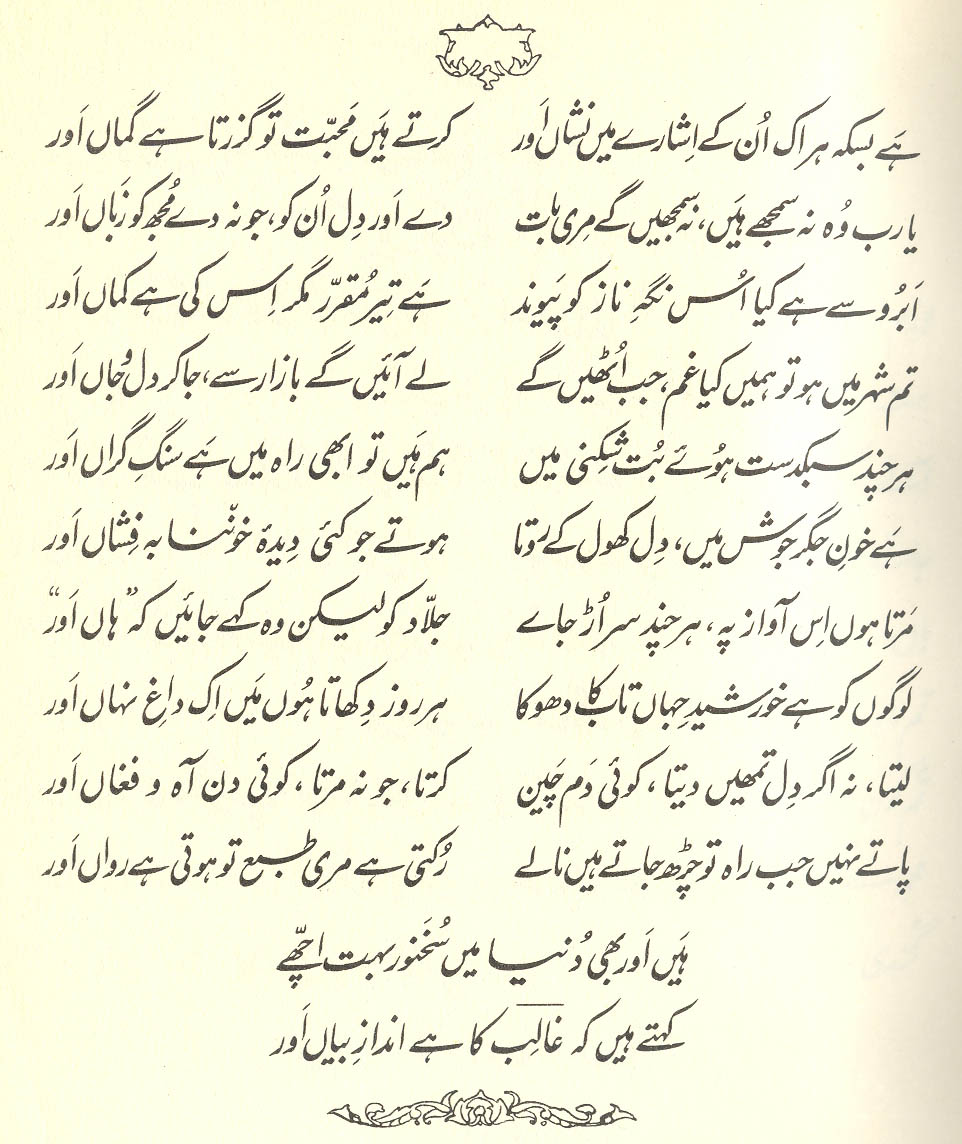
[1864, to Junun:] This is an extremely refined/pleasing utterance []. has a [grammatical] connection with , and is [grammatically] connected [] with . In Arabic, convolutedness of words and meanings [] are both flaws. In Persian, convolutedness of meanings is a flaw, and convolutedness of words is permitted-- in fact it is eloquent [] and agreeable []. Rekhtah is a reproduction [] of Persian. The result of the meaning of the two line s is that if I had not given you [my] heart, then I would have experienced peace for a few breaths/moments; if I had not died, then I would have sighed and groaned a few days more. (Arshi 204-05)
==Urdu text: Khaliq Anjum vol. 4, pp. 1513-14
==another trans.: Russell and Islam , p. 301
==another trans.: Daud Rahbar , p. 266
But from the point of view of meaning, one ought to go against grammatical order here, and he has caused and necessarily to be understood in a way that increases their meaningfulness. That is, now the word order establishes the meaning that it's as if the beloved has said to him, 'You never experience even a few breaths/moments of peace, and now you are heaving fewer sighs'. In answer to that, there is this verse. (63)
== Nazm page 63

The beloved asks Mirza Sahib, 'Why don't you remain even briefly at peace, and why do you always lament?' In reply, Mirza says, [this verse]. Despite the complexity of word order [] (which the Persianists have declared to be permissible), both lines have become extraordinarily enjoyable and meaningful. (110)
Both lines are in one style and of one glory, and this is the style of speech that no one before Mirza had ever adopted in Urdu. (143)
SETS == PARALLELISM
SOUND EFFECTS: 26,7
When Ghalib boasts about this verse, what he's proud of is the refinement of its feats of connection : he shows how he has separated compound verbs that should be together, thus performing an 'inversion' [] of normal word order. For further discussion, see Faruqi on M 1723,1 .
When we read we at first think the two verbs taken [] and given [] are parallel, as they so often are: if the speaker hadn't 'given', he would have 'taken'. Not until the very end of the line, when we encounter , do we realize that the 'taking' would really have been almost nonexistent-- all that would have been 'taken' was a bit of peace (as in the English 'take comfort'), and that too for only a few 'breaths/moments' [].
Similarly, especially after seeing and , when in the second line we read we tend to take the two verbs as psychologically opposite-- if the speaker hadn't 'died', he would have 'done' something or other. Not until we reach the end of the line do we realize that the 'doing' too, like the 'taking', would really have been almost nonexistent -- all he would have 'done' is heaved a few extra sighs and groans [].
Thus according to Ghalib's account, the pleasure of the verse rests on the strategic placement of (vs. ) and (vs. ), both widely separated from their proper grammatical and semantic other halves. Of course, these new juxtapositions offer the charms of strong internal rhyme and rhythmic, almost thumping sound effects as well. But surely the need to go back and enjoyably rethink the verse, reconfiguring it into a more subtle pattern, is a pleasure in itself.
Like a number of verses, this one consists of two parallel lines, with no indication of how to connect them; for more on parallelism , see 22,5 . Do the two lines describe the same situation, or two different situations? Perhaps the lover's giving his heart is basically equivalent to dying-- an equation that becomes plausible when we notice how readily taking a few breaths in peace can be compared/contrasted with heaving a few more sighs.
This verse recalls 20,1 -- if the lover had lived longer, it would have been more of the same old waiting around; but the main thing, union with the beloved, would never have happened, so what would have been the point of living longer? Similarly, in this verse, the lover's giving his heart was what sealed his doom. That having been done, what could possibly have been left of his life except a few sighs and groans more or less? For more examples of dead-lover-speaks verses, see 57,1 .
For more on the idiomatic , see 66,1 .
graphics/heartgift.jpg