Verse 11821aamere ba((d
G5
In this meter the first long syllable may be replaced by a short; and the next-to-last long syllable may be replaced by two shorts.
1
Beauty became loosed/freed from the tug-of-war of coquettish-glances, after me
2
finally the people of tyranny/oppression are at ease, after me
'A sign with the eye, a wink; an amorous glance, ogling; coquetry, affectation.' (Platts 773)
'Repeated pulling; pulling backwards and forwards, or to and fro; jostling, hustling; bringing and taking away; command after command; commanding and countermanding; great unpleasantness, or grief, or pain; distraction, dilemma, perplexity, difficulty; struggle, contention, wrangle, squabble; attraction, allurement'.
'Once, one time, all at once; at last, at length'.
| References | |
|---|---|
| Arshi, Imtiyaz Ali | Ghazal# 57 |
| Raza, Kalidas Gupta | 330 |
| Nuskhah-e-Hamidiyah | 100-101 |
| Asi, Abdul Bari | 109-110 |
| Gyan Chand | 194 |
| Hamid Ali Khan | Open Image |
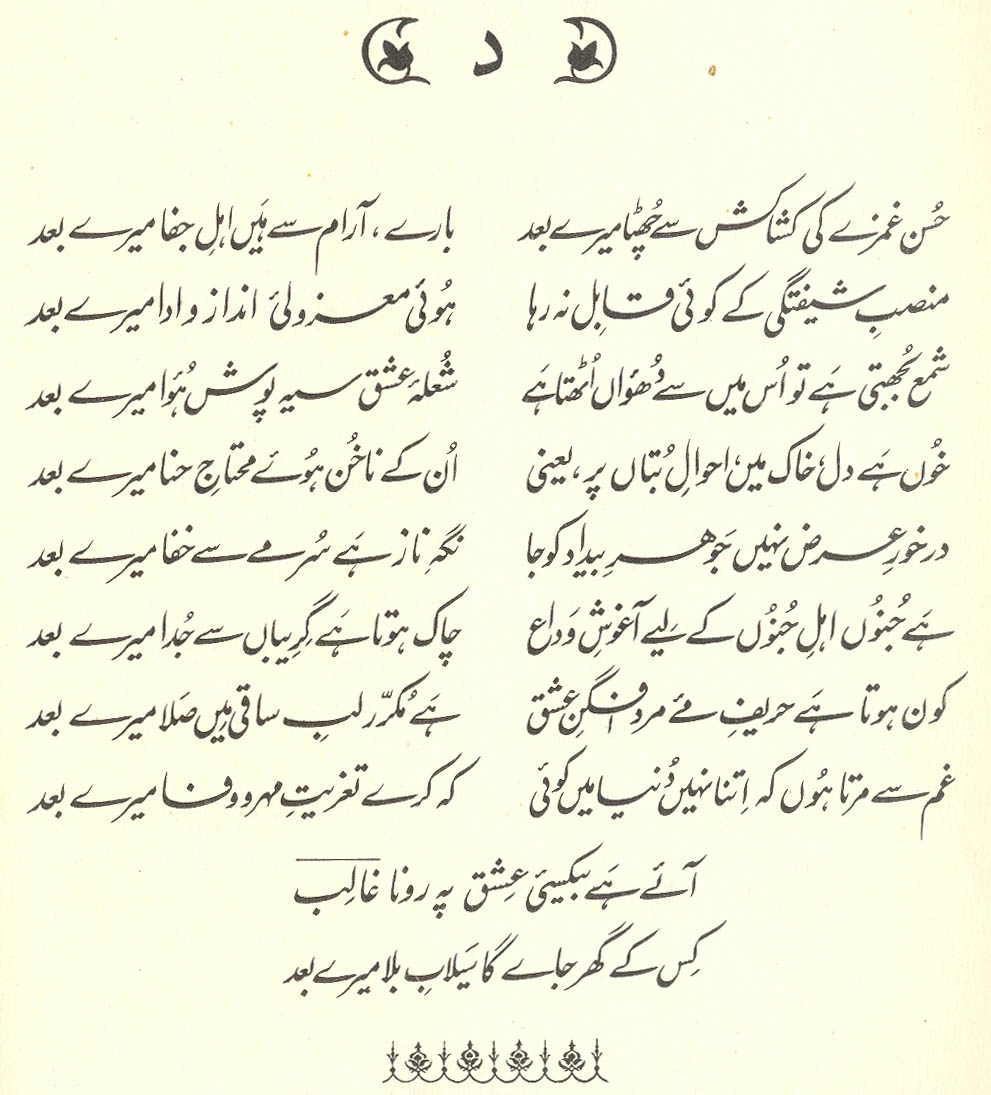
== Nazm page 51

He says, beauty was freed, after my death, from the tug-of-war of coquetry. Finally the cruel and tyrannical ones-- that is, all the beloveds-- became at ease. As long as I was alive, every beautiful one was ensnared in the expression of coquettish graces, in order to make me mad for her. (97)
After death, the lover says, I've died-- that was good. The cruel beloveds are at peace. As long as I was alive, coquettish glances didn't give the beautiful ones any peace. That is, after me, now there's not another lover left at all in the world upon whom the beautiful ones would shower the arrows of their coquettish glances. (123)
In Urdu very few ghazals are found, of which all the verses are continuous and which have been composed with excellence of arrangement [] about different aspects of one single theme . This ghazal of Mirza Ghalib's too is an extremely fine example of continuous verses. (202)
THE DEAD LOVER SPEAKS: This whole ghazal is spoken by the lover, somehow, after his death. This is really no more improbable than, for example, the lover speaking with equal matter-of-factness as a bird (see 126,5 ), or many of the other stylized premises on which the ghazal world is based. Other verses in which the lover speaks or thinks or has opinions after his death: 4,11x ; 8,4x ; 9,3 , on one reading; 9,7 ; 14,5 ; 16,3 ; 17,8 ; 20,9 ; 23,2x ; 32,2 ; 46,6 , on one reading; 51,3 ; 52,1 ; 53,4 ; 57 , ; 62,9 ; 67,1 ; 72,3 ; 76,6x ; 79,3x , on one reading; 83,1 ; 87,7 ; 115,9 ; 121,5 ; 158,4 ; 165,3 ; 175,1 ; 179,4 ; 202,6 ; 210,6 ; 210,7 ; 217,5 // 356x,11 ; 356x,12 ; 434x,6
With a refrain like , 'after me', this ghazal is bound to have a certain degree of semantic unity. Mihr wants to classify it as a continuous ghazal, but perhaps that's a bit too strong. For if the verses were rearranged, or some added or subtracted, we wouldn't be able to detect the fact (except in the case of the opening-verse and closing-verse , of course, for formal reasons). Thus it's clear that the ghazal has no narrativity or ongoing, sequential internal organization, which is usually part of the definition of a continuous ghazal.
In a ghazal with a melancholy refrain we might expect a generally melancholy tone as well, but Ghalib is never melancholy for long. Here he wittily represents the flirtatious exchange of glances as a tug-of-war, a -- a word with a wonderfully elaborate series of meanings, all of them delightfully appropriate here (see the definition above). The lovely ones, personified as 'Beauty', no longer need to undergo this tension and stress now that the lover is gone; they can be at peace. Even the leisurely assonance of seems to suggest the repose that Beauty will now enjoy.
The lover speaks from beyond the grave, solicitously reflecting on the greater relaxation the beloveds will enjoy in his absence. The grandiose implication, of course, is that there are no worthwhile lovers left on the face of the earth, now that he is gone. Every verse in this ghazal is similarly grandiose, in the same style. Not a single one takes the equally hyperbolic tack of imagining extreme neglect, as in 7,7 .
Of course, we know the beloved will no more be happy without a lover than a tiger would be content to forego the 'tension' of hunting down its prey. And surely the lover knows it too. So there's a little flavor of sarcasm and self-mockery-- and mockery of the beloved, to add spice to the verse.
graphics/flirtation1.jpg
graphics/flirtation2.jpg