Verse 71821iinah hu))aa
G5
In this meter the first long syllable may be replaced by a short; and the next-to-last long syllable may be replaced by two shorts.
1
I/he died from the shock of a single movement of the lip, Ghalib
2
from weakness, I/he did not become {equal to / a withstander of} the breath of Jesus
'A fellow-worker (in one's craft or ordinary occupation), an associate, a partner, a mate; —a rival, opponent, adversary, antagonist; an enemy'.
| References | |
|---|---|
| Arshi, Imtiyaz Ali | Ghazal# 7 |
| Raza, Kalidas Gupta | 321 |
| Nuskhah-e-Hamidiyah | 40 |
| Asi, Abdul Bari | 55-56 |
| Gyan Chand | 62-63 |
| Hamid Ali Khan | Open Image |
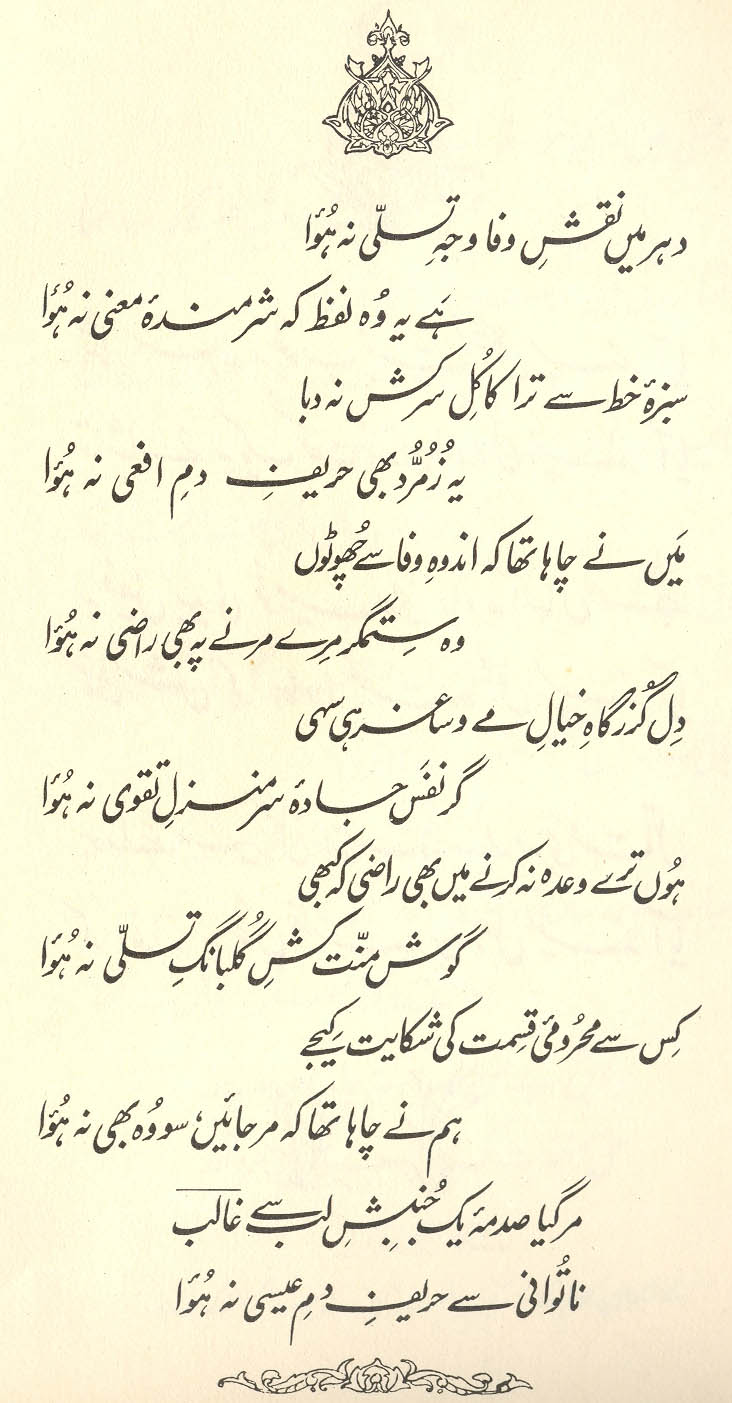
In this verse, the subtle point of meaning is that the poet considers the movement of Jesus's lip to override the effect of the voice of Jesus. He says, I died from the shock of the very first movement, and was not equal to the breath of Jesus; that is, I had no encounter with the breath of Jesus, and because of my weakness I had no chance to hear the voice of Jesus. (10)
== Nazm page 10

Urdu text: Vajid 1902 {9}
By 'breath of Jesus' here ... the voice of the beloved is intended. (18)
Shaukat Merathi writes that in this verse, by 'Jesus' is meant the beloved, not the Messiah. But in the verse there's no indication of this. With regard to convention, the beloved is certainly called the Messiah, but this meaning doesn't necessarily appear everywhere. The more important point is that before the breath of the Messiah, or of Jesus, or because of it, for death to come, is not a new theme . Dard has an extremely powerful verse:
[at the hands of my fate, I am a wound
oh breath of Jesus, I am an oil-lamp]
The breath of Jesus is life-giving, but sometimes it can also be deadly; through Mir Dard's miracle of poetry, I have provided such a proof that one cannot help but have faith....
By comparison, Ghalib's verse seems weak, and the theme too is shopworn (that is, the lover's weakness and frailty). But [Nazm] Tabataba'i has made a good point: that the poet considers the movement of Jesus's lip to override the effect of the voice of Jesus. That is, the lip had scarcely moved when the lover was finished off....
[Concerning the problem of the rhyme -word,] Arabic words ending in have been pronounced in Persian not only that way, but also with . Ghalib has here imitated the Persian usage. Thus in this ghazal the rhymes will be read as and ((iisii .
== 2006: 41
As so often in mushairah verses, from the first line we can't tell what's going on. Could the beloved be about to say something to the lover, something exceptionally cruel or kind? Could she even be about to kiss him? Could he himself be about to say something, and struggling to move his lips? Even when we are finally (under mushairah performance conditions) allowed to hear the second line, the punch-word that alone permits us to understand the verse is withheld until the last possible moment.
In Islamic tradition, the characteristic miracle of Jesus is to breathe on the dying or dead and thus restore them to life. The lover is so extravagantly weak, he has carried his passion so far, that he's more weak than Jesus's life-restorative power is strong. He's so weak that the tiny breeze of Jesus's breath blows out his flickering life, in a way that carries him beyond the possibility of revival. Thus the attempt at a cure is actually what kills him (as in 48,3 ). The effect is an enjoyably paradoxical 'catch-22' one: the lover can't live unless Jesus breathes on him, but if Jesus breathes on him then he dies.
This verse is a member of the 'dead lover speaks' group; for others, see 57,1 . It's true that 'Ghalib' could be the subject in the first line, so that somebody else could be reporting Ghalib's death; but the remote placement of the 'Ghalib', and the strong tradition of self-address in the closing-verse , make this a secondary (and much less powerful) reading.
Note for fans of metrical technicalities: This verse has been criticized for its 'audacity' with the rhyme -word. The criticism is understandable: basically, it doesn't rhyme. In the word , the at the end is really only a bearer of a dagger . The name is thus pronounced as though it ended with , not . To use it as a rhyme-word in this ghazal is really a remarkable liberty to take; but as Faruqi points out, it's based on earlier Persian usage. As Nomanul Haq pointed out in a meter workshop at Penn (October 2005), everybody takes liberties in the opposite direction, using rhyme-words of varying spellings if they have (more or less) the same sound. This verse is an unusual example in which syllables of completely different sound have been harmonized only by archaic Persian usage and (apparent, not real!) spelling. For a similar case see 9,4 , in which has similarly been seemingly forced into being pronounced as .
graphics/jesus_akbar1600.jpg