Verse 11821iinah hu))aa
G5
In this meter the first long syllable may be replaced by a short; and the next-to-last long syllable may be replaced by two shorts.
1
in the world, the image/impression of 'faithfulness' did not become a cause for comfort
2
this is {such a / 'that'} word, that did not become ashamed/embarrassed before Meaning
'A painting, a picture; portrait; drawing; a print; a carving, an engraving, ... an impression; a stamp; a mark'.
'Consolation, comfort, solace; assurance; contentment, satisfaction'.
'Ashamed, abashed, shamefaced, bashful, modest, blushing'.
| References | |
|---|---|
| Arshi, Imtiyaz Ali | Ghazal# 7 |
| Raza, Kalidas Gupta | 321 |
| Nuskhah-e-Hamidiyah | 40 |
| Asi, Abdul Bari | 55-56 |
| Gyan Chand | 62-63 |
| Hamid Ali Khan | Open Image |
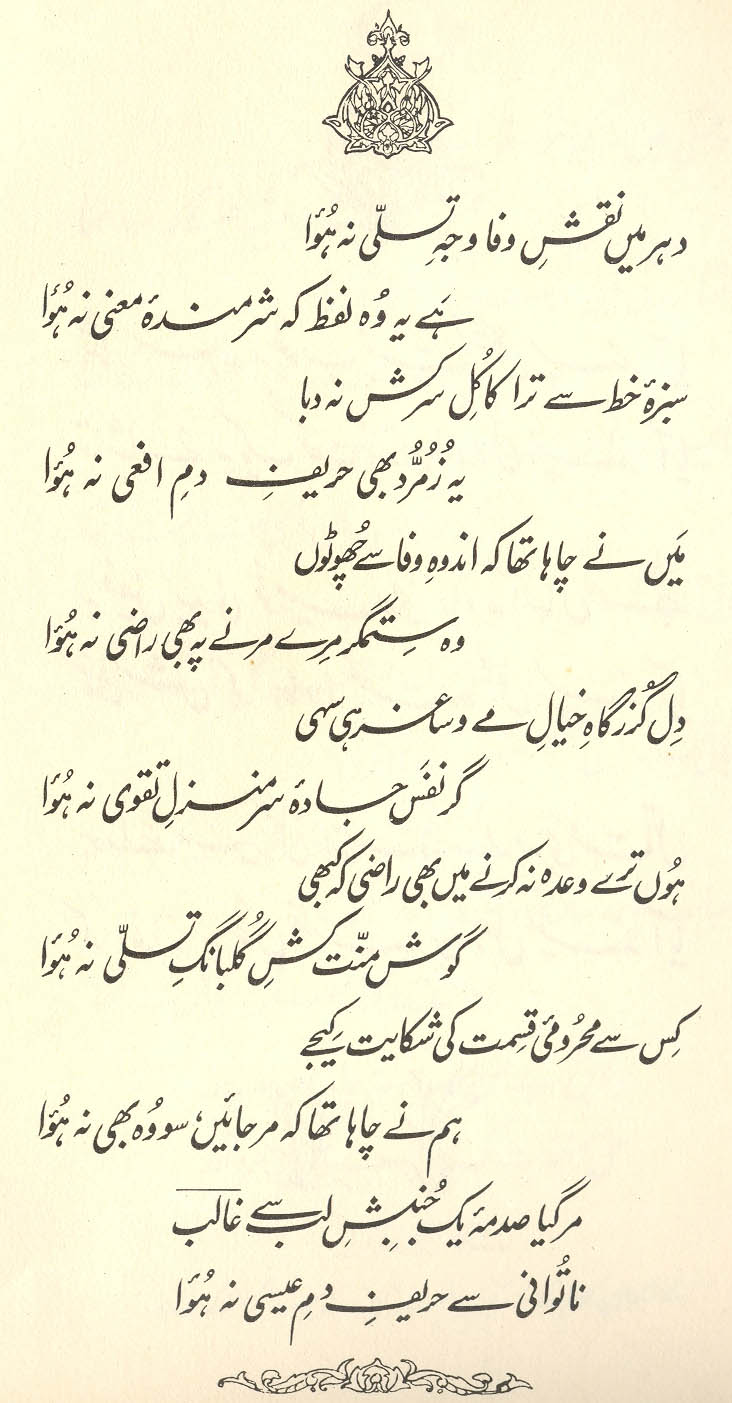
That is, when lovers in the world are faithful, it means that they want comfort. When they are faithful and don't receive comfort, then the word 'faithfulness' is left meaningless and vain. The conclusion is that lovers' faithfulness is a meaningless thing. (9)
== Nazm page 9

Urdu text: Vajid 1902 {9}
He says that when in the world people, through faithfulness, stamp the mark [] of faithfulness on someone's heart, it's as if they waste their time in a useless task. (21)
In the world, no peace could be gained from the word 'faithfulness'. This is the word which has never placed itself under obligation to meaning; that is, this is a meaningless word. (16)
For example, in 9,5 , the beloved's never speaking kindly to the lover means that his ear is not 'indebted' to good news. In 18,4 , Beauty is disgracefully 'pledged' to henna. In 39,4 , the lover rejoices in his freedom from to digestive fluid (yes, really). By contrast, 44,1 depicts Ghalib's poetry as available for free-- except for the weight of (indebtedness to) his kindness that the buyer must bear. More abstractly, 64,5 makes it clear that the path to one's ardently desired 'own truth/reality' requires confiding oneself to oblivion. In 92,4 the lover is glad that his lament does not 'abase itself' before 'Effect'-- which is to say, it has no effect. In 130,3 a door is described as 'bent over' under the weight of to the worker who made it, and the lover is enjoined not to accept favors from anyone. And in 148,5 the edict is laid down, in so many words, that one should accept only what comes 'from one's own existence', since one's own heedlessness is to be preferred to awareness borrowed from others. And so on; there are a number of other examples listed above.
This counsel of self-reliance at all costs, and non-beholdenness at all costs, is in a class by itself as an explicit principle that leaps out at the reader from Ghalib's poetry. In the whole of the divan , no other such principle appears, as far as I can see. And I certainly didn't go looking to find any such principles, including this one. I don't think any serious reader of Ghalib could fail to notice it.
There does actually seem to be a counterpart Mir ian attitude: a hatred of being 'mixed in' with others. For discussion and examples, see M 977,5 . Mir also scorns the doing of , as in M 15,6 .
According to the present verse, not only is there no faithfulness in the world, there's not even any real meaning for the concept. The word 'faithfulness' itself is not beholden to meaning-- it does not blush with the embarrassment or shame of indebtedness when it meets Meaning on the street. For a similar use of , see 9,5 .
The literal meaning of , 'shame-affected', works here to a fine double purpose. On the one hand, to avoid the shame of indebtedness sounds like a virtue. But then, why do all the other words have meanings, and 'faithfulness' is the single one that does not? And of course, by being devoid of meaning the so-called word/quality of 'faithfulness' is shameless-- in fact, entirely lost to shame.
Compare Mir's treatment of meaningless words: M 1370,5 .
graphics/dictionary.jpg