Verse 41816uusthaa
G1
1
how can I say/speak a description of the relief/freedom of/from the disease of grief?!
2 a
whereas/since/although I 'ate the heart's blood', I/it was without indebtedness to chyme
2 b
whatever I ate, it was heart's blood without indebtedness to chyme
'Freedom (from business, &c.), cessation (from work, &c.), finishing and ceasing (from), disengagedness, leisure, rest, repose; freedom from care or anxiety, ease, convenience, comfort, tranquillity, happiness; easy circumstances, competency, affluence, abundance'.
'Declaration, assertion, affirmation; explanation, exposition, description, relation, disclosure, unfolding, circumstantial indication or evidence; perspicuity, clearness'.
'Whichever'.
'Though, although... inasmuch as, whereas'.
'To suppress (one's) feelings, to restrain (one's) emotions, or anger, or grief, &c. -- to consume (one's own) lifeblood; to vex or worry (oneself) to death --to work (oneself) to death'.
'Affliction; concise speech'. (Steingass, p.488)
'The chyme'.
| References | |
|---|---|
| Arshi, Imtiyaz Ali | Ghazal# 31 |
| Raza, Kalidas Gupta | 160 |
| Nuskhah-e-Hamidiyah | 83-84 |
| Asi, Abdul Bari | 71-72 |
| Gyan Chand | 116 |
| Hamid Ali Khan | Open Image |
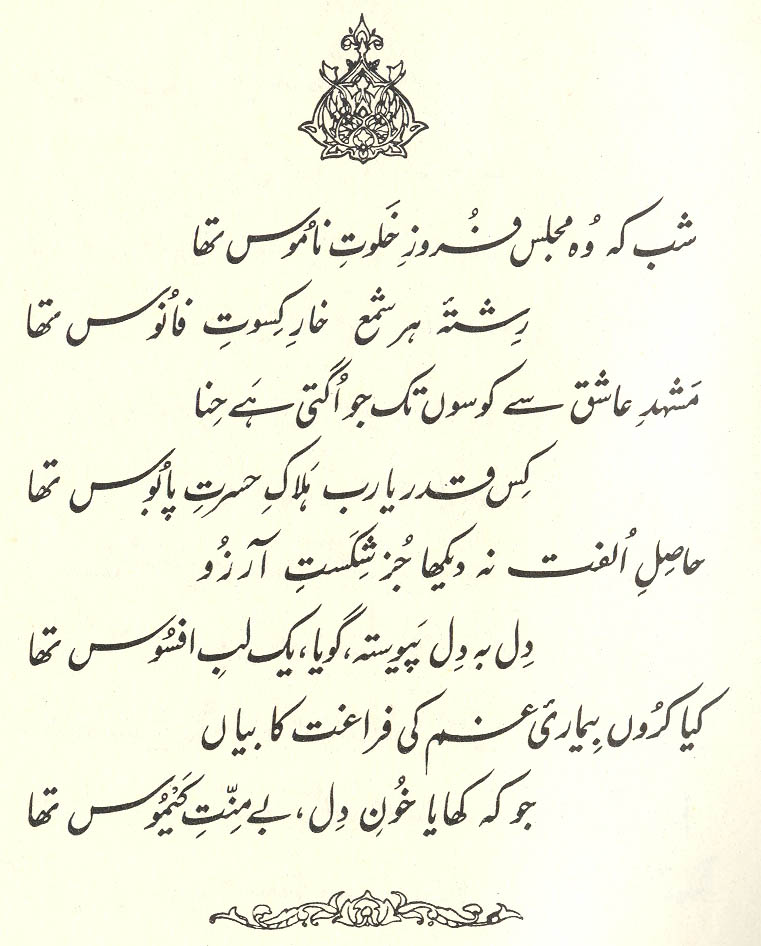
Whatever I ate, it was without chyme, and it became the blood of the liver, that is, our grief. I ate only the blood of the liver, and 'to eat the blood of the liver' is said on occasions of enduring grief and suffering. (38)
== Nazm page 38

Urdu text: Vajid 1902 {39}
Ghalib speaks of the relief of the illness of grief, that when drinking the heart's blood, he had no bother wrestling with chyme and such things, and just went on eating the blood of the liver. (40)
Mirza Sahib says, how can I sufficiently praise the relief of freedom from the illness of grief? Whatever I ate was without chyme, it became the blood of the liver. The meaning is that in the illness of grief, I always dined on the heart's blood. And 'to eat the heart's blood' is used on occasions of grief and anger. The second meaning that arises in this verse is that in the illness of grief I experienced such relief from care that whatever food I ate, it seemed that I was eating heart's blood. (75)
Before food is digested and turns into blood, in the first stage is assumes the form of , and becomes fire; after that in the second stage it attains the form of and becomes like water, and assumes the form of blood. (124)
In place of ([I] might say) there ought to be ([I] might do), and that would fit into the meter as well. Because they say [for 'to mention'] and not . (181)
In this verse Ghalib produced the theme of eating the blood of the heart; that is, this verse is an extremely fine example of his theme-creation .... he has decided that sickness of the heart is freedom itself, and the excellence of the verse is bound up with this inventiveness.
Along with theme-creation, the sarcastic style of expression is also worthy of praise. (372-73)
ABOUT : On the versatility of , see the two definitions above; in the second one, it replaces (see 53,8 ). For discussion of forms in general, see 12,2 .
The first line is , an exclamation about the impossibility of expressing-- what exactly? (For more on , see 15,11 .) Thanks to the multivalence of the , there are several possibilities:
=relief from the sickness of grief, for the speaker (he no longer feels sick with grief)
=relief provided by the sickness of grief, for the speaker (thanks to the sickness of grief, he's no longer indebted to chyme)
=relief for the sickness of grief itself (the sickness of grief feels itself helped and soothed)
The second line offers what seems to be information about the lover's digestive process. Because of the clever midpoint positioning of , there are at least two ways of reading it.
One possibility (2a): Since what the speaker ate 'was' (literally or metaphorically or both) heart's blood, there was no need for digestive fluids like chyme . As Nazm points out, an idiomatic expression (evoked, rather than precisely stated) underlies this idea: 'to eat the blood of the liver' means to suffer grief (see the definition above; on the significance of the liver in ghazal physiology see 30,2 ). The speaker lived on nothing but grief, and so found 'relief' from all worries about digesting his food.
Another possibility (2b): whatever the speaker ate 'turned into' heart's blood-- and without the intervening stage of becoming 'chyme'. His food turned directly into heart's blood, perhaps because he was losing blood so fast, through weeping tears of blood and so on, that every bit of energy had to be diverted at once to the front lines. His whole body had converted itself into an obsessively focused grief-expressing organism. He thus obtained 'relief' from the cares of normal life, including normal digestion.
But there's another sense in which the speaker obtained 'relief', and it's a particularly Ghalibian one. Ghalib develops throughout the divan a concept of , a dependent indebtedness that is always seen as humiliating. For a detailed discussion of this concept, with supporting evidence, see 26,1 . In Ghalib's poetic world, one should always be oneself and use only one's own unique, personal resources, even if they are deficient. Indebtedness to anything whatsoever-- even apparently to digestive fluid-- is a source of shame that one should find real 'relief' in avoiding.
And of course, the first line could be entirely sarcastic, depending on the tone in which it's read. 'What a relief-- now that I'm too sick to eat normally any more, I have no further worries about digestion!' But then, the un-ironic 'straight' reading always reappears. Because the lover is always headed straight for death, aimed like an arrow, and never regrets this fulfillment of his true destiny: for him death is the only real 'relief'.
graphics/foodmet.jpg
graphics/chyme.jpg