Verse 11854aanah hu))aa
G8
In this meter the first long syllable may be replaced by a short; and the next-to-last long syllable may be replaced by two shorts.
1
pain did not become indebted to medicine
2
I didn't become well/good; it wasn't ill/bad
'Kindness or service done (to); favour, obligation; --grace, courtesy; --entreaty, humble and earnest supplication; --grateful thanks, praise.'
'Under obligation, obliged'.
'To become or get well, to recover; to be healed or cured; to be in good health'.
| References | |
|---|---|
| Arshi, Imtiyaz Ali | Ghazal# 47 |
| Raza, Kalidas Gupta | 447-448 |
| Hamid Ali Khan | Open Image |
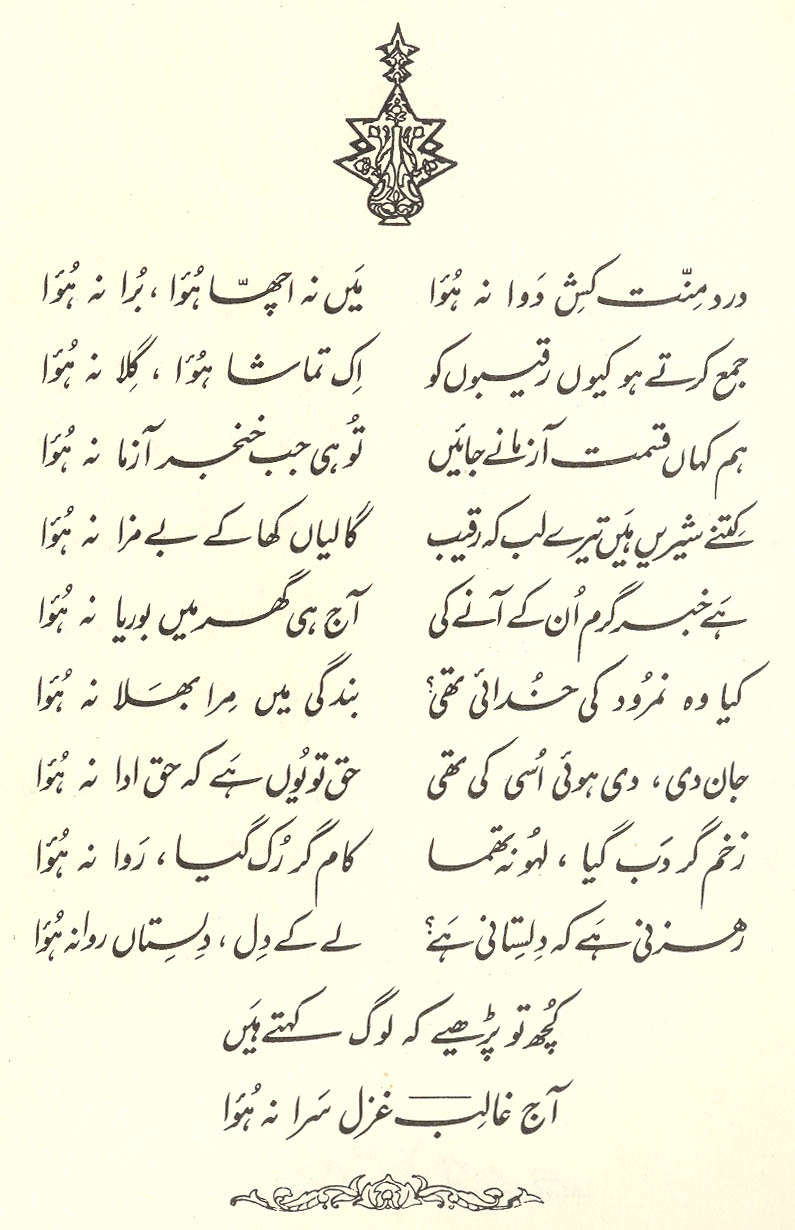
[1858, to Mihr:] I never kept my poetry with me. Navab Ziya ud-din Khan and Navab Husain Mirza used to collect it. What I composed, they wrote down. Now both their houses have been looted. Libraries worth thousands of rupees were destroyed. Now I long to see my own poetry. A few days ago a faqir, who has a good voice and is a fine singer too, found a ghazal of mine somewhere and got it written down. When he showed me that piece of paper, believe me, I felt like weeping. I send you the ghazal [{26}, verses 1, 2, 9, 5, 8, 4, 6], and as a reward for it I want an answer to this letter. (Arshi 192)
==Urdu text: Khaliq Anjum vol. 2, pp. 710-11
==another: trans.: Russell and Islam , p. 182
==another trans.: Daud Rahbar , pp. 88-89
This is not that 'good' that is the opposite of 'bad'; rather, 'to become good/well' means the abating of a disease. (27)
== Nazm page 27

Urdu text: Vajid 1902 {26}
If I had become well, then the pain of my passion would have been forced to be under an obligation toward medicine, and I didn't want to be indebted to anybody. For this reason, it turned out well that I didn't get well []. (53)
[See his commentary on 'opposition' [] in M 21,2 .]
The 'good/bad' wordplay makes for a fine, paradoxical-sounding second line that forces us to think about it for a moment or two before figuring out how to put it together with the first.
This verse is a particularly effective example of what might be called a genuine Ghalibian poetic notion-- namely, that it's shaming to take from others, to be indebted to them, and that this humiliating state is to be avoided as much as possible. (For more on this idea, see 9,1 .) Thus if the speaker didn't get well, he consoles himself by reflecting that at least his pain did not become indebted, , to medicine: it was not obliged to beg and plead, to bow and scrape, to give humble thanks for gracious favors.
AN ANECDOTE: In his youth, the famous Delhi Sufi pir Shaikh Nizam ud-Din Auliya (1244-1325) was a disciple of Shaikh Farid Ganj-i Shakkar of Pakpattan. He lived in Baba Farid's very humble establishment, which was run by the disciples themselves. Once while boiling a wild vegetable ('delah') that had been gathered from the jungle, he realized that there was no salt. He went to a grocer in the neighborhood and bought some salt on credit. When the dish was served, Shaikh Farid reached out to taste it, but then said, 'My hand has become heavier.... Perhaps there is something doubtful in it.' When he learned about the salt, he said, 'The darvesh prefer to die of starvation rather than incur any debt for the satisfaction of their desires. Debt and Resignation are poles apart and cannot subsist together.' Then he sent the dish away. [Source: Khaliq Ahmad Nizami, The Life and Times of Shaikh Nizam-u'd-din Auliya (Delhi: Idarah-i Adabyat-i Delli, 1991), p. 44.]
graphics/goodbad.jpg