Verse 21854aanah hu))aa
G8
In this meter the first long syllable may be replaced by a short; and the next-to-last long syllable may be replaced by two shorts.
1
why do you gather together the Rival s?
2
a single/particular/unique/excellent spectacle occurred, a complaint/reproach did not occur
'One, single, sole, alone, only, a, an; the same, identical; only one; a certain one; single of its kind, unique, singular, preëminent, excellent'.
is spelled to suit the rhyme .
'Complaint; lamentation; reproach, blame; accusation; remonstrance'.
| References | |
|---|---|
| Arshi, Imtiyaz Ali | Ghazal# 47 |
| Raza, Kalidas Gupta | 447-448 |
| Hamid Ali Khan | Open Image |
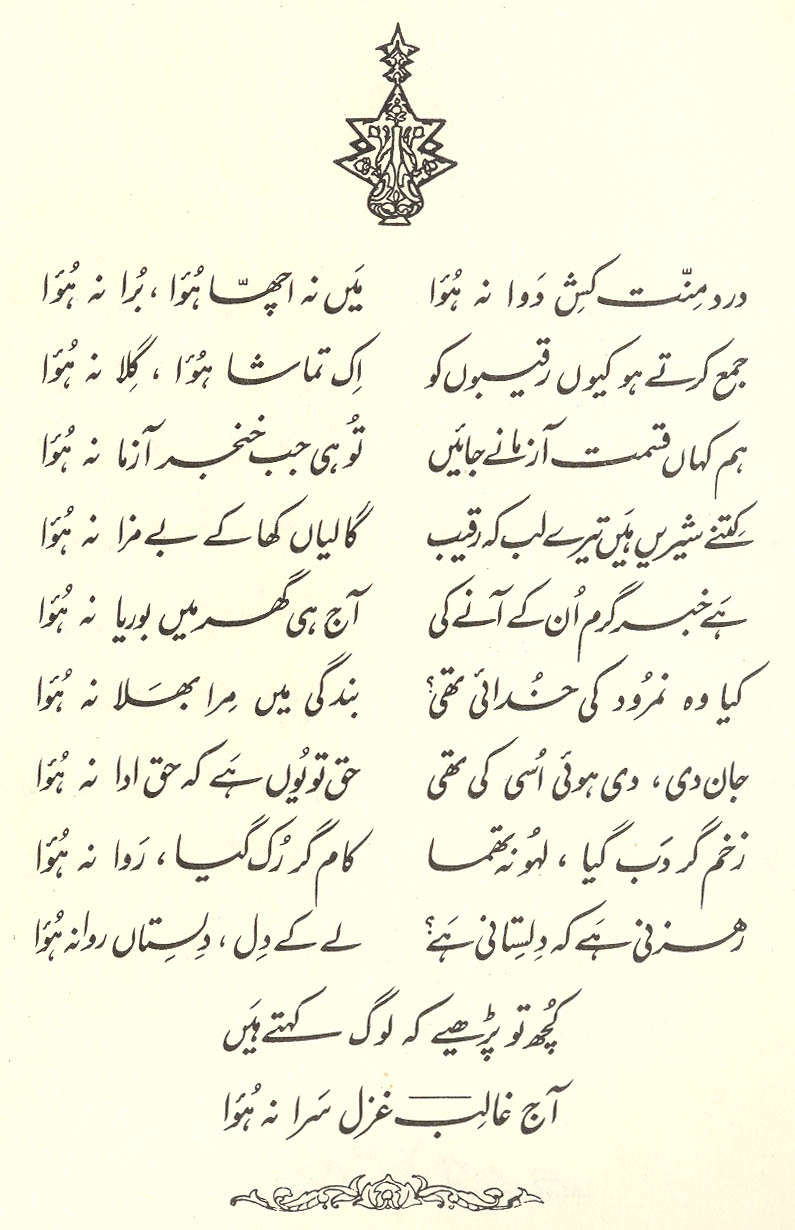
It's the custom that people gather four men in order to complain about somebody, so that they would do justice. But out of jealousy he doesn't like the Rivals to hear complaints about him from her lips and to put in their two cents. (27)
== Nazm page 27

Urdu text: Vajid 1902 {26}
He says, at the time of judgment, why do you collect the Rivals? The quarrel is between us and you; what's the benefit of their only turning the complaints and laments into a spectacle? We can't at all be pleased that the Rivals would hear complaints about us from your lips, and would agree with what you say. (53-54)
The lover has wanted to make a complaint. The beloved has said, 'All right, make your complaint before four men, let's see whether they say you are in the wrong, or I am'. Now he is afraid that if the Rivals are present, they will learn all his secrets. (64)
Naturally the lover objects to the beloved's assembling of the Rival s. Why does she do it? We're left to figure out the reason for ourselves-- and in the process, to decide on the relationship between the two lines. Perhaps A and B are cause and effect: she gathered the Rivals first, and then the second line discusses the results of her action. Or else it could be the reverse, with A and B as effect and cause:a spectacle took place, while a complaint did not take place; and as a result, she (wrongly) gathered the Rivals.
Moreover, we also have to decide the relationship of the two clauses of the second line. Here are some of the possibilities:
=Some particular 'spectacle' took place, but it didn't consist of any kind of 'complaint' on the lover's part; thus the beloved was wrong to assemble the Rivals as a kind of jury
=Some kind of 'spectacle' took place, but it was harmless and even enjoyable, maybe even 'unique', and it didn't result in any kind of 'complaint' from any of the beholders; thus the beloved was wrong to assemble the Rivals as though to plan some kind of punishment.
=The beloved assembled so many Rivals that the crowd of them caused the occasion to turn into a 'spectacle', and it was impossible for any 'complaint' to take place.
Of course, we have no idea what the spectacle might have been, or why it was created, or by whom. Nor do we know whose 'complaint' (the lover's, or the beloved's) did not take place, or why it did not take place, and whether its non-happening pleased, or displeased, either the speaker or his beloved.
In such a 'short meter', when even the smallest word counts heavily, the subtlety of is also cleverly arranged. It can be minimizing ('only'), or particularizing ('certain'), or enumerative ('single'), or emphatically adulatory ('unique, singular, preeminent, excellent'). And since we know nothing at all about the 'spectacle' except this , all the possibilities are fully in play.
Compare 21,3 , in which too there is a question as to whether there is or is not a , a 'reproach' or 'complaint'.
graphics/tamasha.jpg