Verse 41854aanah hu))aa
G8
In this meter the first long syllable may be replaced by a short; and the next-to-last long syllable may be replaced by two shorts.
1
how sweet are your lips! -- for the Rival
2
having received/'eaten' abuse, did not become {relish/pleasure}-less
The spelling of instead of is for the sake of the rhyme .
'Taste, savour, smack, relish; delight, pleasure, enjoyment'.
| References | |
|---|---|
| Arshi, Imtiyaz Ali | Ghazal# 47 |
| Raza, Kalidas Gupta | 447-448 |
| Hamid Ali Khan | Open Image |
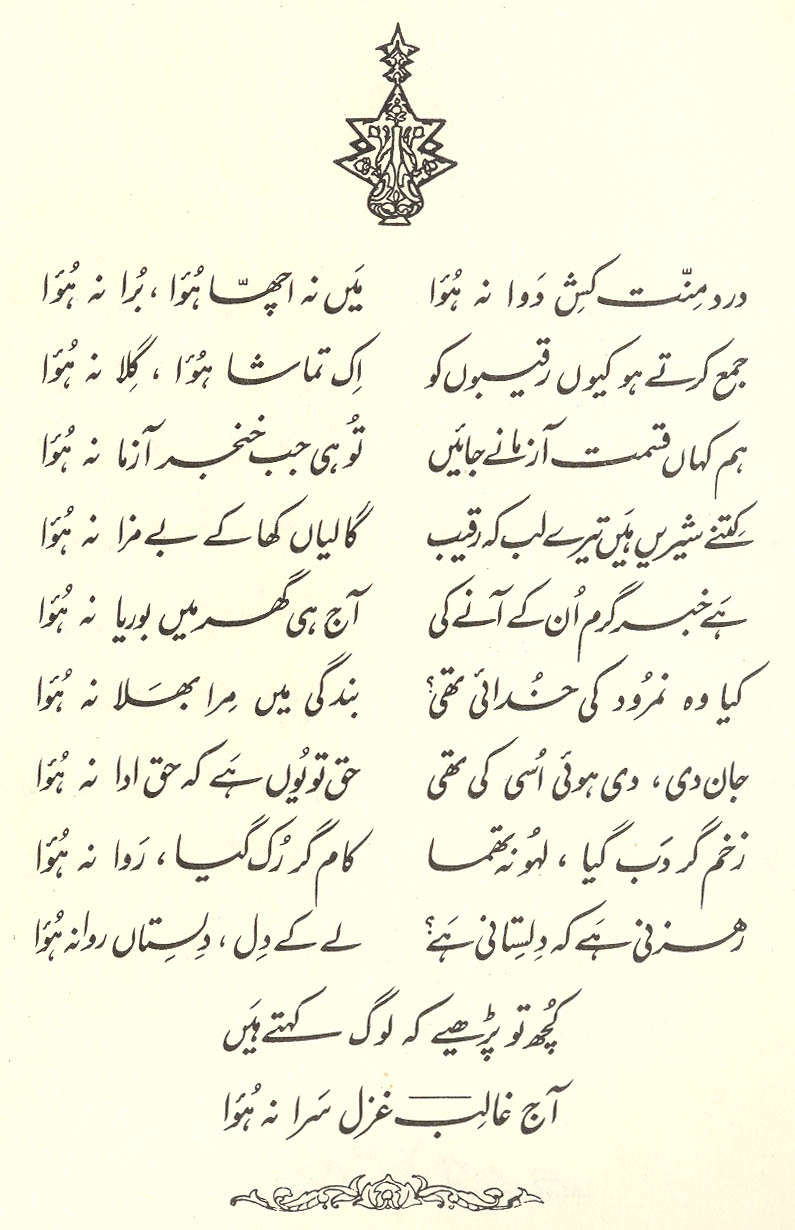
The proof of the sweetness of the beloved's lip is that hearing bitter words from her, even the lustful Rival, who is deprived of the joy of passion, did not lack for relish. (27)
== Nazm page 27

How well the praise of the beloved's sweet-lippedness is proved as part of the theme ! He says, your lips are so sweet that even a lustful person like the Rival 'eats up' abuse without distaste. Although he was deprived of the relish of passion, not even the bitterness of disrepute displeased him. (54)
Mirza taunts both the Rival and the beloved: 'You are very cultured, and he has a fine sense of honor! Neither are you ashamed to abuse him, nor is he ashamed to receive the abuse.'
[Or:] The lover very beautifully gives advice to the beloved: 'Your Honor, please don't use such treatment on me; otherwise, I will despair of life. The Rival is base, and listens to abuse.' (65)
It's a nice little net of wordplay, cleverly put together. Fortunately it's possible to suggest parallel idioms in English. In Urdu one 'eats' abuse (as in English one might 'swallow' it); this is the standard, least-marked usage. 'Eating' abuse, normally distasteful (so to speak), in this case is not devoid of 'relish' because of the 'sweetness' of the beloved's lips. Thus is doubly activated: metaphorically, as 'receiving' abuse, and literally, as 'eating' (sweet) food. This kind of wordplay gives flavor to the ghazal world, and without it a verse may well appear bland or unsavory or half-baked. (See how easy it is to do?)
Just because it's so easy to do and so universally done, a poet like Ghalib would never fail to do something else as well. Both Nazm and Bekhud Mohani seek to answer the obvious question: why is it the Rival who has this experience, while the true lover speaks only as an observer? Their answers, however, are opposite.
For Nazm, even the Rival has this experience of relish, despite his shallow and merely lustful nature; the implication is that the true lover would value the experience far more deeply. Does the lover get his own chance to be abused, or does the beloved's cruelty or indifference deny him even that opportunity? There's no way we can tell.
For Bekhud Mohani, only the rival has this experience, and the lover finds this sort of thing disgusting (such that he accuses both beloved and Rival of vulgarity) or intolerable (such that if it happened to him, he'd die of shame).
A close reader of Ghalib could marshal evidence from other verses for both interpretations. But what would be the point? Here-- as so often, but perhaps more emphatically than usual-- the undecideability is the key. Ghalib makes us ask ourselves questions, and denies us the wherewithal to answer them. He thus gives us some very spicy food for thought.
graphics/lips.jpg