Verse 61854aanah hu))aa
G8
In this meter the first long syllable may be replaced by a short; and the next-to-last long syllable may be replaced by two shorts.
1
was it/that the 'divinity of Namrud '?
2
in servitude, my welfare did not occur
'Slavery, servitude; service; devotion, adoration, worship, praise; compliment, salutation; humility, lowliness'.
| References | |
|---|---|
| Arshi, Imtiyaz Ali | Ghazal# 47 |
| Raza, Kalidas Gupta | 447-448 |
| Hamid Ali Khan | Open Image |
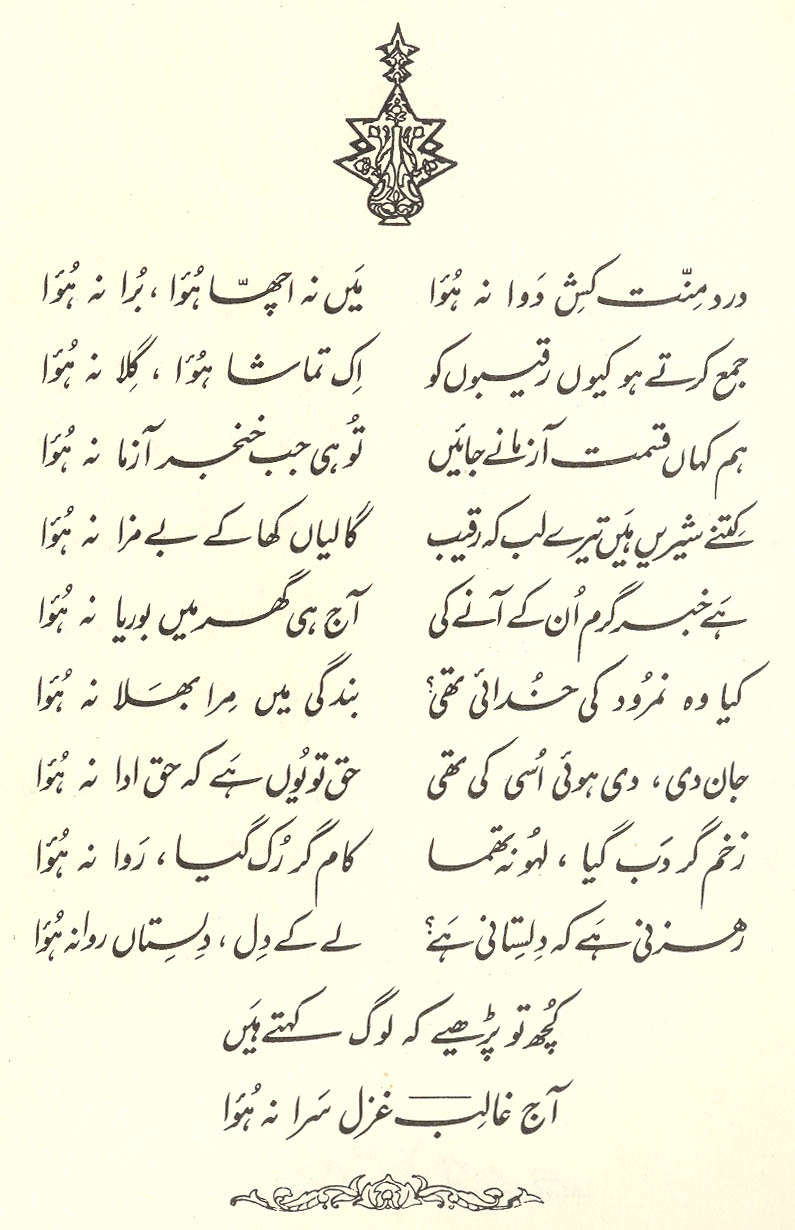
He says that in my servitude was 'the divinity of Namrud'-- it brought me only harm, and no benefit. Here does not mean worship, but servitude. To reject 'the divinity of Namrud' on the grounds of servitude is an absolutely new idea.
==Urdu text: Yadgar-e Ghalib , p. 140
The 'that' alludes to the pride of beauty. (27)
== Nazm page 27

In this verse Mirza Sahib has shown an extraordinary mischievousness [], that has never been seen anywhere. This verse and the verse after it [ 26,7 ] are both the ' high point of the ghazal '. (54)
(1) Compared to worshiping you, the [false] 'divinity' of Pharaoh [] was better, for if I didn't receive the next world, then so what? I would have received this world! Here in this wretched state, I got neither faith nor the world....
(2) To call his own servitude 'the divinity of Namrud' is an exemplary example of poetic mischievousness. That is, 'Oh Provider, was my servitude too like the 'divinity of Namrud'? For its outcome was not good.'
(3) When through pride of beauty the beloved paid no attention to my servitude, I realized it was 'the divinity of Namrud'. (66)
Namrud, the Biblical ' Nimrod ', is said by some to be the king in the Qur'an who 'disputed with Abraham about his Lord, because God had granted him power' (2:258); in Yusuf Ali's translation: 'Hast thou not turned thy vision to one who disputed with Abraham about his Lord, because God had granted him power? Abraham said: "My Lord is He Who giveth life and death." He said: "I give life and death." Said Abraham: "But it is God that causeth the sun to rise from the east: Do thou then cause him to rise from the West." Thus was he confounded who (in arrogance) rejected faith. Nor doth God give guidance to a people unjust.'
In Islamic story traditions there are many anecdotes about Namrud's arrogance and false claims to divinity. The expression is proverbial.
About whom is the lover speaking? If about a human beloved, then the speaker is indignantly (?) accusing one false god of being as bad as another false god. Naturally Namrud wouldn't have cared about the lover's welfare, but he has served her, and she hasn't cared either! Or, as Bekhud Mohani puts it, a proper false god would at least have given him worldly rewards, but she hasn't given me even those!
If he is speaking about a divine Beloved, then the same reproaches become both more poignant and more dangerous, since they verge on impiety. The implication is that he serves God for the sake of his own advantage, and that he reserves the right to reproach or criticize God if God's behavior is not to his liking. This is what Bekhud Dihlavi means by an 'extraordinary mischievousness that has never been seen anywhere'. But it has, of course, starting with 1,1 in which Ghalib is mischievous enough to accuse God himself of 'mischievousness'.
For more on human and divine , see Mir's M 1779,5 .
graphics/fakesun.jpg