Verse 81854aanah hu))aa
G8
In this meter the first long syllable may be replaced by a short; and the next-to-last long syllable may be replaced by two shorts.
1
if the wound was pressed/suppressed, the blood did not stop
2 a
if the task/desire halted, it did not move on [reading ]
2 b
if the task/desire halted, it moved on (again) [reading ]
'Going; flowing; passing'.
'Going, &c.... departed; -- despatched, sent'.
| References | |
|---|---|
| Arshi, Imtiyaz Ali | Ghazal# 47 |
| Raza, Kalidas Gupta | 447-448 |
| Hamid Ali Khan | Open Image |
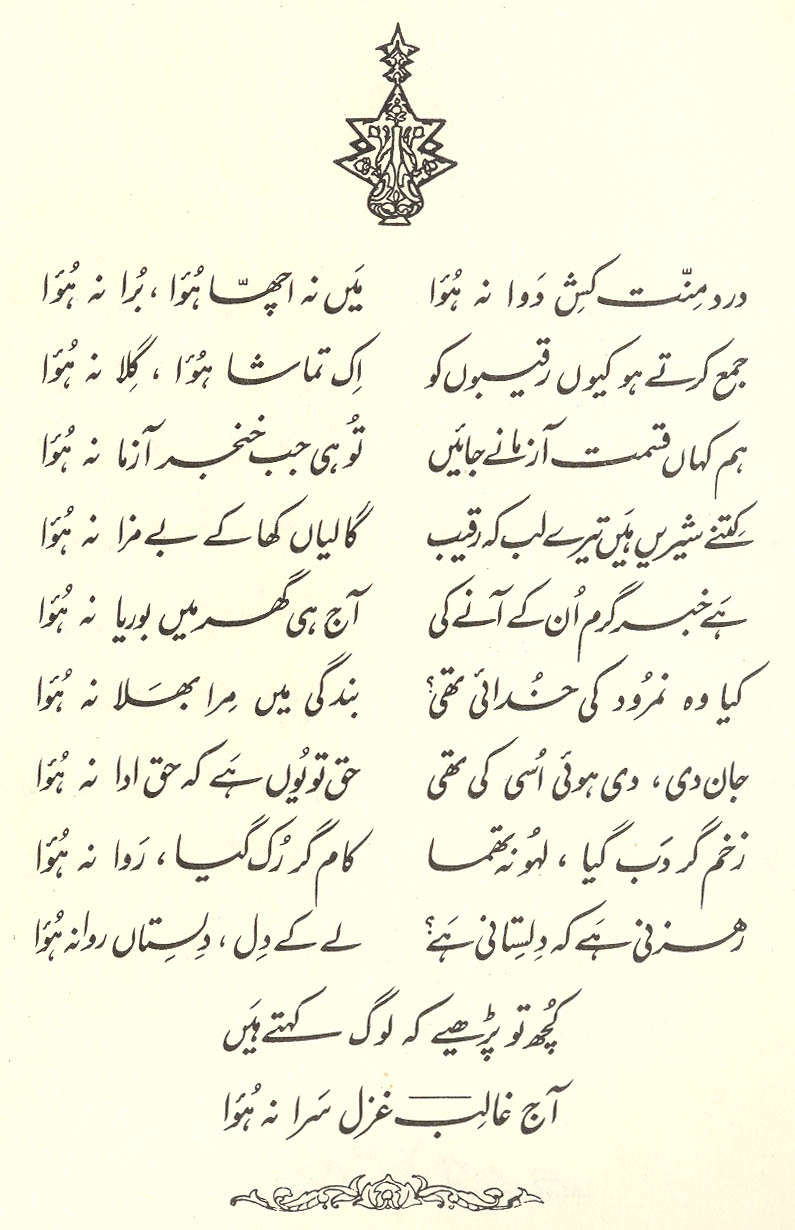
When the task was halted, it ought not to have resumed; from pressing, the blood would not flow. But my case is the opposite. (28)
== Nazm page 28

Urdu text: Vajid 1902 {26}
With what simplicity he has expressed his state of ill fortune! What a large theme he has expressed in two lines! (55)
Although the wound is not now in such a wretched state as formerly, so what? Let it not be. It still gives blood, so what occasion is there for objection? Because although the pace of the work has become slow, nevertheless it does continue. The moral conclusion of this verse is that one ought not to leave any task half-done. And this too emerges: that a lover never under any circumstances wants to obliterate longing. (67)
It seems that both Nazm and Bekhud Mohani read instead of . Although I follow Arshi (and Hamid) in 'officially' reading , we need to leave the door open a bit here. The only way one can tell the difference in reading is by space between the words, and the esthetic of script in Ghalib's day went very much the other way, toward shaping the words in each line (and verse, and ghazal) into an artistically arranged whole pattern. (Ghalib himself certainly followed the same practice, as in this example .)
So I think Ghalib would surely have expected his audience to have in their minds as well-- since the two choices would have been almost indistinguishable both to the ear and (in the script of his day) to the eye. And of course the next verse, 26,9 , definitely uses , so such a ' contrived rhyme ' was obviously something Ghalib was quite prepared to do. Besides, the reading of (2b) works so well that I refuse to give it up. When did Ghalib ever fail to give us two meanings for the price of one, if he had the chance?
Ghalib often creates 'A,B' verses-- in which the two lines are entirely separate in grammar and imagery, and we are given no indication of their logical relationship, so that we are left to decide it for ourselves. The present verse is one such case, with the additional piquancy of parallelism of structure between the lines. (For a strikingly similar instance of parallelism see 22,5 .) In the present verse, the first line reports something unexpected: if pressure is applied to a wound, the blood should stop flowing, but in this case it did not.
The second line, in another equally flat if-then statement, informs us that if an (unspecified) 'task' was halted, it did not continue (2a), or else did continue (2b). There are two choices here: either the 'task' is the wound's bleeding, so that the two statements both report the same situation, one more abstractly; or else it is something else, so that the two statements are independent.
If the 'task' is the bleeding itself, then reading (2a) makes no sense, since the blood can't both continue to flow and cease to flow. But reading (2b) works well; this is Nazm's and Bekhud Mohani's reading. It is a kind of boast: a lover's proper task is to maintain bleeding wounds, and this lover is proud to fulfill it. (In 19,1 he makes it clear that he uses his fingernails to keep his wounds open, despite his friends' attempts to prevent him.) Thus even when under pressure (so to speak), the lover's wound continues to bleed, just as it should, and thus duly proves the lover's incorrigibility.
If the 'task' is not the bleeding itself, then the horizon of possible relationships between the lines becomes much wider. If we adopt reading (2a), then the two lines depict a kind of worst-of-all-worlds scenario: if the speaker's wound is pressed, the blood does not cease to flow; but by contrast, if his 'task' is halted, it does not resume but is stopped forever. Thus he can't get any work done in the world, he can only continue to suffer; such is his destiny.
And if we adopt reading (2b), then we have an unconquerable lover celebrating his unstoppability: if his wound is pressed, it continues to bleed (or perhaps for the sake of parallelism the blood stops temporarily but resumes flowing when the pressure is released), and if his 'task' is halted, it starts up again. The speaker is able to maintain his bleeding wounds, and also do other such 'tasks' in the world of passion, and no well-meaning friends can stop him.
Note for grammar fans: See how lucidly the intransitive forms work in Urdu, and how hard it is to render them clearly in English! In Urdu, and are intransitives, and they convey the idea of action simply happening, with no agent lurking in the background. (If we want to imply an agent, we can use the passives of their counterparts and , which are of course and .) But in English, if we say 'was pressed' or 'was halted', these forms appear as passives. In the case of line two, we can choose 'halted' (because 'to halt' can be both transitive and intransitive), so we happen to be in luck-- but in the case of line one, we can't choose 'pressed', since it would be transitive. So it's a very hit-or-miss business; but the problem is on the English side, not the much clearer Urdu one.
graphics/bloodflow.jpg