Verse 51854aanah hu))aa
G8
In this meter the first long syllable may be replaced by a short; and the next-to-last long syllable may be replaced by two shorts.
1
there is fresh/'hot' news of her coming--
2
only/emphatically today, in the house a reed-mat did not appear/occur!
| References | |
|---|---|
| Arshi, Imtiyaz Ali | Ghazal# 47 |
| Raza, Kalidas Gupta | 447-448 |
| Hamid Ali Khan | Open Image |
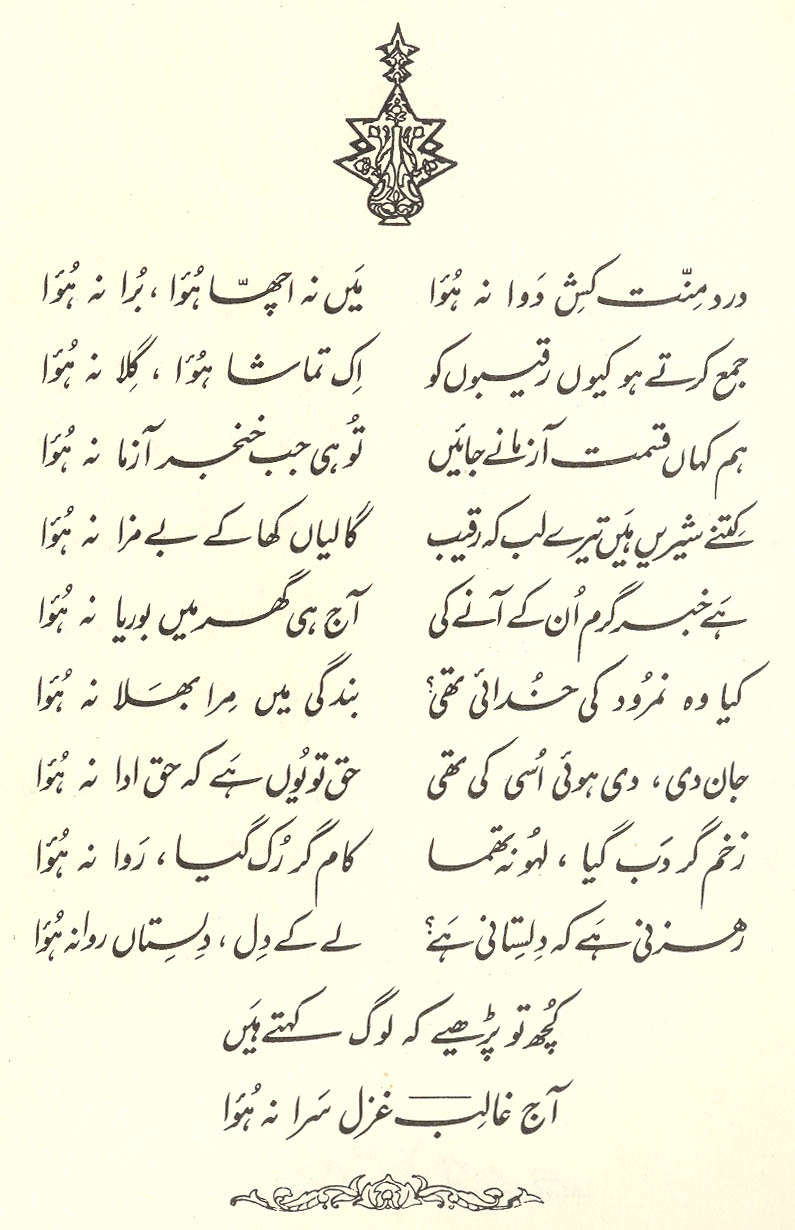
In this verse the intention is to express courteous hospitality and lack of possessions. And the feebleness of the theme is manifest. (27)
== Nazm page 27

Urdu text: Vajid 1902 {26}
There's so much turmoil of the ardor for guest-reception, that when he hears the news of the coming of the beloved, spontaneously he wants to 'spread his eyes' [in welcome]. And such a state of possessionlessness, that today not even a straw mat remains in the house. (54)
The Lord has given me both griefs: the grief of passion and the grief of livelihood [, see 20,7 ]. Such a condition of poverty, such a state as a lover! This is not a verse, but an album of vain longing!
[Or:] It wouldn't be strange if he would have said it jokingly, on the arrival of some intimate friend. [The intensive particle] is worthy of praise.] (65)
[See his commentary on Mir's M 887,1 .]
This amusing little verse is based on tone of voice. It performs a kind of parody of the concerns of an anxious host, eager to provide proper entertainment to an unexpected guest. 'Oh dear, just today of all days there's no X in the house!' We all know what kind of thing X is: fresh fruit, homemade cookies, good cheese, fine wine, fancy tablecloth-- whatever is the proper mark of hospitality that normally would be available, but that requires maintenance and special care.
So what is the lover's X? A reed-mat (on these mats see 10,3 ). From this we learn that he has literally nothing else in his house, since such a mat is almost too basic to count as furniture at all; the idea of treating it as a special piece of guest entertainment is thus particularly ludicrous (or particularly darvesh-like, as Faruqi's commentary points out). The lover's poverty doesn't surprise us, since if he was ever well-off, he is so no longer: he has ruined himself through his mad passion. Really he no longer cares much about maintaining a house at all.
It sounds in fact as though he often borrows a reed-mat from his neighbor, and happens not to have done so today-- otherwise, if he owns a reed-mat, why wouldn't it be there today as well as other days? Could it be that he does own a reed-mat, but today by ill-fortune has lent it to somebody else? Could it be that a friend sometimes comes by and drops off a reed-mat? Could it even be that the sadistic beloved makes a point of planning a visit on the day when she knows he has no reed-mat? Or could it be that he never has a reed-mat at all, but is telling a rueful or face-saving lie?
As we know in our hearts, the beloved almost certainly won't come anyway, so all this worry is for nothing. But isn't it a witty, amusing, enjoyable kind of worry to speculate about? Its patent absurdity, its parodic joie de vivre, counterbalances its ostensible content and saves it from any sense of self-pity. For if she ever by any chance does happen to come, she'll have her own agenda; the last thing she'll pay any attention to is the presence or absence of a reed-mat. For more on the beloved's visits to the lover, see 106,2 .
The perfect form , used where we would expect , sticks out a mile, doesn't it? It forces us to see the presence of the reed-mat as an event or occurrence that did not 'happen', rather than a steady-state situation (the reed-mat isn't there). Does that reflect passivity on the lover's part, or Sufistic indifference, or some other attitude? As usual, we're goaded into paying close attention, and then left to make our own meanings.
More verses about the reed-mat: 4,13x ; 18,7x // 361x,7
graphics/boriya.jpg