Verse 71854aanah hu))aa
G8
In this meter the first long syllable may be replaced by a short; and the next-to-last long syllable may be replaced by two shorts.
1 a
[I] gave [my] life-- the given [life] was only/emphatically hers/his
1 b
[He] gave [us] life-- the given [life] was only/emphatically His
2
the right/truth is like this: that the right/claim did not become fulfilled
'Justness, propriety, rightness, correctness, truth; reality, fact; --justice; rectitude; --equity; --right, title, privilege, claim, due, lot, portion, share, proprietorship; --duty, obligation'.
| References | |
|---|---|
| Arshi, Imtiyaz Ali | Ghazal# 47 |
| Raza, Kalidas Gupta | 447-448 |
| Hamid Ali Khan | Open Image |
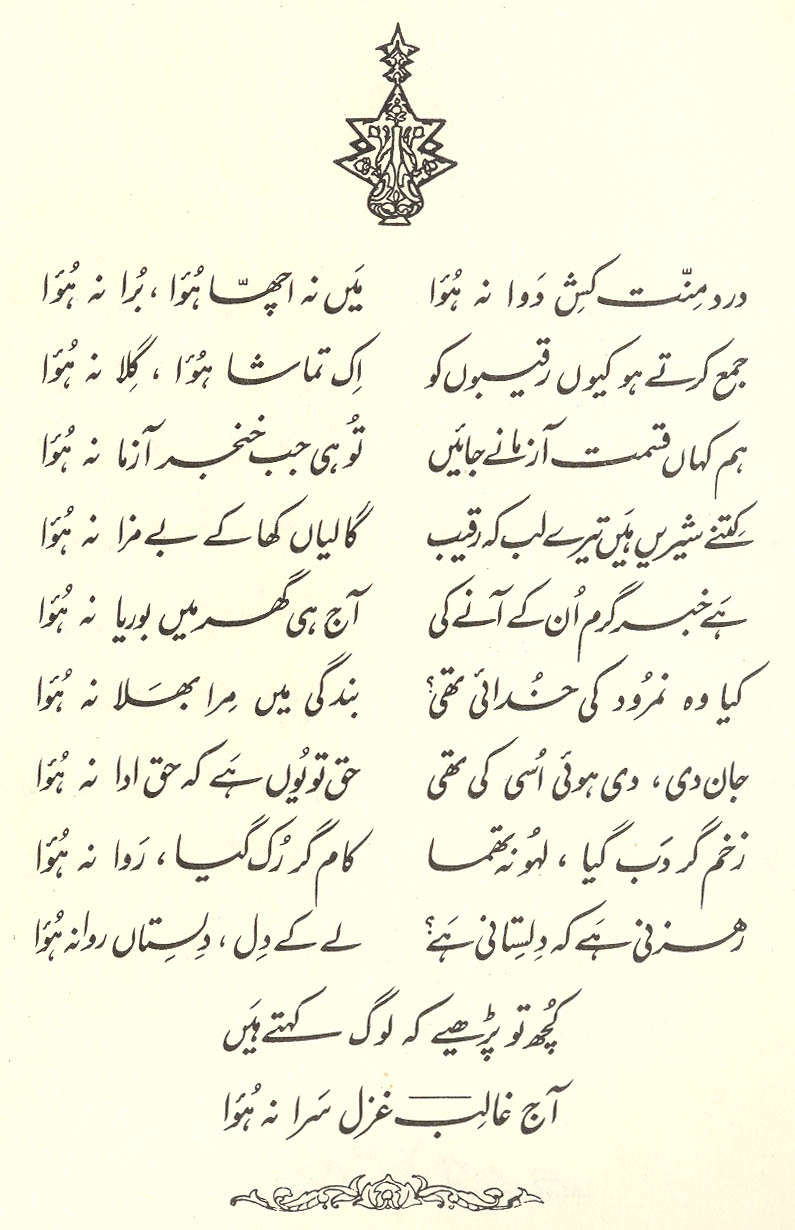
[Sept. 1862, to Majruh:] We hear that in November the Maharaja will be granted authority []. Indeed it will be given-- but that authority will be of the kind that the Lord has granted to his creatures: He has kept all the power in his own hands, and caused human beings to be blamed/disgraced.
==Urdu text: Khaliq Anjum vol. 2, p. 537
The first means 'truth', and the second means 'responsibility'. (27)
== Nazm page 27

Urdu text: Vajid 1902 {26}
[In 26,6 he identifies that verse and the present one as the two that are the ' high point of the ghazal '. (54)]
He says, we have done one task all our life: we have given our life. But then, after reflecting, we understood that that life was that one's gift. We gave that one's trust back to that same one. What is there to be proud of in this?.... This thought-- these words-- this construction--they are all beyond description! (55)
People consider it a great thing to give their life for the Lord's sake. But Mirza, leaving the common path, says that life was a thing given by the Lord alone. If I sacrificed it for Him, then what kind of a big thing was that? Why pride oneself on it? It's a cause for shame that he had given us a gift like life, and in proper return for that gift we were not able to perform any [sufficient] service (worship). (66-67)
If we gave our life in the path of [truth], then what great thing did we do? Because the life was given by that very one; it was only ours as a trust. We gave it back-- what kindness or generosity is there in giving back a trust? Thus the truth is that we were not able to fulfill the duty of the claim-- that is, to give one's life is no big thing. On the contrary-- many other, additional duties are duties are incumbent upon mankind, which it is necessary to fulfill. (95)
When we gave our life, it had been bestowed by that very one. What big task were we able to accomplish? If you want to know the truth, then we were not able to fulfill our responsibility. In place of the first , [=true] too is metrical [and so could better have been used]. (159)
He says, life was a trust from the Lord. He had given us this trust as a blessing, and confided it to us. To complain of this is meaningless. It was his thing, we turned it over to him. What did we give of our own? The truth is that we were not able even to fulfill our duty. (90)
If after dying we gave back to him the life he had given, we didn't do any praiseworthy deed. Because there's no excellence in giving back a trust. Our duty was to have fulfilled the claim of this great kindness on his part-- that is, through the beauty of our deeds to have adorned the life he had given, and thus have given it back with some addition (338-39).
I gave my life on the path of truth, but what virtue of mine is there in this? The life was not mine, the Lord had bestowed it on me. If I returned to him what he had bestowed on me, what great accomplishment was that? The truth is that what we owed to the Lord, what was our responsibility, that was not able to be fulfilled. If we had sacrificed something of our own in His path, then it would have been something else. In that case we could have said that we had accomplished our duty. Now, how can such a claim be a credit to us?
The enjoyable thing is that the extreme limit of sacrifice for man is to sacrifice his life. Mirza does not declare even this to be a fulfillment of duty. Just think how lofty is the picture of sacrifice in the path of the Lord, and the level of fulfillment of duty! (110)
I chose this verse for unusually full treatment because it shows particularly clearly some of the problems and deficiencies of the commentarial tradition. Even a person who didn't know Urdu would notice at once, on hearing this verse, that in the first line every word except one rhymes. This makes this line unique in Ghalib's divan . Perhaps one might not even care for the effect, but an effect it certainly is; Yet not one commentator so much as acknowledges that it exists.
Instead, the commentators devote themselves, as usual, to producing a prose paraphrase of 'the meaning' of the verse. Most of them are indeed reading the first line in two different ways at once, whether or not they are aware of it: in their commentary the meanings I have called (1a) and (1b) are blithely and unreflectively interwoven. The only reason they can read this line in two different ways is that Ghalib has carefully constructed the grammar so as to make the two readings both possible and inescapable (that is, there's no way to rule either of them out). Yet none of the commentators acknowledge this poetically significant fact, or help the reader to reconstruct the two different analyses of the grammar that generate the different meanings.
If we move on to the second line, we find the commentators equally unhelpful. Even someone who didn't know Urdu could tell on hearing the line that was being emphatically repeated, in metrically conspicuous positions, so that special attention was being called to it. Ghalib is clearly bouncing us around in its various meanings of 'truth' and 'justice' and so on, requiring us to reflect on the various senses of (see the definition above). Yet Nazm helps us only by high-handedly defining away the problem (and the pleasure). The others ignore it, except for Shadan who actually rewrites the line, suggesting that could well have been used to avoid the confusion!
Just as none of the commentators acknowledge the conspicuous display of rhyme in the first line, so none of them acknowledge the central and obviously deliberate wordplay (and, importantly, meaning-play) with in the second line. For another example of the ambiguous use of , see 64,1 .
The result is, if you believe the commentators, a bland piece of religious piety. Poor Ghalib! How he would have hated such blindness to his elegant and carefully-wrought devices! Why are the commentators so singularly unhelpful? Nobody can give an authoritative answer. I have written a somewhat speculative paper ('The Meaning of the Meaningless Verses') about this; it is available here .
In the meantime, let me briefly give my own comments on this verse. I think the first line as (1a) and (1b) is a delight, with the two meanings not contradicting each other, but somehow engaging in a kind of tug-of-war. Making the words rhyme seems like something that perhaps began to happen by accident-- since stripping out chunks of grammar to create ambiguity would easily produce a sequence of feminine endings agreeing with -- and that he then continued just because he could, out of the sheer delight of virtuosity, in order to surprise and amuse his audience by offering many pleasures at once.
I would also propose another way of reading the second line: the , the 'claim' or 'right', that didn't get fulfilled could also have been the beloved/God's duty toward us. If the lover gives his life (1a), and the beloved or God considers that it's hers/his already, the lover doesn't get any credit for his sacrifice. Is that fair, is that according to his claim or his right? The truth is, it's not.
Similarly, if God gives the speaker life (1b), and retains ownership of it the whole time, so that it's really always , 'only/emphatically His' -- is that fair or just? The truth is, it's not. God has only pretended to give it, while actually it remains beyond the speaker's control. This complaint of the helplessness of humans in a world over which they have no power is vintage Ghalib: it is exactly the point of 1,1 . And it's echoed in Ghalib's letter quoted above.
Compare the unpublished 424x,7 , which similarly plays with questions of ownership of the self, and which might even be read as accusing the Lord of a veiled form of 'self-worship'.
Compare Mir 's similarly complex exploitation of the possibilities of : M 1059,2 ; and his even more radical enjoyment of the possibilities of sheer wordplay: M 1836,6 .
graphics/givinglife.jpg