Verse 101854aanah hu))aa
G8
In this meter the first long syllable may be replaced by a short; and the next-to-last long syllable may be replaced by two shorts.
1
well, do please recite something, for people say
2
'today Ghalib did not become ghazal -{reciting/'singing'}'
'To read, repeat, recite; to say; to mutter a spell; to learn, study (with acc. & abl.); to make out, decipher'.
'Singing, trilling (used in comp.)'.
| References | |
|---|---|
| Arshi, Imtiyaz Ali | Ghazal# 47 |
| Raza, Kalidas Gupta | 447-448 |
| Hamid Ali Khan | Open Image |
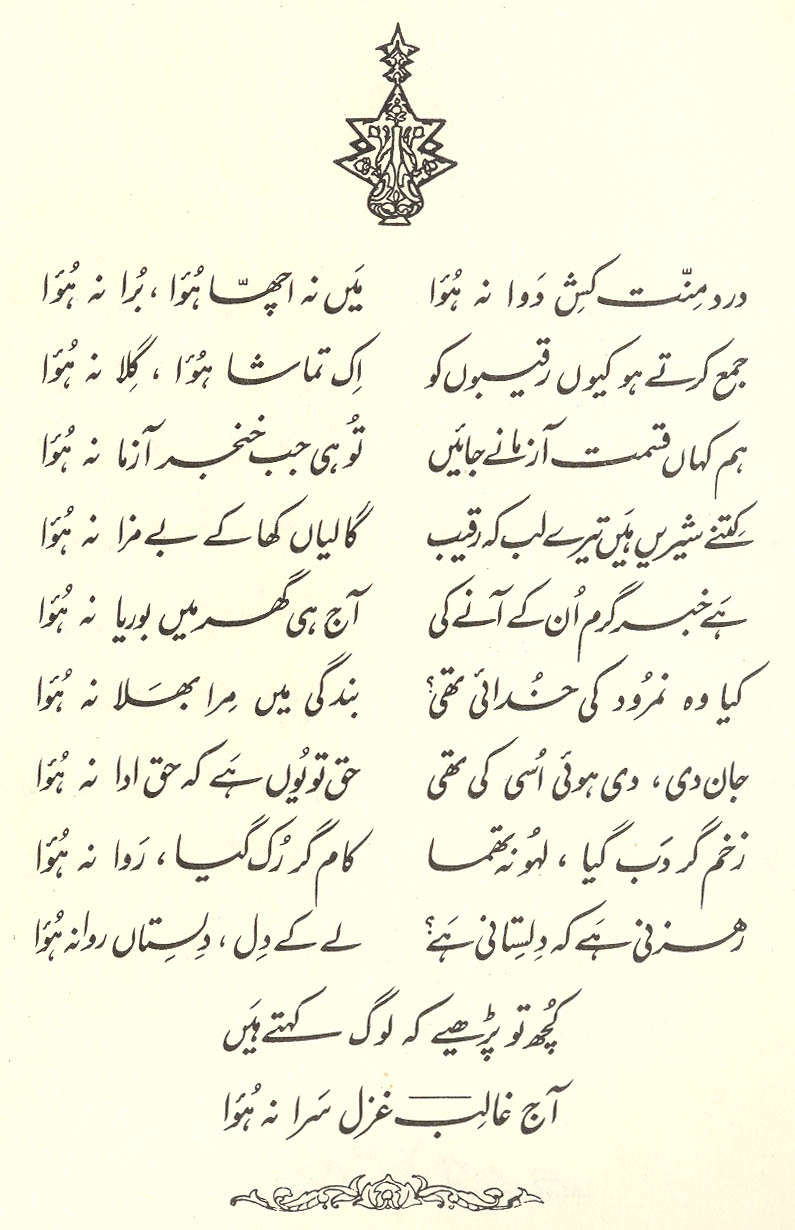
After reading the whole ghazal, to then say, please recite something, perhaps means 'please recite something in the pattern '. (28)
== Nazm page 28

Urdu text: Vajid 1902 {26}
It's said that the [Red] Fort mushairah had been fixed for some prince's house. Mirza Sahib had not written a ghazal in the pattern . When he was urged to the very limit, then he recited a ghazal that was outside the pattern []. He had previously composed a closing-verse on this theme . (55)
That is, please recite something in the pattern. (68)
The story is that this ghazal had been recited in the mushairah of the Auspicious [Red] Fort. He hadn't recited a ghazal in the pattern. For this reason those present insisted on hearing this non-pattern ghazal. As appropriate to the occasion, he must have either composed the closing-verse previously, or composed it right then under pressure of circumstances, and inserted it into the ghazal and left out the previous closing-verse. The words 'please recite something' mean, 'please recite some poetry even outside the pattern'. (91)
The commentators speculate that the key to understanding this verse is to fit it into the structure of a traditional ' patterned mushairah ': perhaps Ghalib has recited a ghazal that was not in the specified pattern for that mushairah, and he thus explains that he was obliged by public pressure to do so, since he didn't have one available that was in the appropriate pattern. To me, this sounds like the forced 'realism' of the 'natural poetry' perspective. After all, poets knew the pattern well in advance, and Ghalib was proud of his ability to create in an arbitrarily assigned pattern (as he makes clear in the letter quoted in 111,1 ); he also had a pressing need to keep his patrons happy. Why would he be unable or unwilling to bring a ghazal in the assigned pattern, when he knew that all his peers (and competitors) would do so?
Why should we not take the verse as more general? Since in principle the verses of a ghazal are not to be considered as a linear string, this verse can be read as part of the poet's reminding himself that it's his duty to compose and recite, that people expect it of him. Even if he's not in the mood, the pressure of public opinion should be obeyed-- a pressure that by implication falls chiefly on the most popular and admired poets, those whose performance everyone awaits.
Perhaps we're meant to feel that the verses of this long ghazal should now be recognized as mere party favors, produced and flung out ('please recite something, Ghalib!') to the audience as a gesture of courtesy. If this is modesty, it's certainly false modesty, because we know that Ghalib had an extremely high opinion of his own talents. Probably it's really something more like impatient arrogance-- 'Even when I'm not trying, I can casually fling out verses like these'. Either way, it makes for a fine rhetorical flourish.
Note for meter fans: The modern pronunciation of pa-;Rhi-ye is here hammered into a long-long shape, pa;Rh-ye, to suit the meter. But since it would be hard to tell the difference in actual speech, this may not represent a pronunciation shift; it may well be just one of the little permissible scansion tricks that poets find convenient.
graphics/ghalib.jpg