Verse 11852aa;Nho ga))ii;N
G1
1 a
not by any means all!-- some became manifest in tulip and rose
1 b
where [did they] all [become manifest]? some became manifest in tulip and rose
2 a
what faces/aspects there will be, that became hidden in the dust!
2 b
will there be faces/aspects that became hidden in the dust?
2 c
which faces/aspects will there be, that became hidden in the dust?
2 d
in the dust, what faces and aspects there will be, that became hidden!
2 e
in the dust, will there be faces/aspects that became hidden?
2 f
in the dust, which faces/aspects will there be, that became hidden?
'Appearing; apparent, evident; conspicuous, prominent;—striking, bold (as a picture)'.
'Form, fashion, figure, shape, semblance, guise; appearance, aspect; face, countenance; prospect, probability; sign, indication; external state (of a thing); state, condition (of a thing), case, predicament, circumstance; effigy, image, statue, picture, portrait; plan, sketch; mental image, idea; —species; specific character, essence'.
'Hid, concealed; secret, private; occult, latent, clandestine'.
| References | |
|---|---|
| Arshi, Imtiyaz Ali | Ghazal# 114 |
| Raza, Kalidas Gupta | 426 |
| Hamid Ali Khan | Open Image |
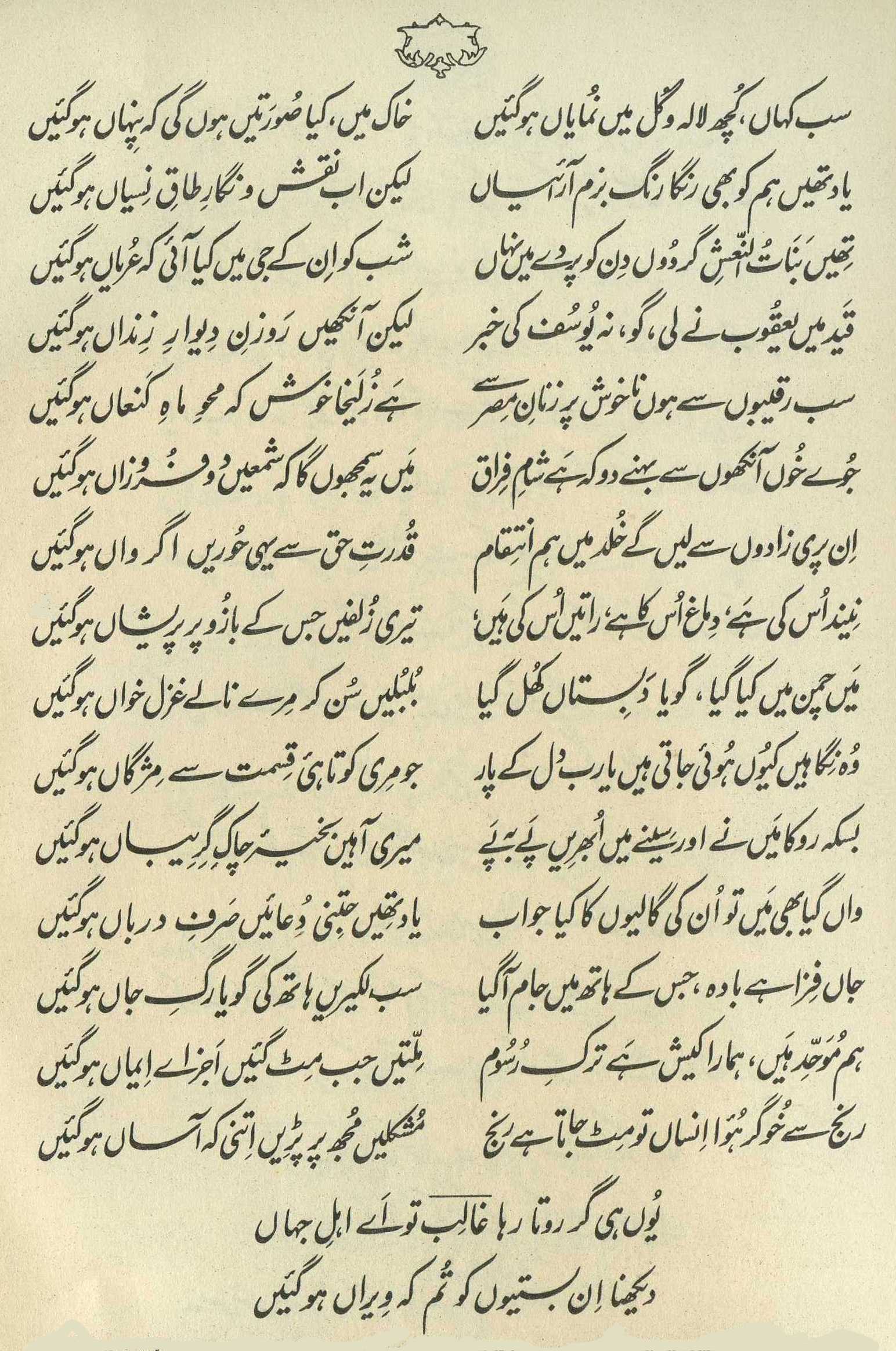
[1852, to Haqir:] Brother! For the Lord’s sake, do this ghazal justice! If this is Rekhtah , then what did Mir and Mirza Sauda compose? And if that was Rekhtah, then what is this? The circumstances of it are that one gentleman among the princes of the House of Timur brought this ground from Lucknow, and Huzur [Bahadur Shah Zafar himself composed a ghazal in it, and commanded me also [to compose one]. Thus I carried out the order, and wrote a ghazal. (Arshi 239)
==Urdu text: Khaliq Anjum vol. 3, pp. 1113-15
==another translation: Russell and Islam , p. 83
[1861, to Raq'at:] I am not worthy of any praise; I am one who sits in a corner, grief-stricken and voiceless. Hazrat Yaqub , peace be upon him!, who was not only a Prophet, but also had a tranquil spirit, wept so much in separation from a single son that he became blind. In the sedition/excess of an ocean of blood [] [of 1857], a thousand of my beloveds [] were drowned in such a way that no trace can be found of what has become of them. I'm in mourning for a thousand people. Many friends of forty and fifty years' standing have been taken away from me. Someone used to call me 'father', someone used to consider me a teacher []. [He then quotes two verses, {111,1} and {111,2}. However, the second line of {111,1} is misquoted as: ] ==Urdu text: Khaliq Anjum vol. 2, p. 733
[1861, to Raq'at:] I am not worthy of any praise; I am one who sits in a corner, grief-stricken and voiceless. Hazrat Yaqub , peace be upon him!, who was not only a Prophet, but also had a tranquil spirit, wept so much in separation from a single son that he became blind. In the sedition/excess of an ocean of blood [] [of 1857], a thousand of my beloveds [] were drowned in such a way that no trace can be found of what has become of them. I'm in mourning for a thousand people. Many friends of forty and fifty years' standing have been taken away from me. Someone used to call me 'father', someone used to consider me a teacher []. [He then quotes two verses, {111,1} and {111,2}. However, the second line of {111,1} is misquoted as: ] ==Urdu text: Khaliq Anjum vol. 2, p. 733
This ghazal was published in the Dihli Urdu Akhbar vol. 14, no. 32 (28th August 1852), with this introduction: 'During this past week at the mushairah [series] held by Janab Mirza Nur ud-Din Bahadur (may his auspicious fortune ever endure!), with the pen-name Shahi, grandson of the late Janab Mirza Sulaiman Shikoh Bahadur, who has come from Lucknow, ghazals by a number of poets were read. And the Prince of lofty lineage often showed himself in splendor at the mushairah gathering. One ghazal of the admired Mirza, that is to say, the chief of the gathering, and a ghazal of Janab Najm ud-Daulah Muhammad Asadullah Khan Bahadur with the pen-name of Ghalib, have come into the hands of the writer of the newspaper; accordingly, they are entered into the newspaper.' (238)
The second line is really like this: . For the necessity of the verse [he has rearranged it]. The meaning is that the tulip and rose are the dust of those same beautiful ones who have mingled in the dust. (116)
== Nazm page 116

In this verse is an allusion to the beliefs of the Hindus about reincarnation. He says, not all, but rather only a few of the faces of those who have been erased have become manifest in tulip and rose. Otherwise, many great beauties have become food for the dust. (166)
The meaning of is and ; he says it in a tone of surprise and sorrow. The gaze has fallen on a garden of tulips and roses, and the mind wanders toward the thought that these are not tulips and roses, but rather this is the dust of beloveds buried in the dust, which is showing its glory in the guise of tulips and roses. Then he feels sorrow, that the tulips and roses which have been manifested from their dust are so flourishing-- how many lovely ones must there have been! That is, from merely looking at the tulips and roses neither can the number of lovely ones be estimated, nor can their loveliness. (218-19)
It is believed that flowers are born from the dust of beautiful ones; thus according to how beautiful they were, that's how beautiful are the flowers that spring from their dust. Thus, seeing the tulips and roses, in a regretful tone he says, the Lord knows what kind of beautiful ones have mingled with the dust and turned to dust-- from among them some few beautiful ones have become manifest in the form of tulips and roses; we don't know what's become of the rest. It's a supremely good verse. (280)
In the second line, the words' being out of order has created a convolutedness, because these words were not able to be arranged in their own places. But Ghalib himself always composes Persian-mixed Urdu. So the arrangement can be like this: . Those beautiful ones who have mingled with the dust take birth as tulips and roses. (290)
Here the word is by way of astonishment: it means something strange and extraordinary. In the first line, read the first two words separately. That is, not all faces, but indeed to some extent they have become manifest in the shape of tulips and roses. And looking at the glory/appearance of tulips and roses, their beauty can be guessed. In addition we can also judge how many extraordinary and heart-stealing shapes have already mingled with the dust; in the shape of tulips and roses only a small part have become apparent. (209)
The poet has used ' elegance in assigning a cause ' and has proved that in the tulip and rose being so beautiful and attractive, the cause is that the beautiful ones of the world, who have been buried in the earth after death, are becoming manifest in the shape of those flowers. (556)
Ghalib says only that in the shape of tulip and rose not all the beautiful ones were able to become manifest-- from among them some have become manifest. Then, seeing the beauty of tulip and rose, he says, 'The Lord knows what faces there must be, that have already gone into the earth!'. From the whole scene he has made a philosophical point about the instability of the world, and has presented it in an extremely moving and heart-affecting style. (370)
[There are earlier uses of this theme , including a Persian verse by Khusrau. But especially worthy of comparison are the following two verses:] Mir 's M 664,4 , and Nasikh 's
128,8 .]]
Ghalib, saying , has created possibilities upon possibilities. For example, consider these:
1) what faces will there be? (inquiry, reflection)
2) what (wonderful) faces there will be (for which beautiful flowers are the return) (wonder)
3) what faces there will be! (praise)
4) what faces will there be? (which ones? of which people?) (reflection)
5) well, what faces will there be? (of what kind will they be?) (ignorance)
6) no telling what kind of faces there will be, for they've become hidden (thought)
This is the height of the style of expression. [But putting the two lines together creates even richer possibilities:]
1) Where did they all become manifest? Only some faces were able to become manifest in the form of tulips and roses.
2) Only some are tulips and roses-- among them, all faces could hardly have [] become manifest!
3) What faces there will be that became hidden in the dust!
4) What faces there will be in the dust, that became hidden!
The interpretation of the second reading of the second line is that the dust too has its faces. Some faces were able to become manifest in the form of tulips and roses, but God knows how many more faces there must be that became hidden (that is, were concealed). As if in this aspect the sense emerges that dust, which outwardly is dead, in reality is full of life. Tulips and roses are its manifestations. There are in addition thousands more of just such manifestations, that have not become evident to us....
From 'became manifest' another thought also arises: that the appearance of beautiful faces in the form of tulips and roses is only coincidental and contingent. The intention of tulips and roses has no part in this, nor do those beautiful ones who have become symbolically evident in tulips and roses have any part. The gesture toward coincidental appearance even further clarifies the verse's central meaning-- that life, or its beauty, is transitory; it is a vulnerable prey to time or death. Another verse of Ghalib's confirms this interpretation: 151,5 .
== (1989: 164-67) 2006: 186-90
The beauty of tulips and roses illustrates the attractive objects earth produces. Beneath the earth, there are countless hidden and beautiful possibilities that have not yet become evident to us. This verse refers to the many faces of dust and dirt and not the faces of buried ones, as often interpreted. One way we know that dirt exists is from its characteristic of supporting flowers and greenery, but there may be many more forms of it that remain hidden from us. We cannot know the many ways God can reveal Himself. Our ability to see things limits us from knowing the reality. A bat cannot see flowers. Does that mean that bat's worldview is at fault? There are hundreds of ways that God reveals Himself to us but we are not capable of appreciating them. --Sarfaraz Khan Niazi, Love Sonnets of Ghalib: Translations & Explications (Lahore: Ferozsons, 2002), p. 411
Well, here's what might be called the mother of all ghazals. It's probably Ghalib's most famous, and as best I can judge it is (along with 20 ) one of the two ghazals of his that are most commonly translated; thus it comes equipped here with a special anthology of translations . Ghalib's own opinion of it was, at least at the time he wrote the above letter , extremely high-- he apparently thought it had reached a completely new level. (For another ghazal that he praised in almost equally extravagant terms, see 163,1 .) Not all the verses are equally superb, but there's no need for them to be, since a ghazal is chiefly a storage and display case for individual verses. And this particular verse is one of his all-time marvels. Thus I've provided an unusual depth of commentary, to illustrate the interpretive range. Faruqi has done an exposition that's unusually elegant even for him-- and is well worth reading in full in the original, if you know Urdu. To it I'd like to add only a few thoughts.
The greatest tension is the word (and meaning) play between 'manifest' and 'hidden'. Both terms embrace many possibilities. If things are manifest [], are they manifest permanently, or intermittently, or only temporarily? At their own pleasure, or helplessly? Inevitably, or contingently? And if things are hidden [], then are they destined someday to be manifest, or are they hidden forever? Were they ever manifest, or have they always been merely latent? Are they findable, or have they been they lost and dissolved? Is their hidden presence verifiable in any way, or only a subject for speculation?
Appropriately, even the 'dust' imagery is complex: 'to mingle with the dust' [] is a common idiom for 'to die'. 'To become hidden in the dust' could be taken as a mere paraphrase, with the same meaning. Or else, of course, it could retain the possibilities of 'hidden'-- someone can hide in something without necessarily melting down and vanishing into it. When in a distraught letter Ghalib misquotes the second line of his own verse (see the second letter above), he even adds an echo of the powerful, bitter idiom ; for an example of its use, see 87,1 . For another, somewhat parallel verse, in which the dust is addressed directly, see 151,5 .
And as for the 'faces' that are hidden in the dust, they are also 'aspects' [], with the same possibilities for abstraction as that translation would suggest; for an example of this abstract use see 10,6 . On this reading, the verse would not be about beautiful dead faces in particular, but about potentials for life and beauty in the universe, both realized and unrealized. For the remarkably full range of meanings of , see the definition above.
Moreover, in the verse we might be interested in the faces/aspects, and inquiring about their possible whereabouts, as in the first three readings given above, and in the commentarial consensus. These readings take to modify , so that the dust becomes a location where 'faces' or 'aspects' might be hidden, but what we are really interested in is the hidden people or things.
Alternatively, we might equally well be interested in the nature of the dust itself, so that we would be inquiring about its contents and their knowability and manifestations, as in the second three readings given above. These readings take to modify , so that what we really want to know about is the dust. The more I look at the verse, the more these two basic foci appear quite distinct to me. These back-and-forth possibilities are based on the role of as what I call a 'midpoints' adverbial phrase, one that can be read as modifying either of the line's two finite verbs.
In addition, the verse takes care to set up further complexities, so that we have plenty of room to think and wonder. The first line emphasizes the partialness of its own information: not all, only some, are in flowers, and the speaker doesn't seem to know where the rest are. The second line has a presumptive verb [], to emphasize the tentativeness of its speculation. And of course and multiply the possible meanings several times over. The translations I've given above are by no means exhaustive; they merely illustrate some of the main lines of thought.
Yet with all these baroque philosophical and mystical strands of thought hovering in a cloud around it, it's still a very clean, flowing, well-balanced verse; in particular, it uses its long vowels and nasals to good effect. It has fully nine nasalized long vowels, four in the first line and five in the second. And aren't they lovely to recite! Above all, the word-and-meaning echo effect of and could hardly be improved upon.
graphics/khak.jpg