Verse 81852aa;Nho ga))ii;N
G1
1
sleep is his, spirit/pride/'mind' is his, the nights are his
2
on whose shoulder your curls became scattered/tangled
'The brain; head, mind, intellect; spirit; fancy, desire; airs, conceit; pride, haughtiness, arrogance; intoxication; high spirits'.
'Dispersed, scattered; disordered, confused; dishevelled, tossed (as hair); amazed, distracted, perplexed, bewildered, deranged; troubled distressed, wretched; ruined'.
| References | |
|---|---|
| Arshi, Imtiyaz Ali | Ghazal# 114 |
| Raza, Kalidas Gupta | 426 |
| Hamid Ali Khan | Open Image |
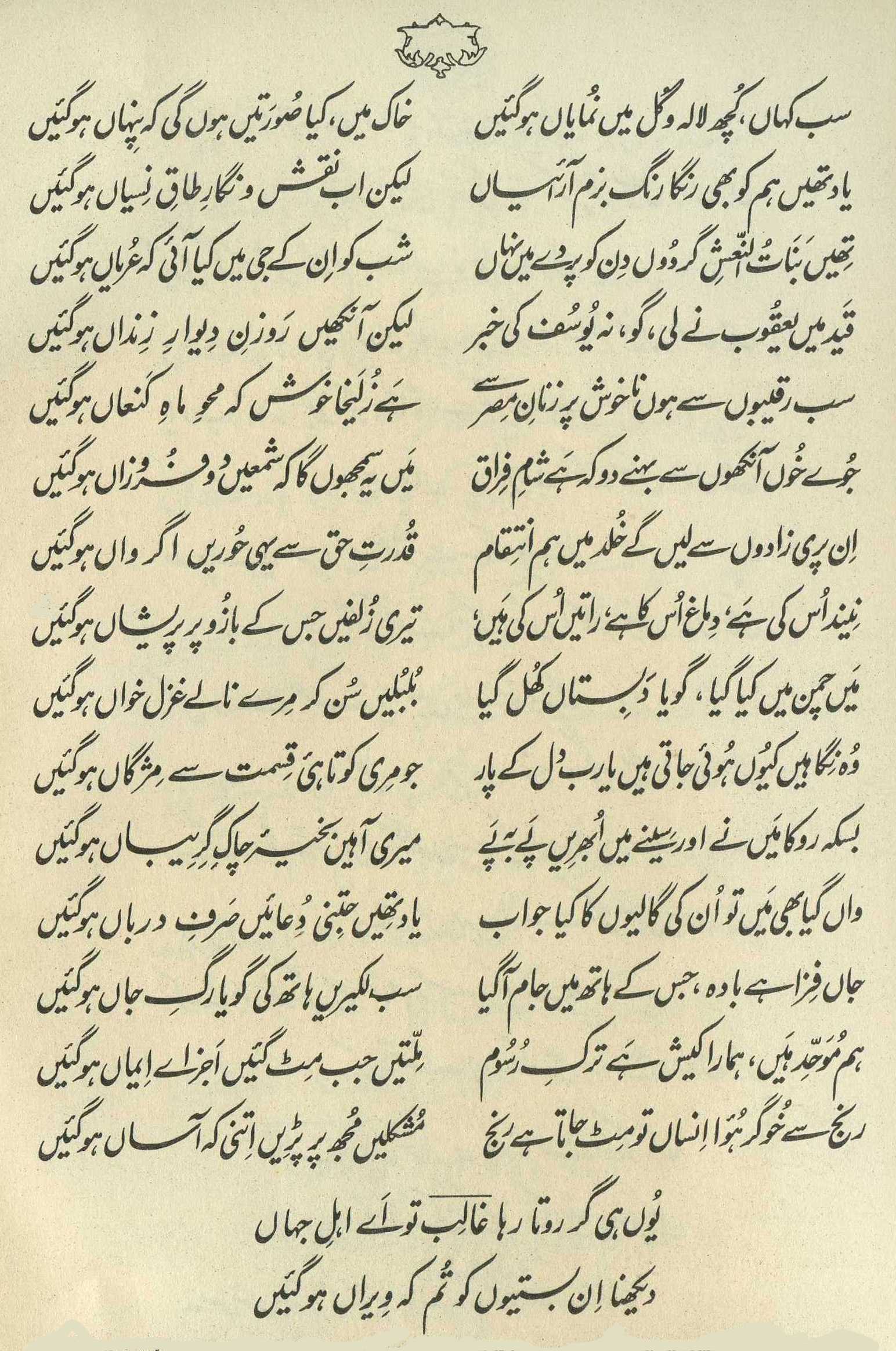
By the curls' being scattered/tangled he has created an implication of the fervor of lovemaking and the excess of kissing and embracing. There's no doubt that this verse is the high point of the ghazal , and a masterpiece []. (118)
== Nazm page 118

This verse is a 'razor' [=sharply effective masterpiece] among Mirza Sahib's 'razors'. Its praise and commentary are beyond expression. People of taste, according to their own ideas, can obtain pleasure from it. (168)
People of vision know-- [from this verse] there must have been an increase in enthusiasm, a rush of emotion, an intoxication in the glances, a smile on the lips. This is not a verse-- it is a created-universe [] of poetry. It is difficult to capture such a heart-captivating picture. (221)
How grateful I was to this verse, long ago! It was the first verse of Ghalib's that I ever truly and entirely understood, all by myself. My students often used to enjoy it in the same way, with a sigh of relief and pleasure, and a touch of self-congratulation. It's no small thing to understand a verse of Ghalib's all by yourself, for the first time-- including the wordplay.
The commentators mostly just go into raptures over this verse, rather than explicating it. Fortunately, we have the explanatory tools right at hand. In its general structure, it's a classic ' mushairah verse'. The first line is piquant but deliberately uninterpretable, so that we have to wait with suspense (under mushairah performance conditions) for the second line. Even then, the 'punch-word' is withheld until the very last moment: not until we hear are we able to go back and grasp the verse.
Grasp it, and savor it. For the absolutely perfect meaning-range of (see the definition above) permits the verse to have simple, intelligible, colloquial kinds of subtlety and sophistication. (This elusive combination is surely why everybody loves it so much.) The literal meaning of of course applies perfectly to the beloved's dishevelled hair. But the great prominence in Urdu of its metaphorical meanings simply compels us (though without a word of explicit instruction from the verse itself) to notice their applicability to the lover's condition in the first line.
The beloved's night-black curls are scattered, tangled, disordered on someone's shoulder-- and just for this reason, so are the lover's thoughts. Thus the lover says: sleep is his (and knowing this makes the lover himself too to sleep); conceit and delight of mind are his (and knowing this makes the lover himself too to think straight); the nights are his (and knowing this makes the lover's own nights wild with ). Thus her blissfully and erotically curls, since they lie disordered on somebody else's shoulder, make the lover utterly and helplessly . And as Nazm notes, through the vast and lovely power of implication , the effect is markedly erotic. (For other verses of erotic suggestion, see 99,4 . )
There's more wordplay as well: the curls, being black, are evoked by the 'nights'; the multivalent word can also mean 'head', thus creating an affinity with the shoulder and the curls.
It's also possible, though less piquant, to remove the overtones of jealousy/envy and read the verse as an abstract general statement, an admiring description of the (erotic) effect of the beloved's beauty. On this reading, it could be spoken by any friend or companion of the beloved's. I thank Mahmood Piracha for pointing this out (June 2021).
The verse also feels wonderfully flowing , with its rhythmic repetitions in the first line, and all its long vowels. The first line is about as semantically and syntactically simple as it can be, full of words of one syllable; and the second line itself isn't much more complex. In the second line, the juxtaposition also creates a kind of stuttering effect, that further suggests the lover's disordered state of mind.
For another, and very different, verse about the beloved's curls and the lover's thoughts, see 71,2 . Another case in point is 176,5 , which also plays on . For an elegant and amusing play on that doesn't involve curls at all, see 133,2 .
Is this verse really the ' high point of the ghazal ', as Nazm maintains? In this particular ghazal, it has a lot of competition.
graphics/zulfenbazu.jpg