Verse 21852aa;Nho ga))ii;N
G1
1
even/also we remembered colorful party-adornings
2
but now they have become ornaments in the niche of forgetfulness
'Adorning, gracing (used in comp.), e.g. , 'world-adorning'.
The abstract noun formed from .
'Decoration, embellishment; —designs; decorations, ornaments; —paintings, pictures'.
taaq>> : 'A recess (in a wall), a niche; a shelf'.
'Forgetting; —forgetfulness; oblivion'.
| References | |
|---|---|
| Arshi, Imtiyaz Ali | Ghazal# 114 |
| Raza, Kalidas Gupta | 426 |
| Hamid Ali Khan | Open Image |
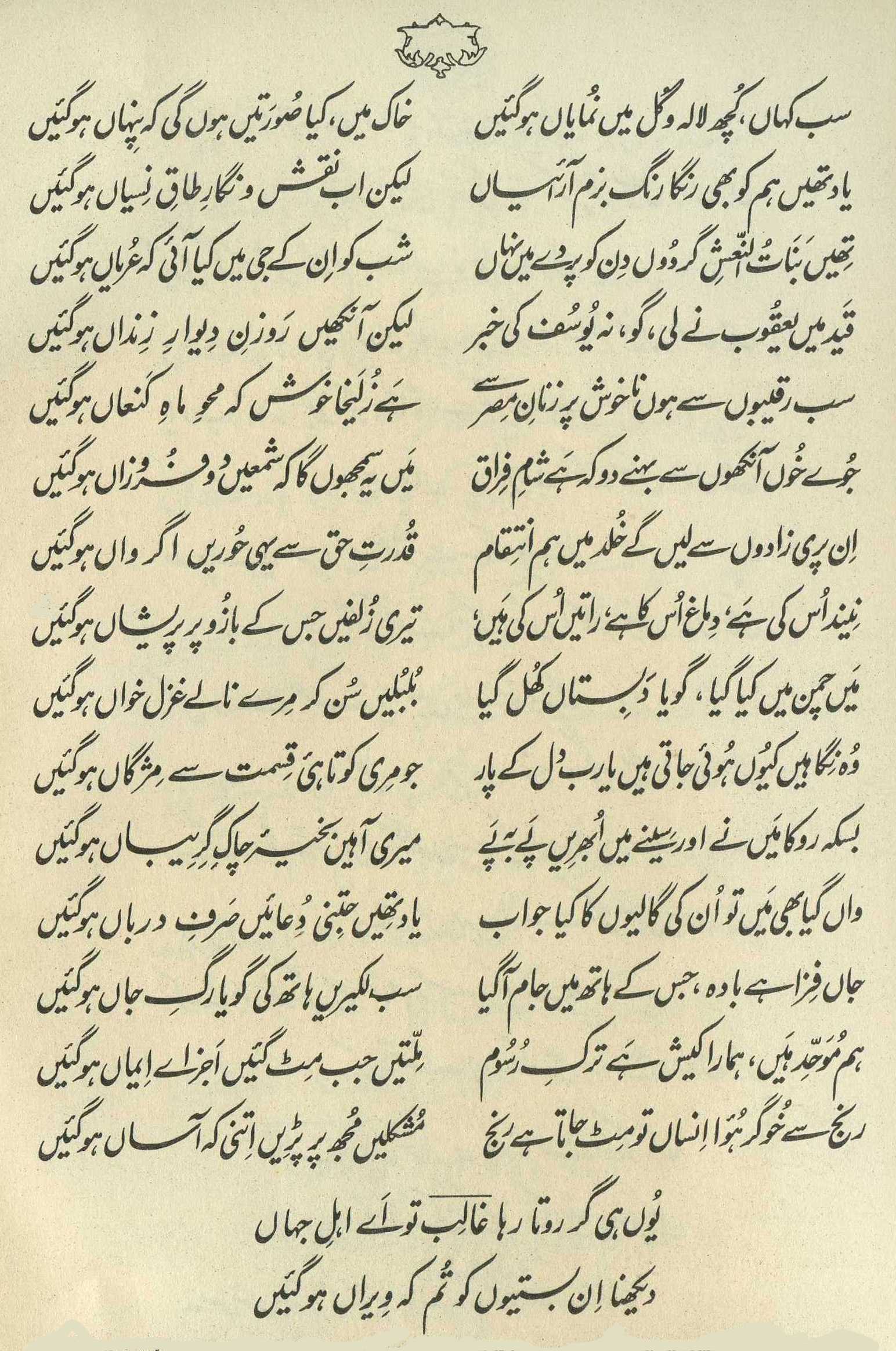
In this verse the word is worth noticing. If this two-letter word were removed from the verse, then how much the meaning of the verse would be reduced! And from this one word, how many additional meanings are suggested! One additional meaning is this: that the way you people always arrange colorful parties, at one time we too had an ardor for such gatherings. But now, look at our state, which ought to be a lesson for you: youth does not last. (116)
== Nazm page 116

The words of this verse are extremely refined [] and colorful, and this whole ghazal is an example of Rekhtah of a high standard. (94)
In this verse is a gesture toward the contemporaries. He says, we too, like you people, had ardor for arranging colorful gatherings, but after the season of youth has passed, now our state has become a lesson. That ardor and those gatherings have become ornaments in the niche of oblivion. Look at us, and learn a lesson. (166)
But now, our heart itself has been extinguished. Now we don't remember anything. Now our state is a source of instruction (that is, youth and enjoyment of the world don't last). And as full of instruction as the theme is, equally beautiful are the words too that Mirza has selected. (219)
Mirza has the habit of taking simple things and mixing them in his temperament to make them convoluted. (209)
The peerless beauty of this verse has so stupefied all [the commentators] that none of them have realized that in the light of the current interpretation, the verse becomes defective, because in it is unacceptable repetition. The result of this repetition is that the second line becomes entirely useless. In the first line it's said, 'at some time I remembered some things'; in the second line it's being said, 'but now I've forgotten them'. [This kind of casual redundancy is common in ordinary speech.] But in the world of the verse, in which every single letter ought to be valuable and meaningful, to give entry to such repetition is to destroy the craftsmanship. [So let's rethink the interpretation.]
The axis of this verse is the 'niche of forgetfulness'. If it had simply been said, 'have been forgotten', then the accusation of repetition would have become unavoidable. But for something to change into ornaments in the niche of forgetfulness doesn't imply its being forgotten. [The Persian usage of this idiom proves] that a thing doesn't spontaneously arrive in the niche of forgetfulness; rather, it's put there deliberately. Those party-adornings that have become ornaments in the niche of forgetfulness didn't arrive there by themselves. I put them in the niche of forgetfulness; that is, I deliberately forgot them.
But the matter isn't finished yet. Those party-adornings are not now present in the niche of forgetfulness. In their place, only 'ornaments' have remained. The meaning of this is that formerly I had put party-adornings in the niche of forgetfulness, then afterwards such a long time passed, or I put them out of my mind so forcefully, that those memories no longer existed even in the world of forgetfulness, but only remained in the form of some ornaments. To decorate the niche, in it or around it ornaments are placed. It's obvious that these ornaments are not real things, but representations of them. Thus the ornaments of the niche of forgetfulness are not memories of past party-adornings, but rather memories of memories of them. That is, now there's only the memory that there was a memory. What was remembered, is now no longer remembered....
The last point is that with 'niche of forgetfulness' the affinity of 'ornaments' is obvious. But the affinity of 'colorful' and 'ornaments' too should be noted.
== (1986: 169-71) 2006: 191-93
[Compare his comments on Mir's M 20,4 .]
On the 'niche of forgetfulness', compare 10,1 ; there the nature of such 'niches' has been discussed, and illustrated as well. That verse also suggests a larger parallel: the diminishing, fading, withering of what is put into the niche. In {10,1}, the whole Garden of Rizvan becomes a 'single bouquet' in our 'niche of forgetfulness'. In the present verse, the 'party-adornings' turn into mere mental 'ornaments', as Faruqi points out in his illuminating discussion of the second line.
Ah but those 'party-adornings' or even 'party-adorningnesses' [] in the first line have never ceased to fascinate and perplex me. They are one more in the list of pluralized abstractions that I'm collecting (see 1,2 for more examples). As in Platts's example (see the definition above), women are often named things like Jahan-ara, 'world-adorning'. Presumably this is meant to suggest that the woman herself is an adornment to the world, rather than that she goes around adorning the world the way one would decorate a room (for a party). Similarly, a women who was an ornament to any gathering might be described as 'party-adorning' []. And her quality would then be 'party-adorningness' [].
But what would we make of 'party-adorningnesses'? Plainly, we're forced into a realm of abstraction. Whatever they are, they are 'colorful' or 'variegated' []. So could they be the appearances of many beautiful beloveds at many parties, over time? Or perhaps after all we should, more suggestively, shift into the transitive mode, so that 'party-adorning' [] would be what a host or organizer does to arrange and decorate the scene of a party. (For another effort to push the suffix a bit further, toward something active like 'creating', see 189,7 .)
So if we remembered 'party-adornings', were we remembering the settings or scenes of many parties? Were we ourselves the party-arrangers, or did we just remember how elegant the decorations appeared? Either way, a party-decorator would surely have attractive and memorable ornaments placed in all available niches. So an affinity between the 'party-adornings' and the 'ornaments' and the 'niche' should surely be added to Faruqi's list.
Any other poet would just remember parties. Only Ghalib would remember 'party-adorningnesses', giving us not only the parties, but also all the extra overtones of will, desire, forethought, control (and a huge bonus of ambiguity). We who remembered the party-adornings are also just the ones able and willing, if we so choose, to collapse the memories and pack them off, diminished, transformed, into the niche of forgetfulness. For another complex use of 'party-adornings', see 153,7 .
The commentators, as usual, choose a lugubriously moralistic tone: 'Look at wretched me, you young things! I'm an object lesson in helplessness and the passing of youth!' Why shouldn't the tone be friendly but firm, maybe with a politely assumed overtone of regret, the way someone who has business elsewhere might decline an invitation to share in some undesired activity: 'Well, I used to be interested in such things, but now they no longer hold any appeal for me. You do the party-arranging, and I'll decline with thanks.' This is, after all, very much the tone of 10,1 , in which the Ascetic with his particular Garden of Rizvan is politely but firmly put in his (very minor) place.
On the translation of as 'have become', see 38,1 .
graphics/decorations_bosschaert_1619.jpg