Verse 7after 1816aachaahiye
G14
1
in my/one's own disgrace, as if any effort succeeds!
2
only/emphatically a beloved [who is] tumult-creating is needed
'Dishonoured, disgraced, infamous, ignominious; humiliated; open, notorious; accused; one held up to public view, as an example to deter'. (Steingass p.576)
'Endeavour, attempt; exertion, effort; enterprise, essay; purpose'.
'A convention, an assembly, a meeting; a crowd; —noise, tumult, commotion, confusion, uproar; sedition, disturbance, disorder; an affray; assault: — , adj. Exciting tumult; creating a disturbance, &c.'.
| References | |
|---|---|
| Arshi, Imtiyaz Ali | Ghazal# 186 |
| Raza, Kalidas Gupta | 299-300 |
| Nuskhah-e-Hamidiyah | 266 |
| Hamid Ali Khan | Open Image |
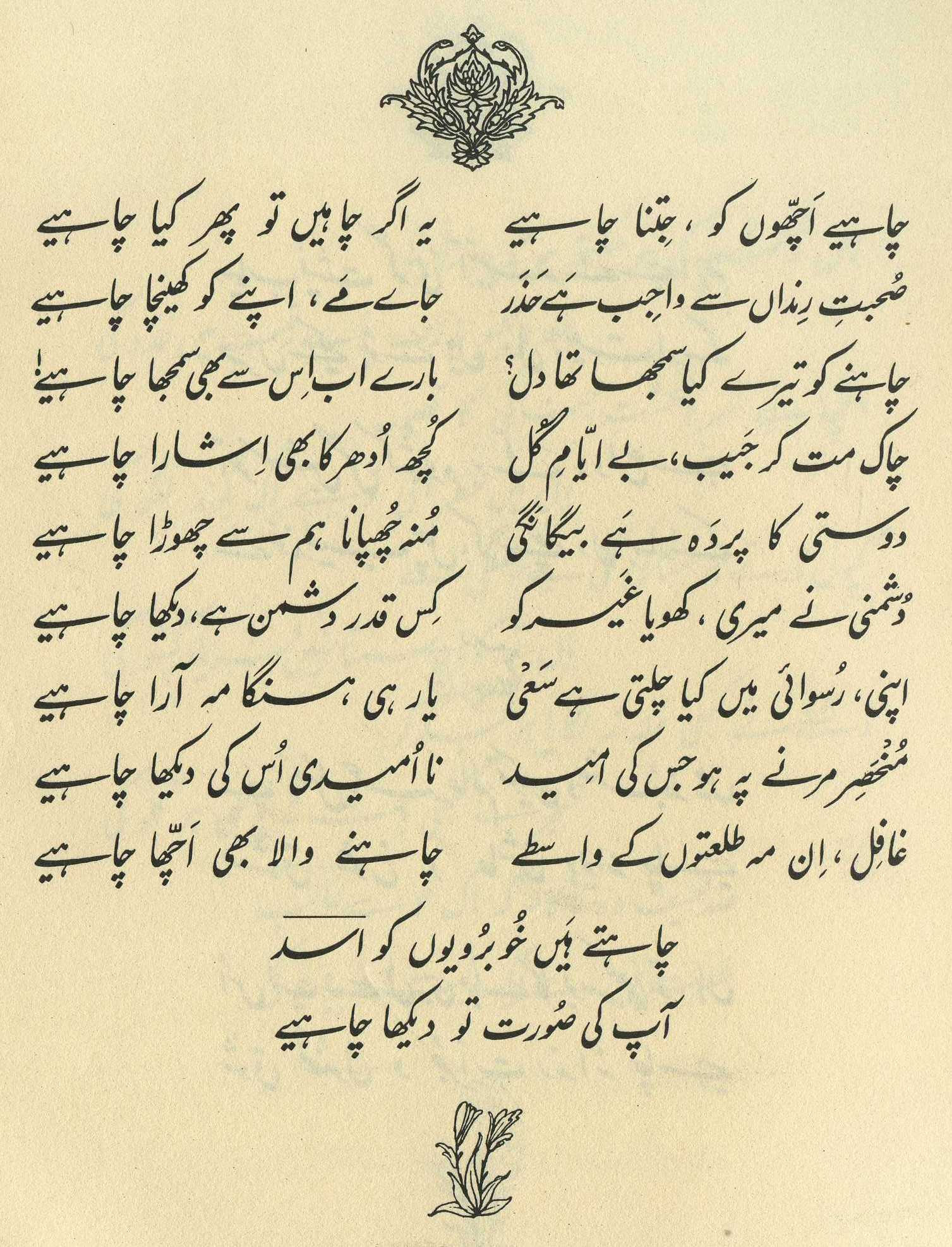
We may want a hundred thousand times to make ourselves disgraced, but no effort succeeds. This field is in the hands of only/emphatically the beloved. That is, she would make whomever she chooses impatient and restless, and then disgrace him. (211)
== Nazm page 211

He says, 'We can't through our own efforts even make ourselves disgraced. Even our ill-fame is dependent on her tumult-creatingness.' That is, whomever she might choose, by showing him the smallest glimpse she would make him agitated and restless, and this would become the cause of agitation and restlessness and ill-fame and disgrace. (270)
In love, where many things are contrary to intelligence, when love becomes extremely great then in some hearts is born a longing for a Majnun -like madness and ill-repute. He says that our disgrace is not within our range of possibility; this can take place only through the beloved's tumult-creatingness. That is, she should be such a fight-seeker, so bad-tempered, so heedless, that ill-repute would come about. (369)
As a rule, Ghalib places great emphasis on independence and self-reliance (for more on this, see 9,1 ); here, by contrast, is a rare counter-example: a situation in which self-reliance simply doesn't work. But what situation is it, exactly? The commentators are sure that it's one in which the lover wishes to achieve disgrace, but is unable to manage it on his own. That's possible, no doubt.
But the grammar would also support the idea that the lover is speaking from within a state of disgrace, and is unable to do something (or anything?) while he's in it-- whether he would wish to increase it, to mitigate it, to conceal it, or something else, we can't tell. It's even possible that the 'disgrace' is in the eyes not of the world but of the beloved, so that it's a question of his falling somehow from her favor. Under mushairah performance conditions, we have to wait hopefully for enlightenment in the second line.
The second line does at least suggest a panacea: whatever is wrong in the first line can be fixed by having a beloved who is, if we read with enjoyable literalness, 'tumult-adorning' or 'tumult-gracing', though the usual sense (see the definition above) is 'tumult-creating'. (Compare the active sense of in 111,2 .)
Real 'disgrace', and/or action by one in a state of disgrace, thus depends entirely on the agitational powers of a beloved: she needs both to 'stir up trouble' through her beauty and flirtatiousness, and then to 'adorn' the turmoil she herself has evoked. For if she doesn't stir it up, where will it come from? Not, in this verse, from the lover. He has somehow been made helpless to achieve a state of disgrace, or else has been paralyzed by being in a state of disgrace. The necessary beloved should be, in short, a real hell-raiser.
graphics/hurricane.jpg