Verse 9after 1816aachaahiye
G14
1
you want fine-faced ones, Asad
2
your 'face' is worth seeing!
'Form, fashion, figure, shape, semblance, guise; appearance, aspect; face, countenance; prospect, probability; sign, indication; external state (of a thing); state, condition (of a thing), case, predicament, circumstance; effigy, image, statue, picture, portrait; plan, sketch; mental image, idea;--species; specific character, essence;--means; mode, manner, way'.
| References | |
|---|---|
| Arshi, Imtiyaz Ali | Ghazal# 186 |
| Raza, Kalidas Gupta | 299-300 |
| Nuskhah-e-Hamidiyah | 266 |
| Hamid Ali Khan | Open Image |
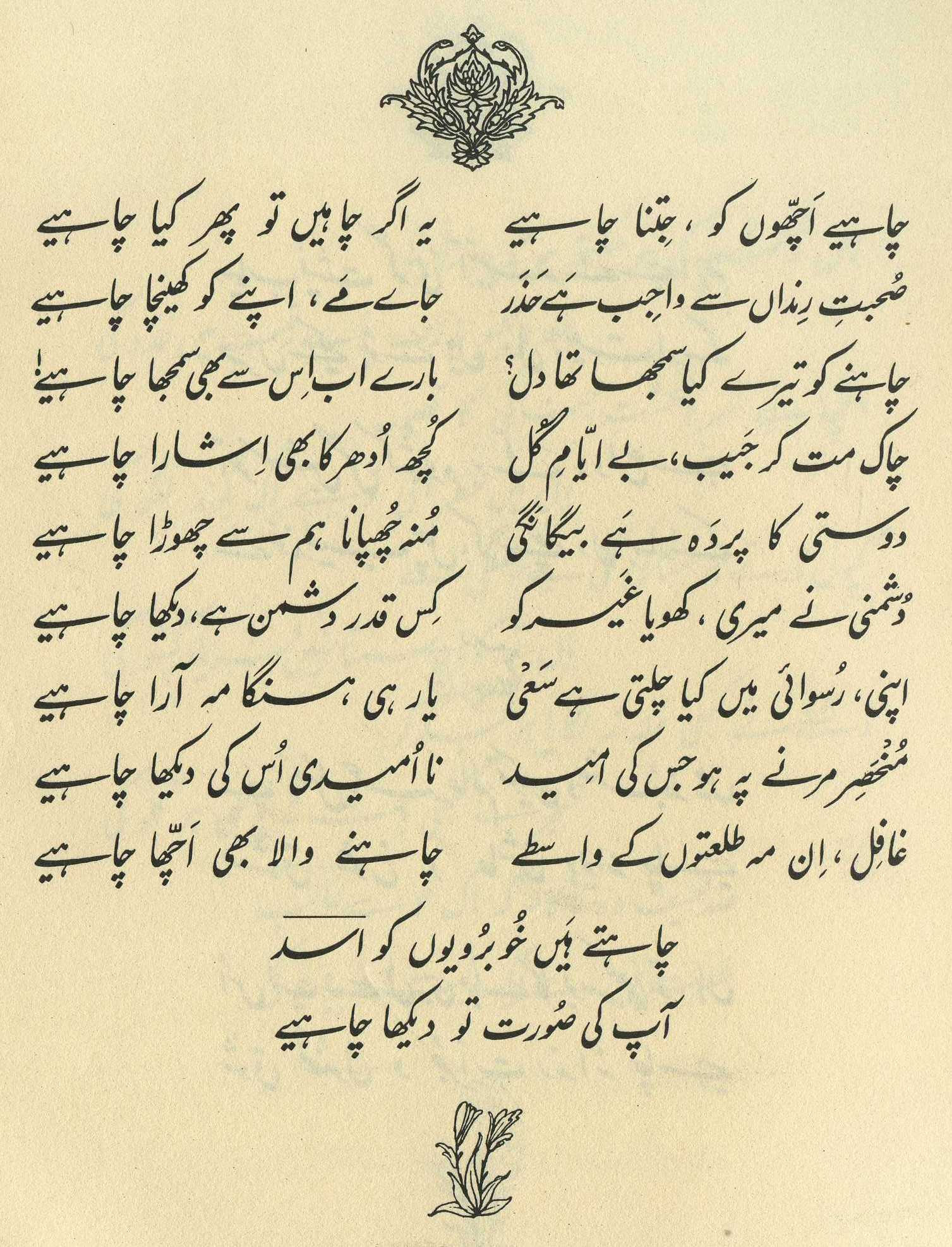
When some individual would seek to transgress beyond his limit, then to chasten him they say, 'Just look at your 'face' []-- is this worthy of that?!'. (211)
== Nazm page 211

He says, here's something new-- just look at the spectacle! Hazrat Asad too claims to be attracted by beautiful ones! Just please consider his 'face'/aspect. That is, when would any beautiful-faced beloved feel attraction for such an unappealing face? (271)
Here's something new-- you want beautiful ones! Just please look at your 'face'. That is, it's a miracle of the Lord-- love between you, and beautiful ones! (370)
This verse marks the beginning of a two-verse verse-set that includes {189,9-10}. Many editors, including Hamid, not only don't mark this verse-set, but also reverse the order of the final two verses of the ghazal, no doubt because it's unusual for the pen-name to appear in the penultimate verse. As always, I follow Arshi. And I do so all the more willingly because the other verse, 189,10 , so clearly follows the same train of thought as this one.
On the grammar of , see 1,3 .
The wonderfully protean (see the definition above) is a word that ranges constantly from the physical ('face') through the all-purpose ('aspect') to the abstract ('state of affairs'). And here the second line is so vague, yet so charged and forceful-- it's really a moral imperative, something like 'ought to be seen'-- that the whole effect is to call attention to the crucial importance of (with of course the wordplay of 'looking at' (a face) as a piquant reminder of its literal meaning).
But what is it exactly about the first line that demands the disdainful, exclamatory corrective of the second line? Here are some possibilities:
=You want fine-faced ones-- but your own face is 'worth seeing', for the sheer contrast with such beauty.
=You want fine-faced ones-- how do you have the 'face' to (or, the nerve to; or, the gall to) aspire so high?!
=You want fine-faced ones-- but your 'situation' or 'condition' renders that aspiration absurd.
=You present yourself as a lover-- you, in the 'guise' or 'semblance' of a lover, are a sight worth seeing!
=You aspire to be a lover-- let's see how your 'plan', your 'idea', turns out!
And so on, and so on. One good verse for comparison: 161,1 , in which plays an almost equally protean role in making the verse slippery and multivalent. Another verse from the same ghazal is 161,10 , in which is used in the same idiomatically disdainful way that is in the present verse.
But then, this verse is also the beginning of a verse-set; so it should also be read in conjunction with 189,10 .
graphics/face.jpg