Verse 1after 1847arnahii;N aatii
G8
In this meter the first long syllable may be replaced by a short; and the next-to-last long syllable may be replaced by two shorts.
1
no hope comes to fruition
2
no aspect/prospect/face/form comes into view
'Fruit, produce, seed, leaf; profit, advantage'. (Steingass p.166)
'Form, fashion, figure, shame, senblance, guise; appearance, aspect; face, countenance; prospect, probability; sign, indication'.
| References | |
|---|---|
| Arshi, Imtiyaz Ali | Ghazal# 214 |
| Raza, Kalidas Gupta | 400-01 |
| Hamid Ali Khan | Open Image |
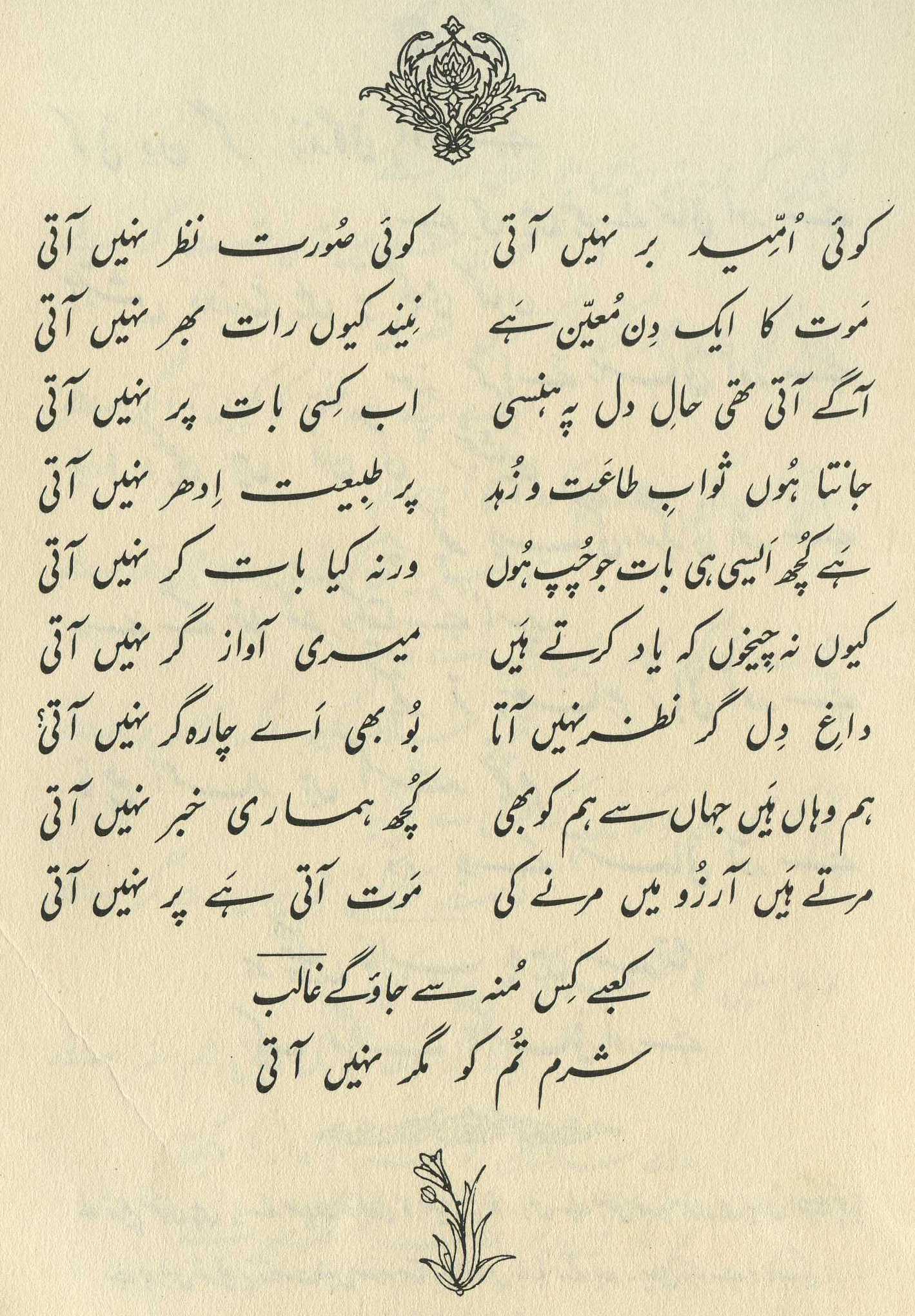
[n.d., to Shaikh Latif Ahmad Bilgrami:] That the pride of inventiveness of the age, a friend like Maulana Fazl-e Haq, should die, and the half-dead Ghalib should remain half-alive! : {161,9}; {161,3}. If I were young and sick, then I would want from you a prayer for health. I've become an old man of eighty years. I'm in hopes of a prayer for merciful release! Wine, the wretched thing, even now can't be left behind. Even now I don't have the habit of doing the prayers: {161,4}; {161,10}.
==Urdu text: Khaliq Anjum vol. 2, p. 832
==on the dating of this letter see Ghulam Rasul Mihr, , vol. 2, p. 919
[1862, to Ala'i:] I'm having to worry about camphor and shroud-- that tyrant is in search of poetry! If I were alive, then why wouldn't I myself come there? Remove this much of the trouble from me-- compose some verses in that ground , and send them to me. I'll give correction and send them along. 'The sceptre of a pir, is proper for a pir' []. By God, my poetry in Hindi or Persian-- nothing of it is in my possession. Previously whatever was present in my memory, I wrote down and sent along. Now whatever has come to mind, I write: [two Persian ghazals; then seven verses of this ghazal-- {161:1, 3, 2, 7, 4, 8, 10}; then six verses of 191 : {191:1, 2, 5, 8, 4, 9}.] ==Urdu text: Khaliq Anjum vol. 1, pp. 392-93 ==A reproduction of this letter: * Routes *
[1862, to Ala'i:] I'm having to worry about camphor and shroud-- that tyrant is in search of poetry! If I were alive, then why wouldn't I myself come there? Remove this much of the trouble from me-- compose some verses in that ground , and send them to me. I'll give correction and send them along. 'The sceptre of a pir, is proper for a pir' []. By God, my poetry in Hindi or Persian-- nothing of it is in my possession. Previously whatever was present in my memory, I wrote down and sent along. Now whatever has come to mind, I write: [two Persian ghazals; then seven verses of this ghazal-- {161:1, 3, 2, 7, 4, 8, 10}; then six verses of 191 : {191:1, 2, 5, 8, 4, 9}.] ==Urdu text: Khaliq Anjum vol. 1, pp. 392-93 ==A reproduction of this letter: * Routes *

That is, no 'aspect/prospect' of the fulfillment of hope. (173)
== Nazm page 173

He says, no aspect/prospect of the achievement of hope is visible at all. Life is passing in failure and despair. (230)
No hope of ours is fulfilled, and not only is it not fulfilled today, but rather in the future too no aspect/prospect of its fulfillment can be seen. (309)
This ghazal was also printed in the 'Ashraf ul-akhabar' [] (Delhi) 1,7 (1 December 1866). (314)
The wordplay with (see the definition above) screams out for attention. (For another verse that does exactly the same trick with , with the same force and seeming 'simplicity', see 189,9 .) On the commentators' reading, the two lines both describe the same condition of despair: no hope is fulfilled, no prospect of success is visible.
But of course, the first line might describe a general condition, and the second line might offer a particular, even a crucial or preeminent, example of it. No hope is fulfilled: that is to say, no face/form is to be seen; the use of 'to come into view' [] surely invites us to consider an actual physical object of sight. The hope is perhaps for even a brief glimpse of the beloved's adorable face or form-- a modest, rock-bottom hope. The hope is not even for a meeting, much less for union with the beloved. It is for the least possible desire of the lover-- and even then, it's destined to remain unfulfilled.
Since the two readings are far from mutually exclusive, the sense of must oscillate endlessly back and forth, between naming a general lack (of any aspect or prospect of hope), and naming an all too specific lack (of a sight of her face or form) which is also the most probable content of the general lack. After all, this is just how the lover's own mind moves, and how his life passes away.
graphics/nothingness.jpg