Verse 9after 1847arnahii;N aatii
G8
In this meter the first long syllable may be replaced by a short; and the next-to-last long syllable may be replaced by two shorts.
1
{we're dying to die / 'we die in the longing to die'}
2
death comes-- but does not come
| References | |
|---|---|
| Arshi, Imtiyaz Ali | Ghazal# 214 |
| Raza, Kalidas Gupta | 400-01 |
| Hamid Ali Khan | Open Image |
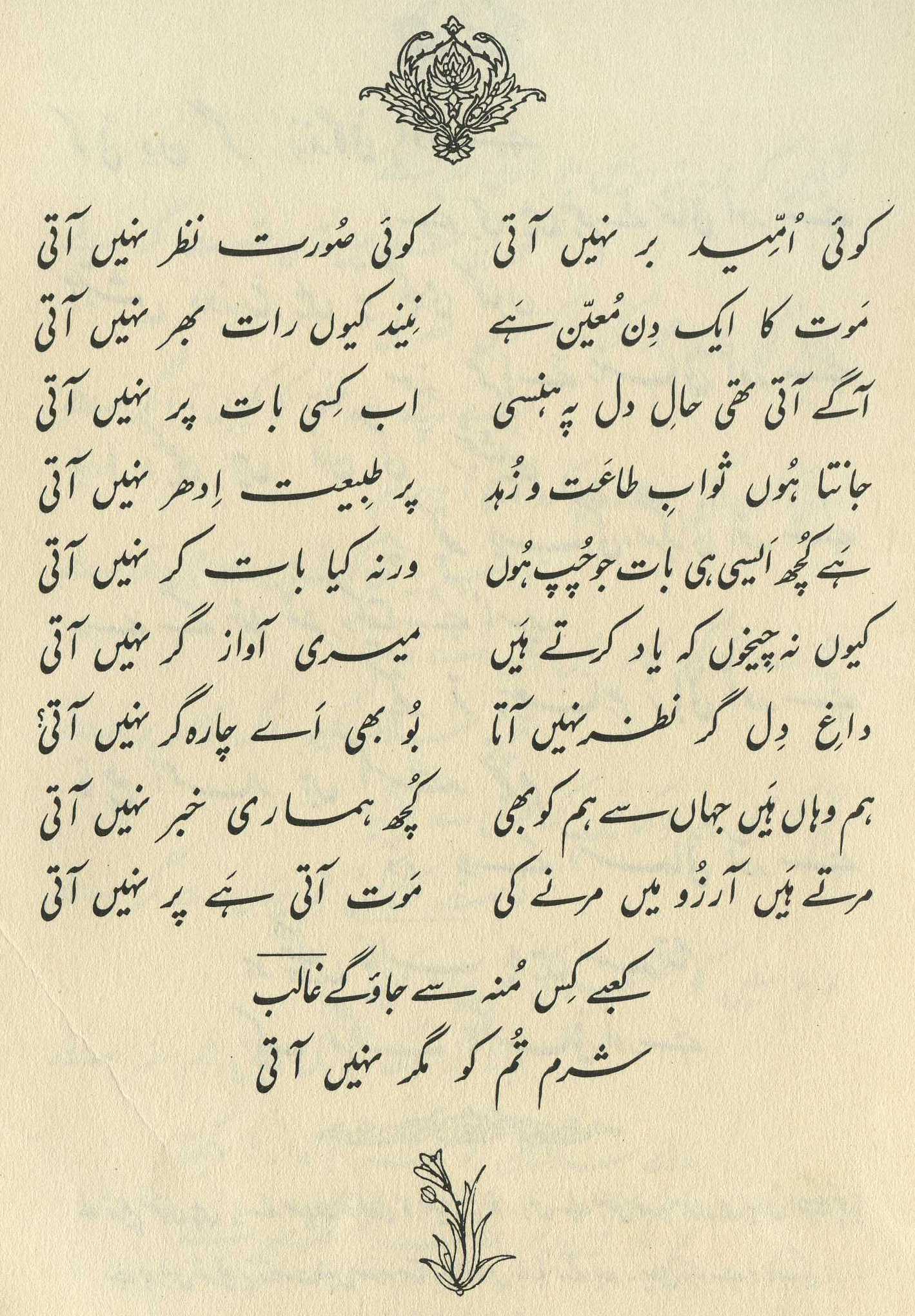
The first is hypothetical [] and conveys an excess of ardor; the second is in its true meaning. (174)
== Nazm page 174

He says, 'we die'-- that is, we are extremely ardent and longing for death. 'Death comes'-- that is, the coming of death is necessary and inevitable; night and day we keep hearing of the deaths of hundreds of people. But to us 'death doesn't come', we don't die. (232)
= 'does not in any way come'. We have an extreme longing that death would come, but it doesn't by any means come. (311)
A verse of wordplay (and meaning-play too, as Faruqi would point out). Fortunately-- and perhaps by no coincidence, since the mental move is so basic-- we can capture some of it very well in English. 'We're dying to die' is an excellent colloquial counterpart for the first line, and captures its ostentatiously paradoxical quality.
Alone among the commentators I've looked at, Bekhud Mohani claims to point to a special idiom: , he says, means something like 'doesn't by any means come'. Perhaps it would then be similar to , which literally means 'even accidentally/forgetfully doesn't come', but has the sense of 'doesn't by any means come'. (There's also the related idiomatic expression of the form , 'even upon being done, wouldn't get done'-- or, 'doesn't by any means get done'; see 191,8 for more on this.) Does, or did, this exact idiom really exist, or is Bekhud Mohani improvising a bit? I don't know.
Other commentators have no trouble finding other ways to read the second line: death comes (to everybody), but doesn't come (to the speaker), for example, as Bekhud Dihlavi proposes. Far more potent, however, is the more general sense in which the night of separation is one long near-death experience, without the closure or release of actual death-- the sense perfectly captured in the second line of 20,8 .
graphics/death.jpg