Verse 8after 1847arnahii;N aatii
G8
In this meter the first long syllable may be replaced by a short; and the next-to-last long syllable may be replaced by two shorts.
1
we are there, from where even/also to us
2
no information about us comes
| References | |
|---|---|
| Arshi, Imtiyaz Ali | Ghazal# 214 |
| Raza, Kalidas Gupta | 400-01 |
| Hamid Ali Khan | Open Image |
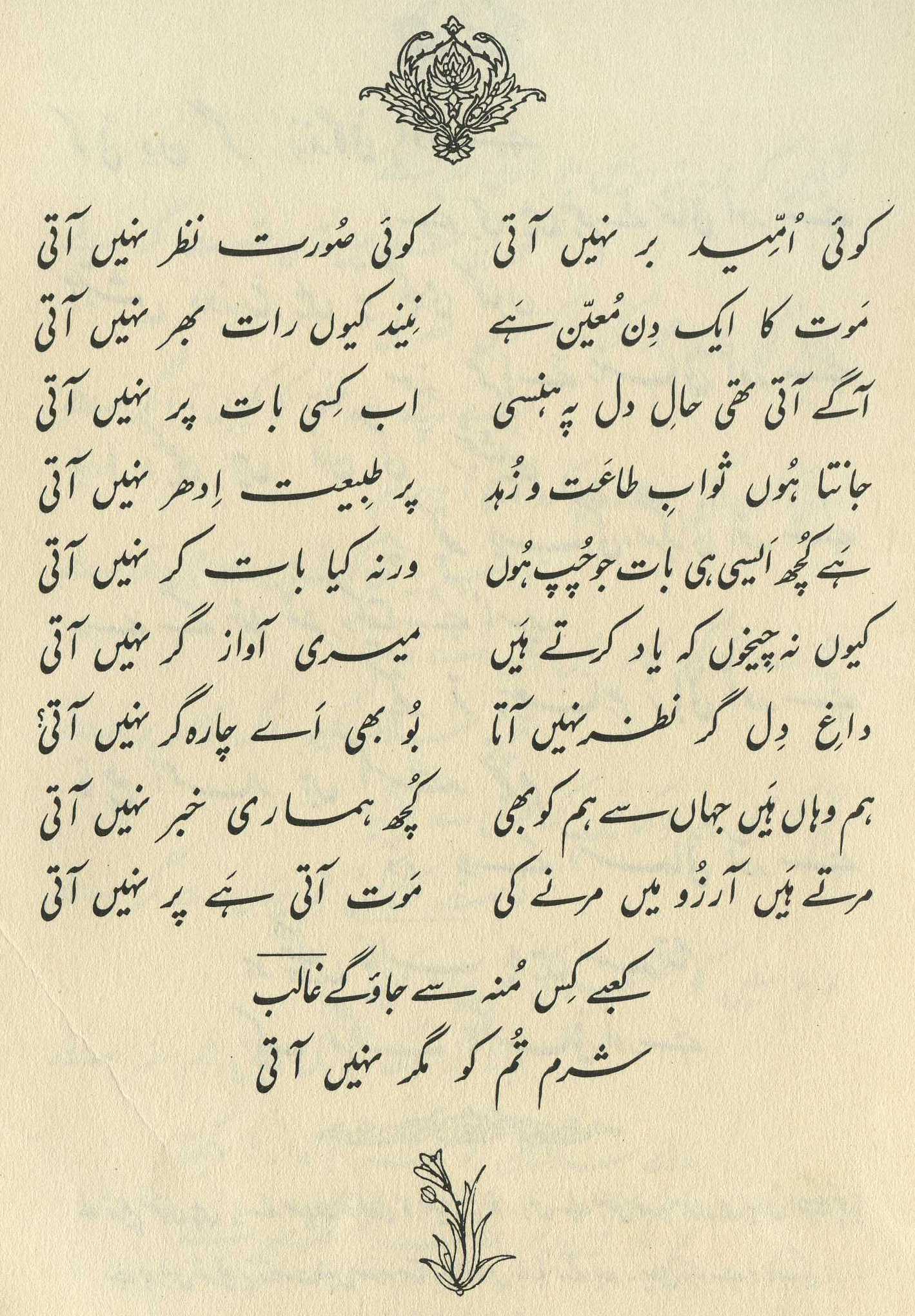
That is, we're beyond ourselves in such a way that we know nothing about our state. (174)
== Nazm page 174

He says, self-transcendence and self-forgetfulness have increased to such an extent that we are unaware of our state. (232)
In Sufism, there are a number of levels of self-lessness, and one of them is that a man would no longer have even a thought of his own existence. (310)
[See his discussion of Mir's M 724,2 .]
Such a simple, stark little verse; it's very effective-- and as so often, it's capable of being read in a number of moods and intonations. But its terse, telegraphic quality is perfect for a sort of truncated explanation of the lover's failure to communicate. This one finds its real nature if read as a postcard from the void.
graphics/emptiness.jpg