Verse 3after 1847arnahii;N aatii
G8
In this meter the first long syllable may be replaced by a short; and the next-to-last long syllable may be replaced by two shorts.
1
before, laughter used to come at the state of the heart
2 a
now it doesn't come at anything
2 b
now it comes at nothing
| References | |
|---|---|
| Arshi, Imtiyaz Ali | Ghazal# 214 |
| Raza, Kalidas Gupta | 400-01 |
| Hamid Ali Khan | Open Image |
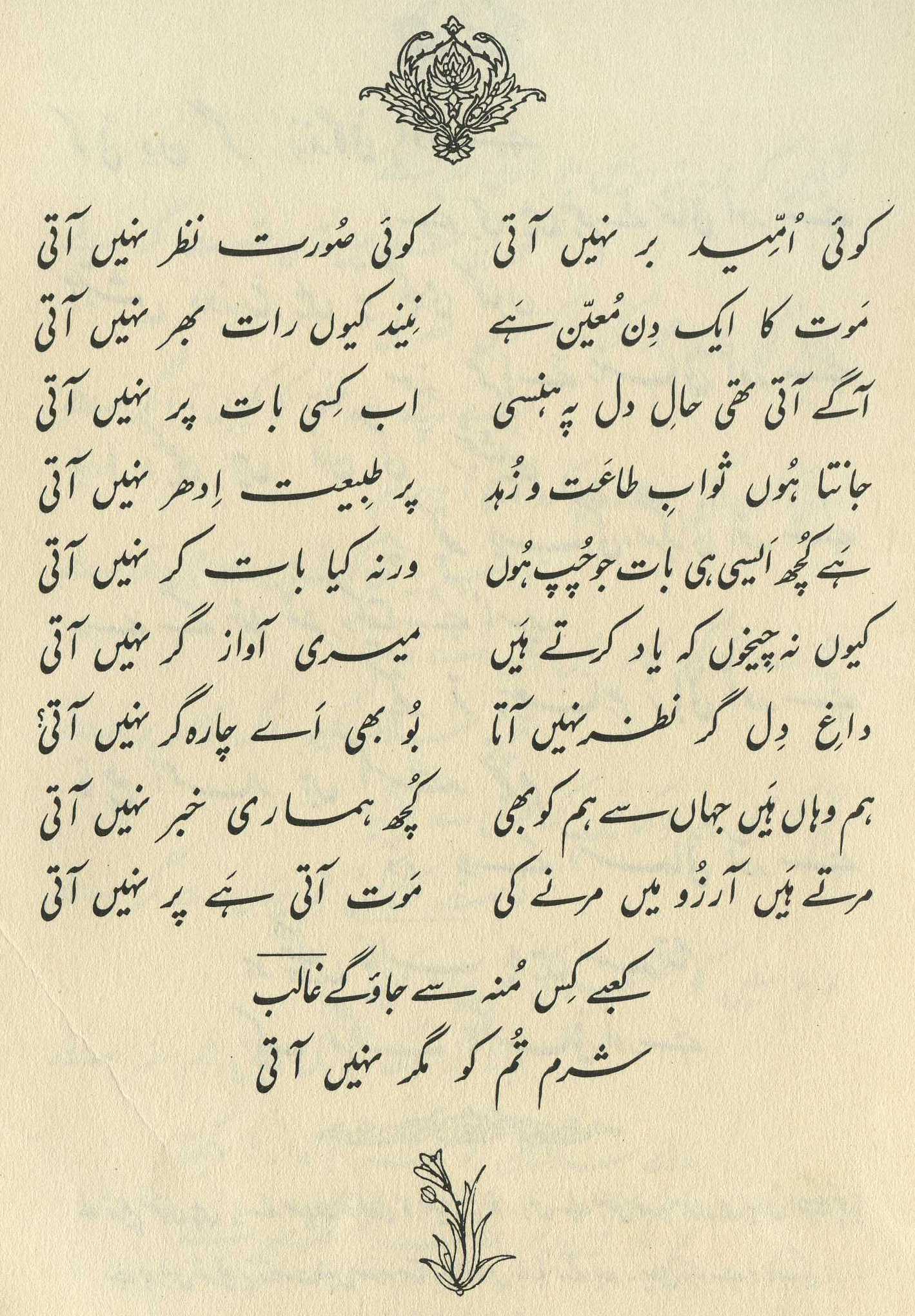
This is a verse that even Mir ought to envy. Under what a rubric he's presented sorrow of the temperament, and how excellently he's presented a commentary on it! (173)
== Nazm page 173

We never laughed very much. Indeed, sometimes we laughed at the heart's restlessnesses, the heart's anxieties, the heart's unheard-of yearnings. But now sorrow has reached such a limit that we don't laugh at anything. (309)
Here apparently there's no [special] point. But suddenly it becomes clear that the meaning of the second line can also be that now laughter comes at nothing, or rather, at the matter of silence. Now this verse seems to be based on the theme of madness and mental defect, rather than despair and sorrow. Because of this specialty of Ghalib's, it's very difficult to make a selection of his poetry.
-- S. R. Faruqi, , p. 61
This is another brilliantly simple verse that works by implication . It's so impersonally phrased that it could almost be spoken about someone else. But of course we know that it's the lover's own voice.
The speaker/lover used to laugh (ruefully?) at the state of his own heart. Why then does he now not laugh at anything? Here are some possibilities:
=Because the state of the heart used to amuse him, but now the heart's state is so grim that it's not amusing any more.
=Because his heart is now gone completely, having melted into a pool of blood, so it's no longer there to laugh at.
=Because he's now too depressed and grief-stricken to feel like laughing.
=Because now he's almost catatonic with suffering, and no longer responds to anything in the world.
Or, to adopt Faruqi's clever reading, because now he laughs at nothing-- that is, he's truly gone mad.
graphics/despair.jpg