Verse 7after 1847arnahii;N aatii
G8
In this meter the first long syllable may be replaced by a short; and the next-to-last long syllable may be replaced by two shorts.
1
if the wound in the heart doesn't come into view
2
doesn't, oh healer, even the smell come?
| References | |
|---|---|
| Arshi, Imtiyaz Ali | Ghazal# 214 |
| Raza, Kalidas Gupta | 400-01 |
| Hamid Ali Khan | Open Image |
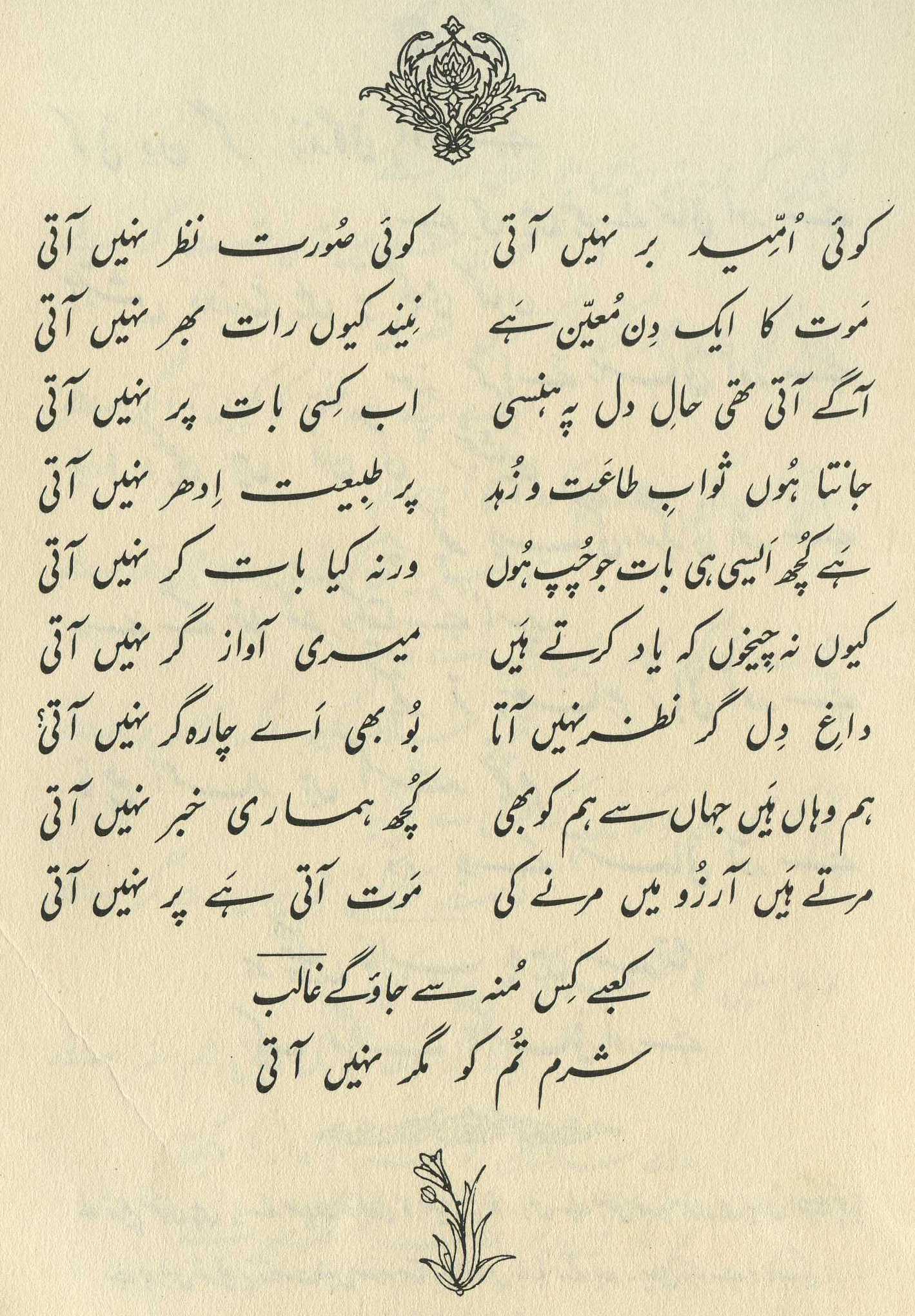
In the second line is a rhetorical question, and reproach of the incomprehension of the healer. (174)
== Nazm page 174

He says, 'Oh healer, I agree that the wound of my heart is veiled, that is, it is hidden within my breast, so that you can't see it. But, oh wretch, is your nose closed, that you don't even smell the aroma of its burning? With my breath, the scent of a kabob is coming, and you can't smell it, and deny that the heart is a kabob.' In the second line is a rhetorical question. (231)
[The commentator] Janab Shaukat says, 'The second line will probably be like this: '. How is more eloquent than ? In the appearance and expression of blame begins to be seen. (310)
He reproaches the healer's incomprehension. In the wound of the heart there is burning. From burning or fire meat [] burns; the smell of the burning meat always arises. Thus he says with irritation to the healer, 'If you can't see the sorrow-wound in my heart, can't you even smell it?' Only from the smell can you estimate the nature and existence of the wound of the heart. (280)
If you can't see the wound of the heart, then don't you at least smell the burnt meat []? (680)
The result of the wound can be that the meat [] would burn, and a smell would emerge from it. (532)
The theme of burning or burnt meat and its smell will seem unattractive to modern tastes. Mir too has used it [M 485,7 ]:
[perhaps the heart roasted in the fire of grief
for some time there's been a smell like a kabob]
The fact of some particular theme's being declared attractive or unattractive in some age cannot establish the excellence or inferiority of that theme. But neither of these verses is of an especially high order....
[Shaukat Merathi is wrong to object to .] By means of the word he has challenged the healing ability of the healer, and proved his ignorance. In such a situation, by means of the direct address he has created force in his speech: 'Oh healer, don't you understand even this much?'
== (1989: 285-86) 2006: 309-10
Everybody quite rightly reads the second line as a question. But we do so only for semantic reasons, since it appears as a flat statement. Such is the power of the colloquial omission of 'kya'.
Everybody agrees that in the ghazal world the lover's wounded heart is on fire and burning, and eventually may burn away completely (see 5 for several examples). But can that metaphor be fruitfully concretized in a culinary direction, with the heart as burning/roasting meat or even explicitly as a 'kabob'? Plenty of poets have thought so, including Mir, as Faruqi points out.
The commentators here are also very comfortable with the vision of burnt or roasted meat; Bekhud Dihlavi explicitly brings in the kabob itself. In my view, this image crosses the line into the category of 'grotesquerie'-- excessive physicality, of a grossly detailed kind that, poetically speaking, just doesn't work. Kabobs have too many other qualities-- they drip with juice, they may be greasy or chewy, they are surrounded with onions and green peppers, they are delicious-- that interfere with our imagining of the lover's wounded heart.
To what extent does Ghalib encourage this kind of explicit 'meat' vision? Certainly he opens the possibility, for what other kind of 'smell' could be expected to come from the wounded heart, if not that of burning? (Don't think of smelly pus or gangrene; those are not in the ghazal's repertoire of ailments.) And what other 'objective correlative' do we have except the physical, fleshy, meaty heart itself, that could generate an actual smell of burning or roasting? So it's certainly not a forced interpretation. And don't forget that in 6,4 the lover cheerfully imagines his heart as a feast, and his friends as enjoying it to the full extent that their 'lips and teeth' permit.
But in the present verse, Ghalib does also distance himself a bit from the physicality of it. There's that rhetorical question, after all-- the lover doesn't himself say anything about burning, but only makes an inquiry. And the inquiry seems sarcastic, irritated-- perhaps the lover is patronizing the poor inept would-be healer, or insulting him by pointing out his incompetence. Perhaps the rhetorical thrust, the desire to make a strong sarcastic sneer, outweighs any attempt at clinical description of actual burning flesh or roasting meat.
But it's also possible that the verse may be describing the metaphysical or transcendent nature of the fire in the heart; think of 5,3 , in which the lover's fiery sighs were in a universe of such fancy nonexistence that they no longer burned even the feathers of the Anqa. Possibly the lover is just calmly describing to his doctor the (new?) refinement or subtlety that his burning passion has attained, and forgiving him for his inability to diagnose it. This reading makes the verse an elegant introduction to the next verse, 161,8 .
I can't resist adding one more 'kabob' example from Mir [M 117,8 ]:
[the scent of a roasted kabob comes somewhat into my nose
very likely, oh breeze, last night someone's heart burned]
graphics/kababs.jpg