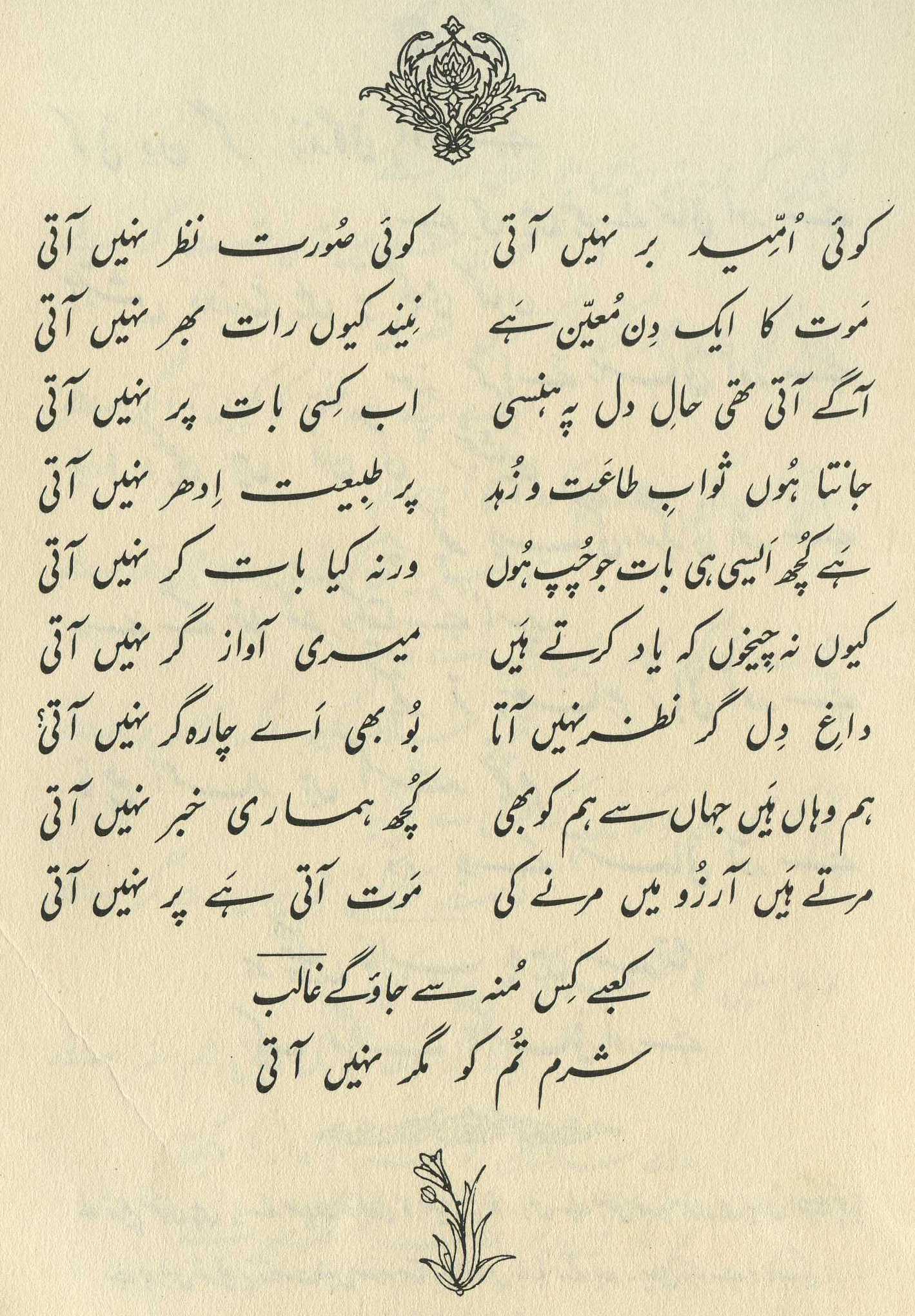
Verse 4after 1847arnahii;N aatii
G8
In this meter the first long syllable may be replaced by a short; and the next-to-last long syllable may be replaced by two shorts.
1
I know the reward/merit of obedience and abstinence
2
but my temperament doesn't incline/'come' this way
'Recompense, compensation, requital, or reward (especially, of obedience to God); the reward of virtue in the future state; a meritorious or virtuous act'.
ta((at>> : 'Obedience, submission, submissiveness; devotion; obsequiousness'.
'Abstinence; continence; devotion'.
tabii((at>> : 'Nature, disposition, constitution, temperament (syn. ); a humour (one of the four); complexion; genius; mind; temper; natural constituent, intrinsic property, essence'.
| References | |
|---|---|
| Arshi, Imtiyaz Ali | Ghazal# 214 |
| Raza, Kalidas Gupta | 400-01 |
| Hamid Ali Khan | Open Image |
[To illustrate Ghalib's lack of self-pity and his lively sense of humor, Azad quotes from one of his letters to Majruh:]
Mir Mahdi, you’ve forgotten my habits. In the auspicious month of Ramzan, have I ever missed the late night prayer at the Jama Masjid? How could I have stayed in Rampur during this month? The Navab Sahib [of Rampur] didn't want me to leave, and kept dissuading me at great length. He kept tempting me with the mangoes of the rainy season. But my friend, I came away in such a manner that I reached here on the night of the new moon. Sunday was the first day of the holy month. Since that day, every morning I go to the mosque of Hamid Ali Khan and hear Maulvi Ja'far Ali Sahib reciting the Qur'an. At night, I go to the Jama Masjid and offer the late-night prayer. Sometimes when I feel like it, at the time of the breaking of the fast I go to Mahtab Garden-- I break my fast, and drink the cool air. Bravo, bravo! -- in what a good way my life passes!
Now listen to the true state of affairs. I had taken the boys with me. There they gave me no peace. I was afraid that if I sent them alone, and, God forbid, some accident happened on the road, the reproach would remain for my whole life. For this reason, I came away quickly.
From the first of Ramzan to this point, it is all tongue in cheek. Because all the things in these phrases are ones from which Mirza would run a mile. And this letter was written after the Rebellion [of 1857]. At that time, in Delhi these things had become mere dreams and fantasies.
==Azad: Pritchett and Faruqi , pp. 491-92
To merely know the excellence of obedience and abstinence is not enough, as long as there is not grace from that direction [from God]. (173)
== Nazm page 173

He says, 'I know that abstinence and worship are religious merit, and I'm well aware of the excellence of both these things. But my temperament is not inclined in that direction-- what can be done? The meaning is that until God Most High gives grace, man cannot do any virtuous action. (231)
To some Advisor , or to his heart, he says, it's not that I'm unaware of the religious merit of worship and abstinence-- but alas, what can I do? I know everything, but my heart doesn't want it. (309)
Compare 118,3 . (248)
Should it be , or ? Arshi doesn't give us a reading. Hamid chooses , and that makes sense, because it goes well with the use of .
You'd think the more biographically-minded commentators would be all over this one, since it presents itself as a direct, unequivocal statement, in the first person singular, and it also corresponds very well to what we know about Ghalib's life. In the letter quoted by Azad above, for example, Ghalib first fantasizes for himself an impeccable kind of religious behavior, then brushes it away in a single sentence ('Now listen to the true state of affairs'). Apparently the idea of such pious behavior from him is so absurd in itself as both to amuse Majruh, and to require no explicit labeling of the kind that Azad felt it necessary to provide for the benefit of those who didn't know Ghalib the way Majruh did. But not one of the commentators I've looked at has a single word to say about the 'natural poetry' possibilities of this particular verse!
Since the first line makes it clear that the first-person speaker does know the religious merit of properly pious behavior, the second line can imply either (1) that the speaker is distraught at his inability to practice what he knows to be virtuous behavior (the line should then be read in a tone of frustration and self-reproach); or (2) that he basically doesn't give a damn (the line should then be recited rakishly, with a wink, or else languidly, punctuated with a metaphorical yawn).
graphics/sitaram1814jamamasjiddelhi.jpg