Verse 2after 1847arnahii;N aatii
G8
In this meter the first long syllable may be replaced by a short; and the next-to-last long syllable may be replaced by two shorts.
1
one day of death is decreed
2
why does sleep not come, the whole night?
| References | |
|---|---|
| Arshi, Imtiyaz Ali | Ghazal# 214 |
| Raza, Kalidas Gupta | 400-01 |
| Hamid Ali Khan | Open Image |
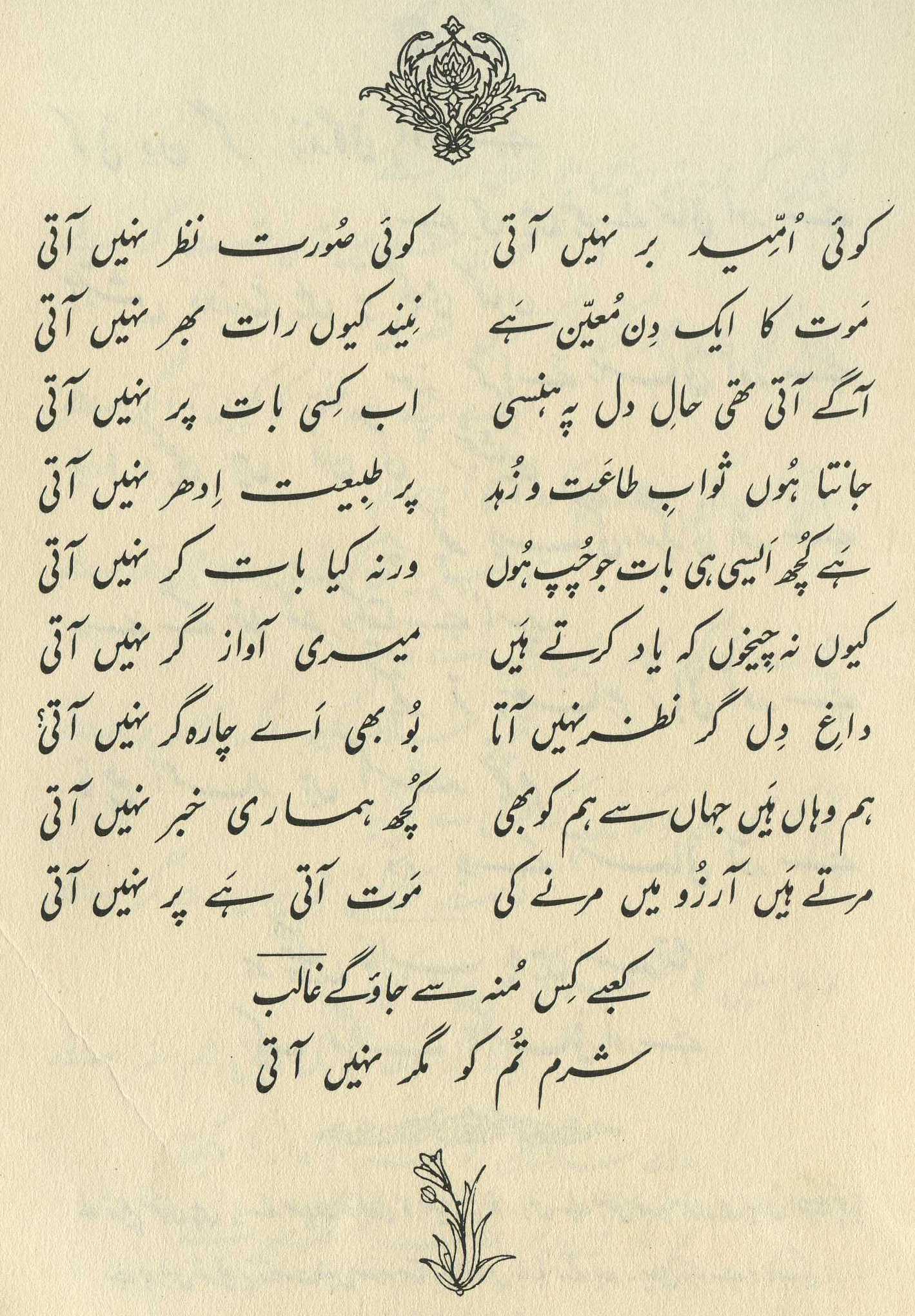
During the night of separation, if death doesn't come then it has an excuse, for it's impossible that there would be delay and postponement in the time that has already been decreed for its coming. But what happened to sleep, that it doesn't come all night, night after night? (173)
== Nazm page 173

He says, for death, one day has already been decreed. Until that day comes, how can death come? But during the night of separation, what happens to sleep? It's not that wretched death, to be bound by the fixing of some special day for its coming. Why does it (that is, sleep), not come, night after night, during the whole night of separation? (230)
Has that wretched sleep too become that wretched death?
[Or:] From fear of death, sleep has taken flight. He explains to his heart that after all, what's the benefit of this fretting? Death can't be postponed, one day is fixed for it. That is, when death can't be postponed, then to be anxious is contrary to wisdom and courage. (309)
This is one of those very simple-looking verses that can be read with various emphases, such that its meaning runs through a gamut of possibilities as we shift the stress:
=ONE single day of death is decreed, so why is there no sleep all night, night after night?
=one DAY of death is decreed, so why worry at night?
=one day of DEATH is decreed, so if the speaker will get that, why can't he get its cousin, sleep?
=one day of death is DECREED, so why bother losing sleep over it?
Could there possibly be a better example of creating maximal effects from minimal means?
graphics/sleeplessness.jpg