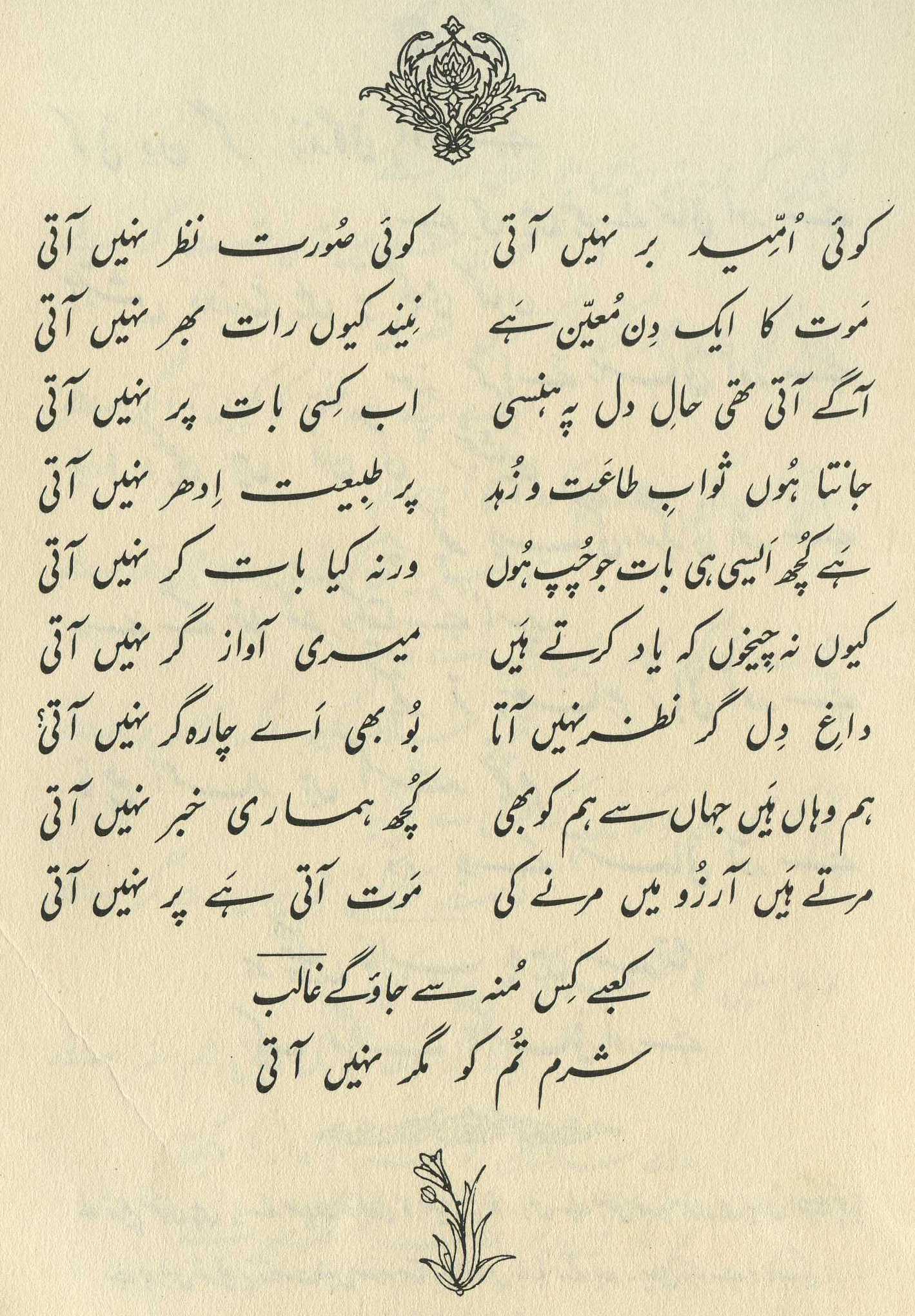
Verse 10after 1847arnahii;N aatii
G8
In this meter the first long syllable may be replaced by a short; and the next-to-last long syllable may be replaced by two shorts.
1
{how will you have the nerve to / 'with what face will you'} go to the Ka'bah , Ghalib?
2
but/perhaps shame does not come to you!
| References | |
|---|---|
| Arshi, Imtiyaz Ali | Ghazal# 214 |
| Raza, Kalidas Gupta | 400-01 |
| Hamid Ali Khan | Open Image |
Your whole lifetime passed in idol-houses and churches-- now, if you go to the Ka'bah, how will you show your face to the Lord []? (174)
== Nazm page 174

He says, oh Ghalib, your whole life long you kept worshipping beautiful ones and drinking wine. Now, how do you have the 'face' [] to decide to go to the house of the Ka'bah? Do you have no sense of shame?! []. (232)
He intends to go to the Ka'bah, but his heart reproaches him: 'You are completely shameless, your whole life was spent in idol-temples, how will you have the 'face' [] to go before the Lord?' (311)
There's a line of scolding or reproach in English that consists of phrases like, 'You have a lot of nerve to... !', or 'Do you have the gall to...?', or 'And then you have the face to... !'. Of all these similar idioms, 'to have the face to'-- meaning, 'to be sufficiently brazen or impudent or shameless as to'-- seems nowadays, alas, to be archaic. If it could have been kept on life support long enough, it would have provided the best translation for the first line. A delightfully lively and colloquially energetic scolding, administered of course either by oneself or by some companion. Nazm illustrates it well, in his commentary on 189,9 . (Compare the very different use of the expression in 91,2 .)
And then the second line is a magnificent, classic case of the uses of . If we take it as meaning 'perhaps', then we have the wonderfully withering effect of 'Perhaps you have no sense of shame?' And if we take it as meaning 'but', then we have the equally scathing 'But then, you never did have any sense of shame!'. The result is an irresistibly witty (and complex) note on which to end the ghazal.
graphics/kaaba.jpg