Verse 8after 1847aarhotaa
G6
1
to whom might/would I say what/how it is-- the night of grief is a bad disaster!
2
what harm/'bad' to me was dying, if it had taken place one time?
'Trial, affliction, misfortune, calamity, evil, ill; a person or thing accounted a trial, affliction, &c.'.
| References | |
|---|---|
| Arshi, Imtiyaz Ali | Ghazal# 43 |
| Raza, Kalidas Gupta | 397-398 |
| Hamid Ali Khan | Open Image |
One time when the month of Ramzan had just passed, he went to the Fort. The King asked, 'Mirza, how many days of fasting did you keep?' He petitioned, 'My Lord and Guide, I did not keep one'.
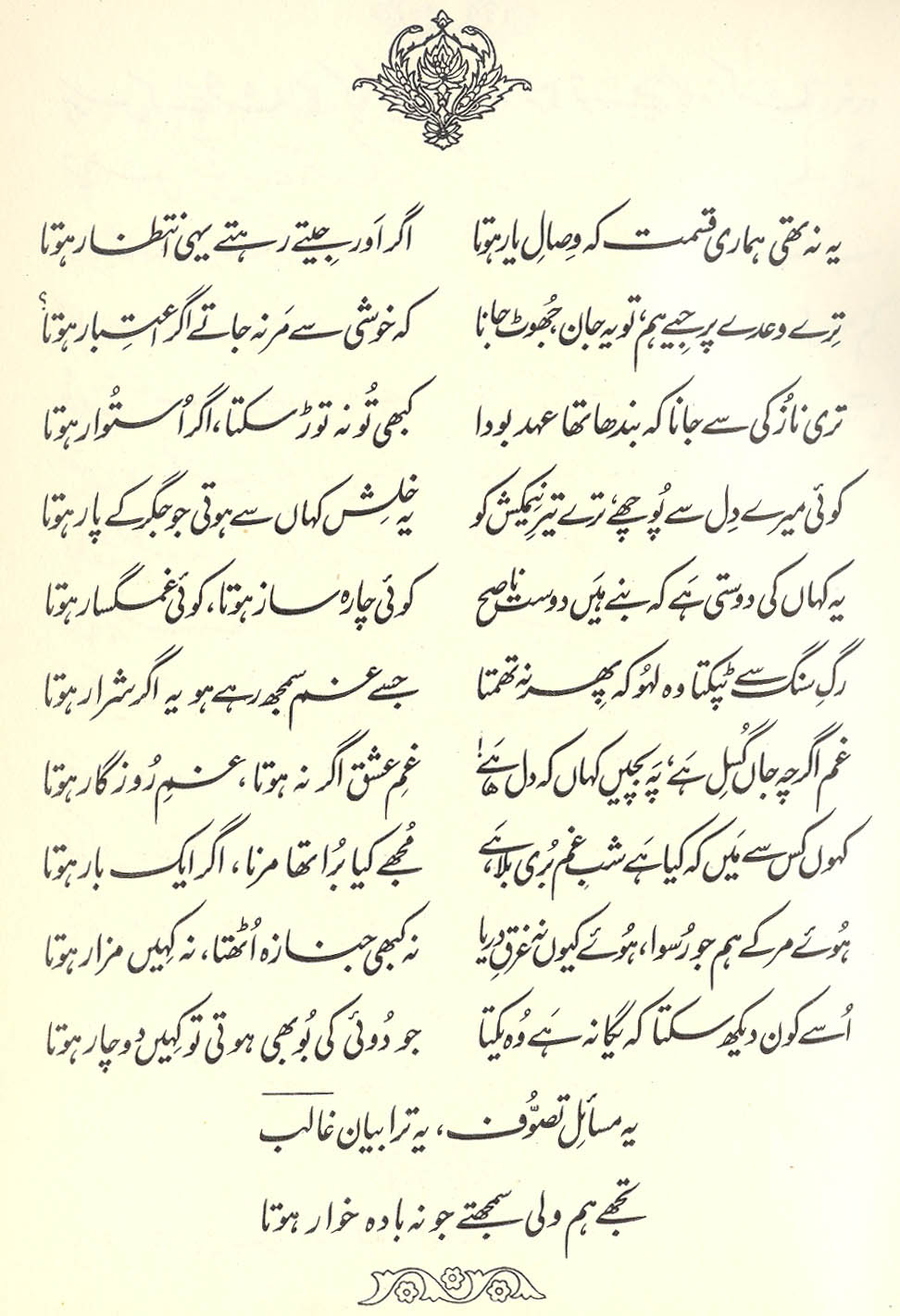
==Urdu text: Yadgar-e Ghalib , p. 66
== Nazm page 21

During the night of grief I am compelled to die thousands of times. I endure the suffering of death, and then I don't die. How excellently he has shown that the night of grief surpasses death! (43)
In this verse the rhetorical effect [] of 'to whom can I say what it is' is enchanting.... This verse is peerless. (50-51)
In every verse of this ghazal there is purity of style, easiness, an unattainably simple style/air, and informality of language. And despite all these [colloquial] excellences, a special type of meaning-creation and inventiveness of style are things worthy of praise. (78-79)
One of the torments of the 'night of grief' is that the lover is so alone-- so there's nobody at hand whom he can tell about it. He only know that it's 'bad news'-- has that kind of colloquial energy.
The first line is particularly flowing , with its internal rhyme and long vowels, and phrases that closely match the metrical feet. And there is the wordplay of and -- the night of grief is such a 'bad' disaster that by comparison the lover would not have found dying one time 'bad' at all.
But what exactly is so bad about the night of grief? Too much death, or too little? Is death the essence of the night of grief, or is it (vainly) sought as a final refuge from it? The grammar of the second line gives us two choices about dying: literally means, 'if [it] took place one time', in the contrafactual. But does that mean that instead of taking place one time, dying took place many times, or that (despite the lover's longing for it) it never took place at all?
Both readings are equally plausible, and both yield witty and appropriate interpretations when joined to the first line. And of course, in the lived suffering of the night of grief, both effects at once are involved, even if paradoxically. When did a little paradox ever get in the way of Ghalib's spectacular effects? On the contrary-- paradox is the name of the game. For a similar but even more strikingly paradoxical invocation of the (not) coming of death, see 161,9 .
Hali's witty little anecdote (presented above) makes use of exactly the same ambiguity: what does 'I did not keep one' imply?
graphics/griefnight.jpg