Verse 3after 1847aarhotaa
G6
1
from your delicacy [I/we] knew that the vow/promise had been made/'bound' weak/loose
2
you could never have broken it, if it had been strong/firm
for a vow to be made, or literally 'bound'. (Cf. Platts p.767)
'Weak, feeble; soft, faint-hearted, low-spirited, timid; low, mean, trifling, trivial, worthless'.
'Strong, powerful; stable, firm; even, level, equal; straight'.
| References | |
|---|---|
| Arshi, Imtiyaz Ali | Ghazal# 43 |
| Raza, Kalidas Gupta | 397-398 |
| Hamid Ali Khan | Open Image |
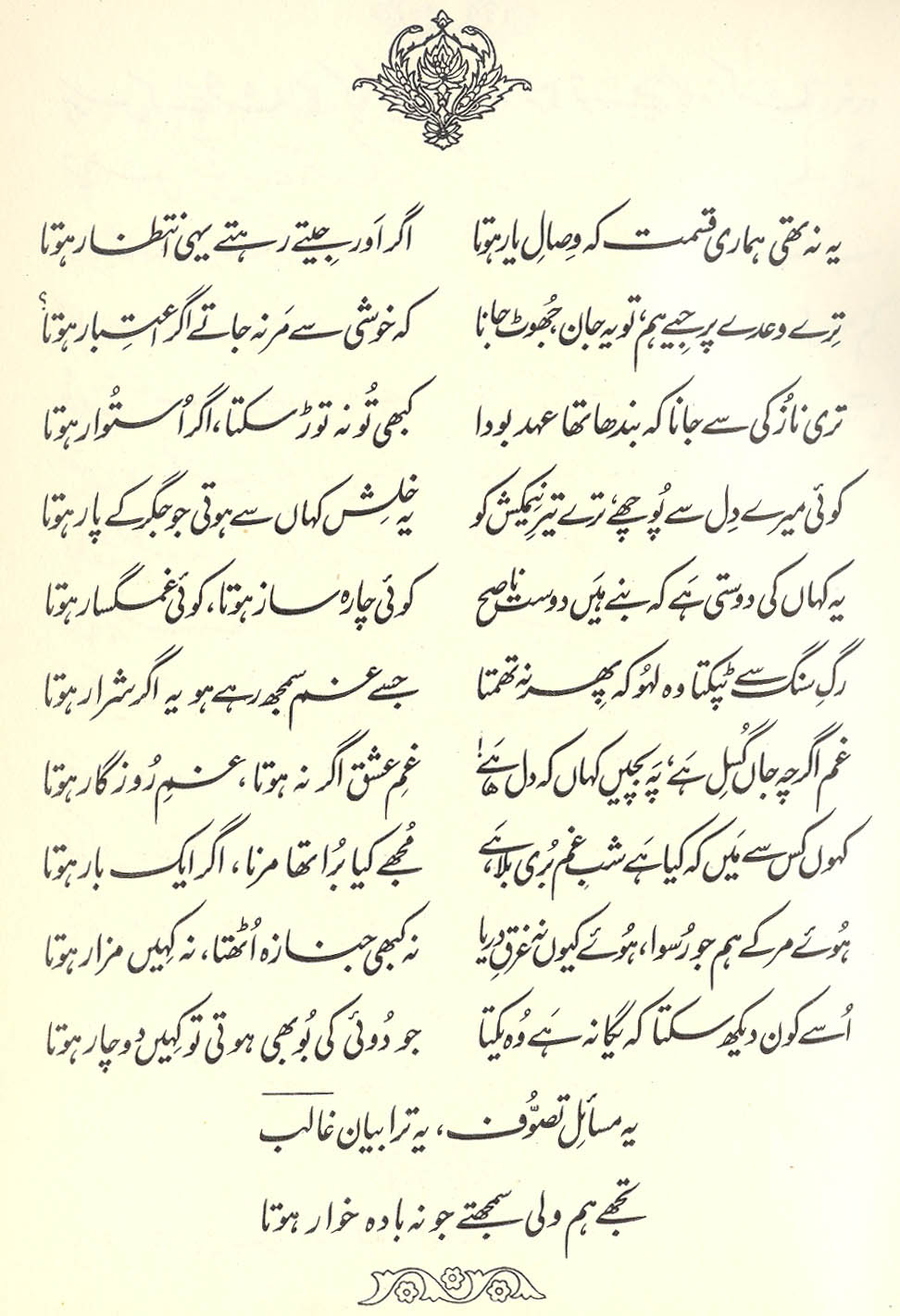
The subject of 'knew' [], , is omitted ; and means . (20)
== Nazm page 20

Your delicacy [] forbids promise-breaking. With such delicacy, when you broke the promise, then we realized that the promise had been loosely tied. If it had been strongly tied, then you couldn't have broken it. How excellently he has reproached the beloved for promise-breaking, and comforted his heart. (42)
Since you're delicate, your vow too was delicate. This fact we knew because if the vow had been strong, then you could hardly have broken it. In connection with the beloved's promise-breaking, he has shown her delicacy through a beautiful aspect. (49)
THE BELOVED SEEMS NOT TO BE GOD: This verse has, to my mind, a particular claim to fame. It provides a refutation to critics who allege that, in principle, any verse of classical ghazal can be addressed just as well to a Divine beloved as to a human one, and can or even should be so interpreted. This verse would be extremely hard to read as addressed to God. God might be as cruel, fickle, capricious, disdainful, etc. as any human beloved; we might even consider God just as likely to be a promise-breaker. (Faruqi and I used to argue about this.) But can we really tease God for being so 'delicate' and weak that He could only break a promise that had not been firmly 'tied' in the first place? It does seem quite devoid of theological tact. Some other examples of verses that it's hard to imagine as addressed to or evoking a divine beloved: 24,10x *; 25,8 ; 31,3 ; 32,1 ; 34,8 ; 36,6 ; 65,1 ; 83,2 ; 97,7 ; 100,6 ; 111,7 ; 115,8 ; 116,1 ; 116,3 ; 124,6 ; 173,7 ; 196,7 ; 205,8 ; 231,8 // 413x,3 **, idol instead
In the same group should also be included the verses in which the beloved is imagined as falling in love (for examples, see 13,2 ); and perhaps those in which she is teasingly said to have 'no mouth' ( 91,4 ) or 'no waist' ( 99,4 ). Conversely, there are also verses that apparently can only be addressed to God, not to a human beloved: see 20,10 for examples.
This verse continues to tease the beloved as a notorious promise-breaker, a theme carried over from 20,2 . Its wittiness is based on the sudden physical activation of , 'to make-- literally, to bind, to tie-- an oath'. Thus to 'break'-- -- the oath is imagined as a physical act, like ripping open a knotted cord. This the beloved is too , too delicate or frail, to accomplish, so she must have 'bound' the oath loosely in the first place. We have enough comparable English idioms-- we are 'bound' by oaths (especially by 'binding' ones), and we too 'break' vows-- so that the wordplay is not at all remote.
This verse plays with 'doubly activating' both the literal and the metaphorical possibilities of -- for a similar trick with , see 19,7 and 89,3 .
Compare Mir 's way of teasing the beloved for her delicacy: M 1548,8 .
graphics/knot.jpg