Verse 81821aa;Nsamjhaa
G5
In this meter the first long syllable may be replaced by a short; and the next-to-last long syllable may be replaced by two shorts.
1
why did you give your heart, considering her faithful, Asad ?
2
you made an error, in that you considered an infidel [to be] a Muslim
'Infidel, impious; ungrateful; — one denying God, an infidel, an impious wretch; — a Caffre; (met.) a mistress, sweetheart'.
| References | |
|---|---|
| Arshi, Imtiyaz Ali | Ghazal# 13 |
| Raza, Kalidas Gupta | 325 |
| Nuskhah-e-Hamidiyah | 56-57 |
| Gyan Chand | 91 |
| Hamid Ali Khan | Open Image |
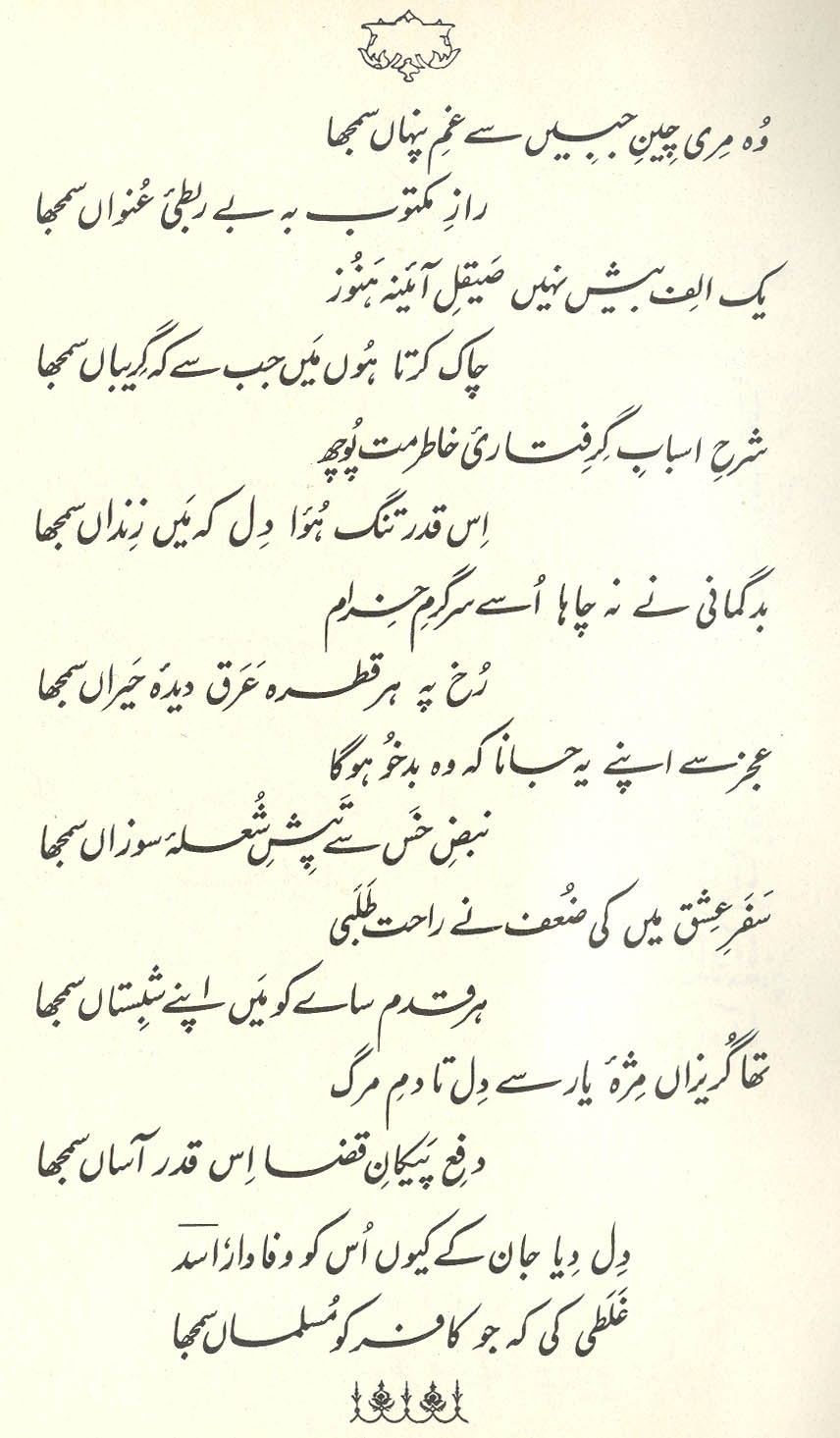
Believing a faithless one to be faithful, you gave your heart; that is, you made an error: you considered an infidel a Muslim. The allusive of has also been articulated in this. (34)
== Nazm page 34

Urdu text: Vajid 1902 {34}
One point in this is that one who has no faith is not a Muslim. (82)
In there is an . He says, Oh Asad, why did you consider that faithless one to be faithful, and give your heart?.... To consider her faithful is just the same kind of error as to consider an infidel to be a Muslim. (113)
Nazm points out the subliminal evocation of the phrase, , 'heart and life' (a petrified phrase like 'heart and soul' in English), at the beginning of the first line. The audience might well expect a parallel construction: , or the like. Only in retrospect is it possible to pick up the correct sense of .
The verb , although it's usually translated 'to know', can also be used for erroneous beliefs; on this see 16,5 . Similarly, the verb can mean not only 'to understand' (accurately), but also 'to consider' (subjectively, perhaps inaccurately); on this see 90,3 .
And Baqir explains the 'misdirection' involved in . We expect that it will be an affectionate, teasing epithet for the beloved. Only at the end of the line, when we see it contrasted with , do we realize it's meant literally.
Except, of course, that it still is an epithet for the beloved, both metaphorically and really; since in this verse the distinguishing mark of a is the faithfulness that she so clearly doesn't show, the two meanings can't entirely be disentangled.
This is another verse that would be hard to interpret as applying to a divine beloved; for more examples see 20,3 .
graphics/betrayal.jpg