Verse 71821aa;Nsamjhaa
G5
In this meter the first long syllable may be replaced by a short; and the next-to-last long syllable may be replaced by two shorts.
1
the heart was in flight from the beloved's eyelashes until the moment of death
2
the averting of the arrowhead of fate/death, it considered easy to that/this extent
'Taking flight, fleeing, fugitive'.
'Pushing, thrusting, beating off; preventing, averting, repelling; warding off'.
'Divine decree, predestination; fate, destiny; fatality; death'.
| References | |
|---|---|
| Arshi, Imtiyaz Ali | Ghazal# 13 |
| Raza, Kalidas Gupta | 325 |
| Nuskhah-e-Hamidiyah | 56-57 |
| Gyan Chand | 91 |
| Hamid Ali Khan | Open Image |
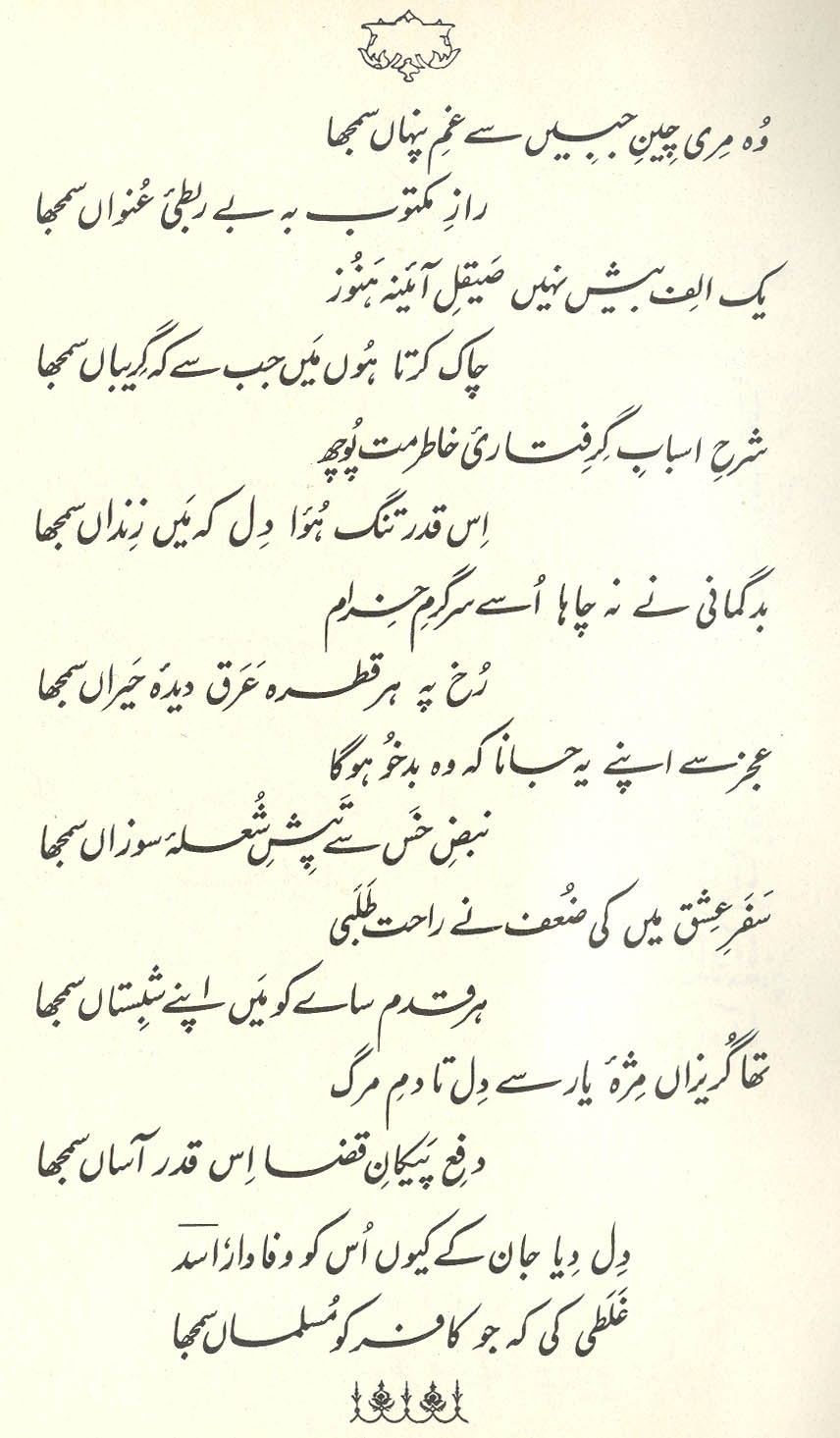
The phrase 'until the moment of death' is meant to make it clear that in the end he couldn't escape. And the arrowhead for fate is a witty metaphor . (34)
== Nazm page 34

Urdu text: Vajid 1902 {34}
He says, until the time of death my heart fled from the beloved's eyelashes, and always feared them. And foolishly I considered running to be warding off fate. It's surprising that I had considered the warding off of the arrowhead of fate to be so easy. (66)
He has called the beloved's eyelashes the arrow of fate, which never misses. Up to the moment of death my heart kept fleeing from the beloved's eyelashes. Look at its simplicity, that it considered escaping the arrow of fate to be so easy! That is, it was the heart's ignorance, that it didn't want to be prey to the beloved's eyelashes. Finally, it was killed. (81-82)
He has called the eyelashes arrows of fate, and this simile is well-established. Zauq has called them the feathers of the arrow of fate:
[what glance! and what eyelashes! we considered them both disasters
this, we considered the arrow of fate; that, the feather of the arrow of fate]. (100)
Between 'the arrowhead of fate' and 'the eyelashes of the beloved' there is a subtle affinity of meaning. Perhaps no one has pointed out the mischievousness and innate wit in this verse. The point is that up to the moment of death, the heart keeps fleeing from death. This is as if someone would be given the blessing, 'Live your lifespan!' It's clear that when the moment of death came, then fate came. Before death, then of course death wasn't to come. At the moment of confronting the beloved's eyelashes, death came. Or, at the time when death was to come, then the beloved's eyelashes were confronted. The confrontation was to come when death was to come. Thus to keep fleeing, or not to flee, was the same thing.
== (1989: 52) 2006: 69
Surely -- which can also be read , though without much change in meaning as far as I can see-- is the key to the complexity of the verse. To consider something easy 'to that/this extent'-- what does that mean? How are we to gauge the 'extent'? Does the lover, like someone trying to elude an ordinary pursuer, naively think that fleeing from the eyelash-arrows will be a simple task that, if carried out successfully, will prolong his life? Or does the lover know the real truth: that the pursuit is coterminous with his life, and that he is doomed to a lifelong and ultimately vain flight that will end only with his death? The verse doesn't enable us to decide.
And we can't forget that it's technically the lover's 'heart' that thinks and considers all this. The lover himself seems to comment ruefully and retrospectively on the 'extent' of his heart's belief. But is he rueful because the foolish heart thought the task would be easy or at least possible (a mere matter of keeping one step ahead)? Or is he rueful because the heart knew all along that despite its efforts, the task would be impossible and its doom would be certain?
Or alternatively, is the lover rueful because in fact the task of escape would be far harder than one could possibly even imagine, and to think to measure it by something as small as a mere lifetime's flight is a sign of the heart's hopeless naivete? The phrase 'to that/this extent' can accommodate all these possibilities, of course, as well as leaving room for ambivalence and various kinds of mystical reflection.
On as 'to consider', see 90,3 .
graphics/arrow.jpg